
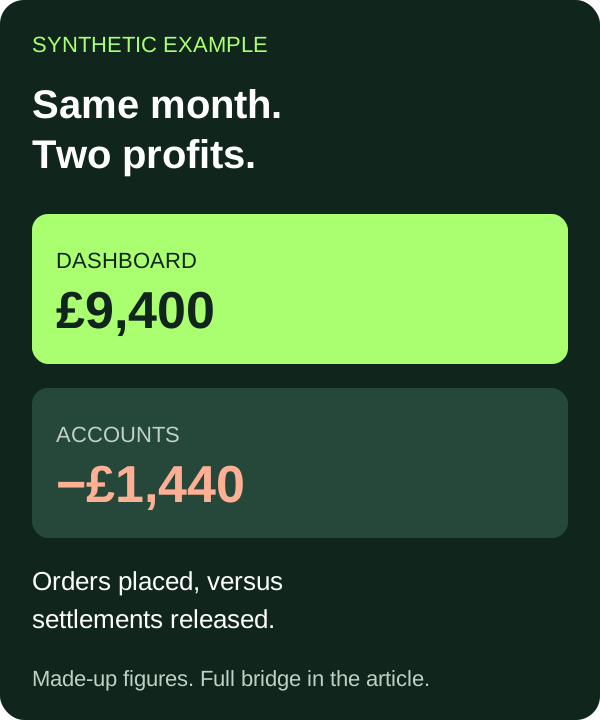
In this synthetic month, a profit dashboard shows £9,400 and the accounts show a £1,440 loss. The sales are still there. The dashboard counts orders placed in the month. The accounts count settlements Amazon has scheduled for payout, using release date as the default posting date, then apply the splits a settlement posting makes for tax, fees, refunds and reimbursements, stock cost, and advertising charged to a card.
The worked example is for a founder-led UK brand selling on Amazon, including brands that also sell on Shopify or TikTok Shop. Keep this bridge on the Amazon account. The other channels need their own payout tie-out. The bank deposit is a third total: Amazon builds a disbursement from the beginning balance, sales, expenses, refunds and a withheld reserve, and the cash can take up to five business days to appear after Amazon initiates the payment.
What is each profit figure counting?
Seller Central’s Payments dashboard is where Amazon says you can review balances, recent payouts and the next disbursement. This article’s dashboard is a separate, order-date profit view. The accounts column is the profit and loss after the settlement lines have been posted.
Link My Books posts from Amazon’s Settlement V2 report, the report it says Amazon uses to calculate payouts, and by default it uses the settlement release date. Orders Amazon has deferred therefore land in the later month. Link My Books also says an add-on can recognise those orders in the month they were placed. This example uses the default, so the two columns are allowed to disagree on date.
| Question | Dashboard | Accounts |
|---|---|---|
| Which date? | Orders placed in the month | Settlements released in the month |
| Which sales? | Product charges on those orders | Released product sales, after tax lines |
| Which stock cost? | Units ordered, times £15 | Units in the released settlements, times £15 |
| Which advertising? | The card charge | The same card charge, posted on its own |
What does one synthetic month add up to?
Synthetic example, labelled as such. One Amazon.co.uk account, one currency, a flat unit cost of £15. Storage fees, the selling-plan subscription, shipping credits, promotions and reserve movements are left out so the bridge stays readable. Add them back from the settlement when you do this on a live month. The fee amounts are made up. On a live month, use the fees on that settlement.
Dashboard stock cost is 4,000 units × £15 = £60,000. Accounts stock cost is the 3,500 units inside the released settlements × £15 = £52,500. Sales in the accounts are the £104,000 of released product charges minus a made-up tax split of £7,640, which is £96,360. That £7,640 is a placeholder amount. Copying it onto a VAT return would be a mistake.
| Line | Dashboard | Accounts |
|---|---|---|
| Product charges | £120,000 | £104,000 |
| Tax taken out of sales | £0 | £7,640 |
| Sales in the profit figure | £120,000 | £96,360 |
| Fees | £36,000 | £31,200 |
| Refunds | £8,000 | £6,200 |
| Card advertising | £9,000 | £9,000 |
| Stock cost | £60,000 | £52,500 |
| Reimbursements | £2,400 | £1,100 |
| Profit | £9,400 | −£1,440 |
Dashboard arithmetic: £120,000 − £36,000 − £8,000 − £9,000 − £60,000 + £2,400 = £9,400. Accounts arithmetic: £96,360 − £31,200 − £6,200 − £9,000 − £52,500 + £1,100 = −£1,440.
| Step | Change | Profit after |
|---|---|---|
| Dashboard profit | — | £9,400 |
| Deferred product charges removed | −£16,000 | −£6,600 |
| Fees on those deferred orders removed | +£4,800 | −£1,800 |
| Cost of those 500 units removed | +£7,500 | £5,700 |
| This month’s refunds still unreleased | +£4,000 | £9,700 |
| Earlier refunds released this month | −£2,200 | £7,500 |
| Tax taken out of sales | −£7,640 | −£140 |
| Reimbursement still unreleased | −£1,300 | −£1,440 |
| Card advertising, already in both | £0 | −£1,440 |
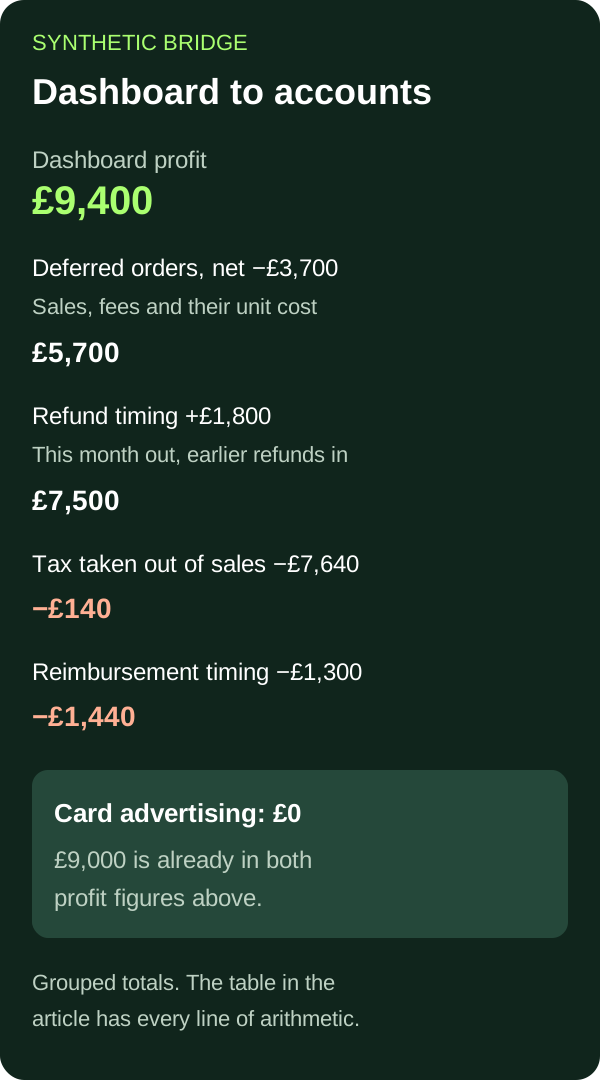
The accounts column follows three product choices, stated so you can see them: Link My Books’ default release-date posting, A2X’s default mapping of settlement categories, and A2X’s cost-of-goods entry. A setup that posts on the order date will sit closer to the dashboard. This page shows one stack on made-up numbers. Use the shape of the bridge on your own reports. Leave these figures out of any journal.
Which orders has Amazon held back?
Amazon describes a deferred transaction as one it will pay at a future date. It says most transactions are deferred for some period, that payment can be pending for invoiced orders or for delivery reasons, and that on deliveries it typically reserves funds for seven days so the customer can inspect the order and request a refund if they need to. In general it settles accounts every two weeks.
Link My Books names three reasons a calendar month and a settlement month diverge: a delivery-date hold until seven days after delivery, B2B orders held for up to 30 days, and a settlement that includes orders placed in one month and released in the next. It also says orders, date-range transaction, business and inventory reports will not reconcile to the Settlement V2 file. Download that CSV from Seller Central, then Payments, then Payments, then All Statements, for the payout you are tying.
In the illustration, £16,000 of product charges, £4,800 of fees and 500 units were placed in the month and are absent from the settlements released in the month. Those three amounts are a chosen subset, stated as a group. Removing them moves profit by −£16,000 + £4,800 + £7,500 = −£3,700. Amazon still pays that group later. The order record remains.
How a cash book and an accruals book score that delay is a separate question, covered in cash versus accrual for Amazon sellers. The practical tie-out of each payout is in how to track Amazon FBA settlements.
Where do fees and refunds land?
On the orders that have been released, this example uses the same fee on both sides: £36,000 − £4,800 = £31,200. The fee gap is the deferred orders.
A2X groups settlement lines into their own categories, including commissions and selling fees, fulfilment and warehousing, product refunds, and a separate category for refund and return fees. Its default mapping creates an income account called Amazon Refunds for the product-refund lines. The category tells you where to look for them.
The dashboard refunds are £8,000, all tied to orders placed in the month. The released settlements contain £6,200: £4,000 of those same refunds, plus £2,200 of refunds on earlier orders. The other £4,000 of this month’s refunds are still unreleased. The £4,000 refunds and the £16,000 of deferred product charges are separate populations, so the bridge removes each once. Fee types you will meet on a real settlement, including referral and fulfilment fees, are set out in the UK FBA fee guide.
Why is the advertising outside the settlement?
Amazon Ads lists two ways to pay for advertising spend: deduct it from the seller or vendor account balance, or charge it to a credit card. Invoicing is also available for vendors on an invite-only basis. When advertising cost is inside the settlement, A2X maps it as its own category, covering ad spend, lightning-deal fees and other advertising costs, and the default mapping creates an advertising expense account.
This illustration charges £9,000 of Sponsored Products to the company card. Both profit figures already include that £9,000, which is why the bridge line is £0. Drop the card charge from the accounts only, and that profit becomes −£1,440 + £9,000 = £7,560. The dashboard has deducted the ads. The accounts, in that version, still have the charge on the card statement. Advertising that does come through the settlement sits in the advertising category A2X maps, which is a different document from the card.
Why does the sales account show £96,360?
The released product charges are £104,000. A2X’s tax category holds tax amounts Amazon has calculated and separated. Depending on the seller’s Amazon setup, A2X says you may find principal, gift-wrap and shipping tax, refund tax, and marketplace-facilitator tax in that category. With A2X’s default mapping, those lines go to a current liability account called Amazon Sales Tax Collected, so they stay out of the sales account.
Link My Books takes sales and fee amounts from the settlement, and VAT figures from Amazon’s VAT reports (the VAT Transactions Report, plus the VAT Calculation Service report when the seller is enrolled). It waits for the VAT data for every month the settlement covers, which it says normally arrives in the first days of the following month.
£104,000 − £7,640 = £96,360. The £7,640 is the placeholder from the table, made up for the illustration. A live month uses the tax lines on the settlement and the VAT report.
Why does the stock you bought leave both profits alone?
A2X’s cost-of-goods entry is a non-cash posting. It reads the SKUs and quantities in the settlement, multiplies them by cost prices you supply, credits the inventory asset and debits the cost-of-goods expense. In Xero it arrives as a draft bill whose total is zero, because the two sides match, and you approve the bill to commit it. A2X can post that entry on its own, separately from the settlement invoice. When a settlement crosses two months, A2X says it splits the cost invoices by month.
Here, 4,000 units were ordered and 500 of them are in the deferred group, so 3,500 units are in the released settlements. 3,500 × £15 = £52,500, which is £7,500 below the dashboard’s £60,000. A £40,000 stock purchase in the same month is in neither profit figure. Put that £40,000 through the profit and loss as well and the accounts move by £40,000 while the dashboard stays at £9,400. The purchase is a stock movement. The cost-of-goods entry is the part of that stock that the settlement says was sold.
Reimbursements are their own lines. A2X’s reimbursements category can include items related to inventory reimbursements, often for lost or damaged stock. You may see items such as Reimbursement Customer Return, FBA Inventory Adjustment Customer Return, Warehouse Damaged and Warehouse Lost. The default mapping creates an income account called Amazon Reimbursements for them. The dashboard added £2,400. The released settlements contain £1,100. The £1,300 difference is still outside those settlements in this illustration. How to read a reimbursement against stock is covered in accounting for FBA reimbursements.
What should you tick off before you call the gap an error?
- Download the Settlement V2 CSV for the payout from Seller Central, then Payments, then Payments, then All Statements. Orders, date-range, business and inventory reports are the wrong files for that tie-out.
- Write down the date basis in the column heading: orders placed, or settlements released. Link My Books’ default is the release date, and its deferred-transactions add-on uses the order month.
- List the deferred balance on its own. Amazon will pay a deferred transaction at a future date, and the Payments dashboard is where you see balances and the next disbursement.
- Take tax lines out of product sales before you compare them with the sales account. A2X’s default mapping creates a current liability account called Amazon Sales Tax Collected. Which tax types appear depends on the Amazon setup.
- See whether advertising was deducted from the seller balance or charged to a card. Amazon Ads lists both methods. When the cost is in the settlement, A2X maps an advertising category. A card charge needs the card statement.
- Match refunds to the settlement they were released in. Product refunds are their own category.
- List reimbursement lines on their own, then decide which account they were posted to. A2X’s default is an income account.
- Build stock cost from settlement quantities times your cost. That entry credits inventory and debits cost of goods. The supplier purchase stays on the balance sheet. The entry moves the cost of the units in the settlement.
- Explain the bank deposit with the beginning balance and the reserve. Amazon withholds a reserve and can take up to five business days to show the cash, and A2X’s default reserved-balance mapping is a current asset.
A month-end pack that holds this bridge is a different document from the year-end accounts. That case is made in why Amazon sellers need a monthly management report.
Frequently asked questions
Which Amazon report should agree to the payout?
The Settlement V2 CSV for that payout. Link My Books says Amazon uses that report to calculate payouts, and that orders, date-range transaction, business and inventory reports will not reconcile to it. Download it from Seller Central, then Payments, then Payments, then All Statements. Amazon’s Payments dashboard is where you see the disbursement itself, including the date it will try to pay you and the estimated amount.
Does a deferred order mean the sale is missing?
Amazon says a deferred transaction is paid at a future date, and that most transactions are deferred for some period before they are paid. Link My Books’ default posting uses the settlement release date, so the order shows up in the month Amazon releases it. The sale sits in a later column of the bridge.
Where does card-billed advertising get posted?
Amazon Ads says you can deduct advertising from the seller or vendor account balance, or charge it to a credit card. A2X maps an advertising category when that cost is in the settlement data. A charge on the company card still needs posting from the card statement. In the synthetic month, leaving out the £9,000 card charge moves the accounts profit from −£1,440 to £7,560.
Should the stock purchase be expensed to force the two profits together?
A2X’s cost-of-goods entry moves the cost of the units in the settlement from inventory to cost of goods, and it is non-cash. In the example the £40,000 purchase is in neither profit figure. Putting it through the profit and loss moves the accounts by £40,000 and leaves the dashboard at £9,400.
Where does your own month go next?
We have published a short case study of a seller whose dashboard and accounts disagreed: why an Amazon seller’s dashboard did not agree with the accounts. If the bridge on your own month will not tie, Unfck Your Books is the clean-up, and Amazon accounting is the ongoing work. Once the month is trustworthy, fractional CFO support is where those numbers turn into stock and cash decisions.
Prepared by Social Commerce Accountants editorial with AI assistance. The example is synthetic and independently checked. This is not a claim of human professional review or personalised tax advice.