

If you’re running an Amazon FBA business, you’ve probably had that moment. You check your bank balance, and it looks healthy. You think you’ve had a killer month. Then, you look at your P&L (or worse, your tax bill), and the numbers tell a completely different story.
This disconnect usually comes down to one fundamental decision: Amazon seller accounting methods. Specifically, the choice between Cash and Accrual accounting.
Most sellers start with a Cash basis because it’s simple. But as you scale, Cash basis stops being a tool and starts becoming a trap.
Here is the no-nonsense guide to understanding the difference, why it matters for your Amazon FBA bookkeeping, and when you need to make the switch.
The Core Difference: Cash vs Accrual
Let’s strip away the jargon. The difference between these two methods is purely about timing—specifically, when you record money moving in and out of your business.
Cash Basis Accounting
This is likely what you use for your personal life.
- Income is recorded when the cash hits your bank account.
- Expenses are recorded when the cash leaves your bank account.
Cash basis accounting records transactions only when money changes hands. It provides a clear view of cash flow but often distorts profitability for inventory-based businesses like Amazon FBA.
Accrual Basis Accounting
This is the standard for professional ecommerce accounting methods.
- Income is recorded when the sale is made (even if Amazon holds the cash for 14 days).
- Expenses are recorded when the bill is received or the liability occurs.
Accrual basis accounting records revenue when it is earned and expenses when they are incurred. This method matches income to the specific costs required to generate it, offering a true picture of business performance.
Why Cash Basis Lies to Amazon Sellers
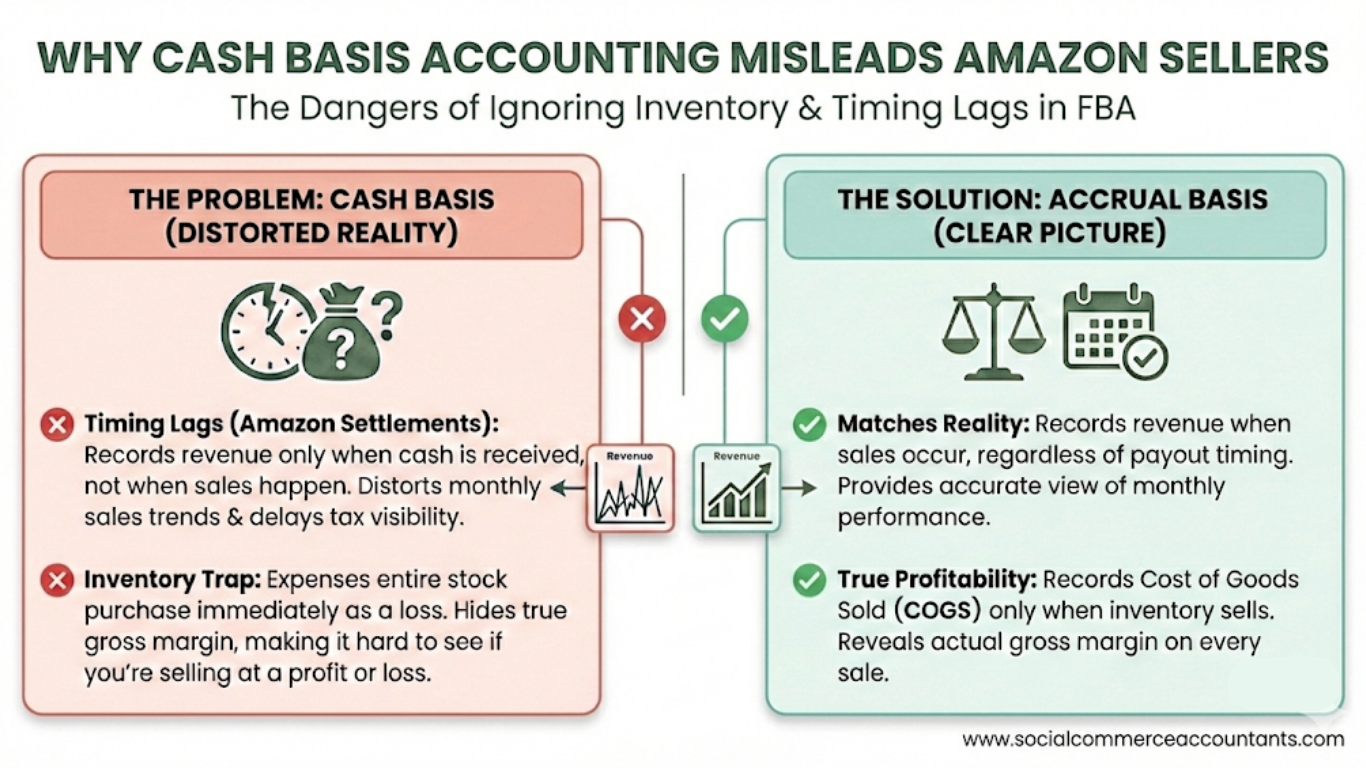
If you are a service business—say, a graphic designer—cash basis is fine. You do the work, you get paid, end of story.
But accounting for Amazon FBA, cash basis can be dangerous. Why? Because of inventory and timing lags.
The "Amazon Settlement" Lag
Amazon typically pays sellers every 14 days. If you sell £10,000 worth of stock on December 28th, but Amazon doesn't deposit that cash until January 4th:
- Cash Basis: You made £0 in December and £10,000 in January.
- Accrual Basis: You made £10,000 in December (when the sales actually happened).
If your financial year ends in December, Cash basis just pushed that revenue into the next tax year. While that sounds nice for delaying tax, it makes your December look like a failure and your January look like a miracle, making it impossible to analyse your actual sales trends.
The Inventory Trap
This is the big one. Imagine you buy £20,000 of stock in November to prepare for Q4.
- Cash Basis: Your books show a £20,000 loss in November because the cash left the bank.
- Accrual Basis: Your books show an exchange of assets (Cash for Stock). You only record the expense (Cost of Goods Sold) when you actually sell the units in December.
What this means for you: On a Cash basis, you can't see your gross margin. You might be selling products at a loss, but because you bought the inventory months ago, you don't feel the pain until you run out of cash to restock.
The "Matching Principle": How to See True Profit
As an ecommerce accountant in the UK, I always push growing brands toward accrual accounting because of the "Matching Principle."
You want to match the revenue from a sale with the expense of that specific item in the same month.
Example:
- You buy a unit for £5 in January.
- You sell the unit for £15 in March.
Cash Basis View:
- January: -£5 (Loss)
- February: £0
- March: +£15 (Profit)
- Verdict: Confusing monthly data.
Accrual Basis View:
- January: £0 (Inventory sits on balance sheet)
- February: £0
- March: £15 Revenue - £5 COGS = £10 Gross Profit.
- Verdict: Accurate profitability.
When Should You Switch?
You don't need to overcomplicate things on Day 1. If you are just starting out, keep it simple. However, there are triggers where staying on cash basis becomes negligent.
- Turnover over £85k (VAT Threshold): Once you are VAT registered, accrual accounting makes VAT returns significantly more accurate and compliant with HMRC’s expectations for businesses of this size.
- Holding Significant Stock: If you are carrying thousands of pounds in inventory across month-ends, you need accrual to track COGS accurately.
- Seeking Investment or Loans: No bank or investor will take cash-basis accounts seriously. They want to see a proper Balance Sheet and P&L prepared on an accrual basis.
Handling the Complexity
Moving to accrual does require more work. You can't just rely on your bank feed anymore.
You need a process that reconciles your Amazon settlement reports line-by-line. This means breaking down every payout into:
- Sales Principal
- FBA Fees
- Shipping
- Advertising
- Refunds
Instead of just recording the "net" amount that hits your bank, you must record the "gross" sales and the associated fees separately. This is the only way to know if your advertising spend is eating your margins, or if your refund rate is spiking out of control.
A Note for Online sellers & Sellers: If you are running a hybrid model—selling on Amazon FBA and acting as an online seller/channel on TikTok Shop—it gets even trickier. You likely have income streams arriving at different times with different payment terms. An Amazon accountant in London (or remotely, like us) helps ensure every penny is allocated to the right month, so you don't get a nasty surprise at tax time.
The Bottom Line
Cash basis tells you how much money you have right now. Accrual basis tells you if your business is actually working.
You can run an Amazon business on a cash basis, but you can only grow one on accrual.
If you’re tired of guessing your margins or fearing your tax bill, it’s time to professionalise your numbers.
Need help sorting your books? At Social Commerce Accountants, we help sellers move from chaos to clarity. Let’s get your Profit & Loss telling the truth.