
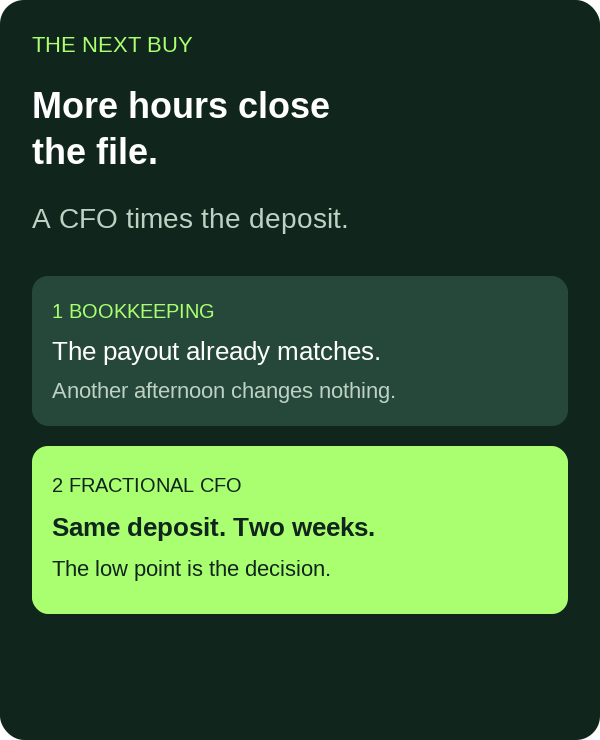
More bookkeeping hours finish the record of money that has already moved. A fractional CFO is the next buy when that record is already good enough to hand to someone else, and the open question is a decision the record cannot make: whether a stock deposit, a hire, or the next channel order breaks cash in a week that has not happened yet. The page is written for a founder doing roughly £1–5m. The trigger is the decision, at whatever point inside that range it shows up.
This is for a founder-led UK brand on Shopify, Amazon and TikTok Shop. What a reliable month end must prove is the pack of files. Contribution margin across the three channels is how you rank a unit after fees. The 13-week cash forecast is how you lay the weeks out. The finance systems between £1m and £5m are the machinery under that pack. Controller versus accountant is who keeps the pack true. A supplement brand’s first CFO and a sports brand’s first CFO are those sectors’ versions of the hire. This page is the buy in front of those pages: another block of bookkeeping hours, or a fractional CFO.
What does another block of bookkeeping hours finish?
It finishes a file about a period that has closed, or a payout the platform has already described. That file is the input. The supplier date is a different job.
| File the hours can finish | What the product says that file is | The question it leaves open |
|---|---|---|
| Shopify Payments activity report | Shopify says to use it for month-end reconciliation, PDF record keeping and an accountant handoff. It reflects Shopify Payments balance activity. Shopify says it is not a statement of revenue, and that revenue in the Finance reports is based on orders and sales activity, which might use different timing or totals than this report. The Finance reports display sales and payment activity based on orders and captured payments, and might display different totals or timing than the activity report. Payout timing can make a date range disagree with the bank deposits for the same dates. The report has a 3-day data delay. | Can we send the deposit next week? |
| One Shopify payout | The payout date is the date Shopify sends the payout. Deposited means the payout was sent. It does not mean the funds are in the bank. The bank may still need 1 to 3 business days. Pending amounts and payout dates on that page are estimates, and the final amount can change before the funds are sent. | Which week is that cash actually spendable? |
| The UK Shopify Payments clock | Shopify’s UK row states a minimum settlement time of 3 business days, in GBP, and a minimum payout amount of £1. Settlement time is the gap from when the customer’s payment is captured to when those funds are available to be paid out. After the payout, the money might take another 1 to 3 days to show in the bank. Shopify says you can choose a daily, weekly or monthly schedule, and that some countries limit those options. Charges captured on Friday, Saturday and Sunday are grouped and sent as one payout. A higher-risk account can be placed on a custom schedule of 5 to 20 business days, and Shopify says support cannot shorten that settlement time on request. | Does that clock fund a supplier payment dated before the payout? |
| The next Amazon disbursement | When the balance is positive, Amazon sends one disbursement to the bank account on the seller’s payment settings. In general it settles every two weeks: beginning balance, plus sales, minus expenses, adjusted for refunds, then a reserve withheld. That reserve becomes the beginning balance of the next period. After Amazon initiates the payment, the cash can take up to five business days to appear. A deferred transaction is paid at a future date. On deliveries, Amazon typically reserves funds for seven days. The Payments dashboard shows the date Amazon will try to pay, and the estimated amount. | Is that estimated amount cash you can promise a supplier this week? |
| TikTok Shop commission on the statement | TikTok Shop UK says the commission fee is deducted from the order settlement. The line sits under Fees, named “TikTok Shop commission fee”. The same page says its screenshots are mock-ups and that the live interface and rates differ, so the amount you keep is the one on the live statement. | What cash is left on the next settlement, after an order you have not placed? |
A bookkeeper can finish every row and the forward question is still open. That is the work those hours buy. Doing the same row again, once the difference is already nil, does not move a supplier payment.
When is the fractional CFO the right buy?
These are practical tests from the decisions founders actually bring, not a published hiring standard and not a revenue rule. Three of them in the same month is the point to stop buying extra hours and brief a fractional CFO. One of them, while the month-end pack still does not exist, is still a bookkeeping job.
| What is on the desk | Why more hours miss it | What the fractional brief is for |
|---|---|---|
| A stock deposit has a date, and the payouts that would fund it do not | The activity report and the disbursement describe cash that has moved, or cash the platform has already scheduled. They do not move the supplier’s date. | Put the deposit on a week, move it, and read the low point before anyone commits. |
| The channel with the most sales is the one about to be restocked | A sales total is a finished count. Contribution after platform fees is a different ranking. Hours that tie a payout do not choose the next unit. | Decide which channel gets the units, from contribution and from the week the cash lands. |
| A hire, an extra warehouse week, or a creator push needs an answer this month | Recording last month’s payroll shows a cost that has already been paid. It does not show the week that new cost overlaps a reserve or a late disbursement. | A short case with the cost included, and a quieter sales case beside it. |
| The bookkeeper is being asked to approve the order | The file is evidence. Approval is a cash decision with someone’s name on it. | A written yes, no, or smaller order, with the weeks attached. |
A fractional CFO on top of a missing pack is bookkeeping at the wrong price. Where the activity report, the bank line and the settlement are not files you can hand over, buy the hours. The CFO conversation starts when those files exist and the order is still a guess.
Which familiar signals are still a bookkeeping job?
One myth says any finance pain is cured by more bookkeeping time. The mirror myth says any finance pain is a CFO. Both waste the month. These four stay with the record.
- The payout does not match the bank. That is a file to finish. The month-end pack is the list. Unfck Your Books is the clean-up when the list fails.
- Revenue has crossed a round number. £1m and £5m are the range this page is written for. A brand near the top of that range, with one channel and no dated stock deposit, can still be a close-and-bookkeeping job. A brand near the bottom, with a deposit dated before the next Amazon disbursement, can already be a cash decision.
- The dashboard should look cleaner. Shopify’s activity report is the period file for Shopify Payments balance activity, and Shopify says it is not the revenue statement. Another chart of that same balance is still the past.
- The accountant appears at the year end. That gap is who produces the monthly pack, which is the question in controller versus accountant for a £5m brand. It becomes a fractional CFO question once the pack is landing and the decisions in the table above are still being made without it.
What does one synthetic decision add up to?
Synthetic example, labelled as such. One GBP bank balance. Four weeks. Opening cash is £30,000. Operating cash out is £15,000 every week, a single made-up bundle for payroll, ads and the warehouse. Cash in is £12,000, £12,000, £24,000 and £12,000, placed in the week this illustration assumes the money lands. Those inflows are not a Shopify settlement, not an Amazon disbursement and not a TikTok Shop statement. The stock decision is one supplier payment of £40,000, paid in full in week 2 or in full in week 4. In this illustration the historical payouts already match the bank. Reconciling that nil difference for another afternoon leaves both columns where they are.
| Week | Cash in | Operating cash out | Close, no deposit | Close, £40,000 in week 2 | Close, £40,000 in week 4 |
|---|---|---|---|---|---|
| 1 | £12,000 | £15,000 | £27,000 | £27,000 | £27,000 |
| 2 | £12,000 | £15,000 | £24,000 | −£16,000 | £24,000 |
| 3 | £24,000 | £15,000 | £33,000 | −£7,000 | £33,000 |
| 4 | £12,000 | £15,000 | £30,000 | −£10,000 | −£10,000 |
Week 1, no deposit: £30,000 + £12,000 − £15,000 = £27,000. Week 2: £27,000 + £12,000 − £15,000 = £24,000. Week 3: £24,000 + £24,000 − £15,000 = £33,000. Week 4: £33,000 + £12,000 − £15,000 = £30,000. The four inflows are £60,000 and the four operating weeks are £60,000, so the no-deposit close returns to the £30,000 opening balance.
Pay £40,000 in week 2: £24,000 − £40,000 = −£16,000. Week 3 is −£16,000 + £24,000 − £15,000 = −£7,000. Week 4 is −£7,000 + £12,000 − £15,000 = −£10,000. Pay the same £40,000 in week 4: weeks 1 to 3 stay on the no-deposit column, and week 4 is £33,000 + £12,000 − £15,000 − £40,000 = −£10,000. Opening cash plus £60,000 in, minus £60,000 of operating cash, minus the £40,000 deposit, is −£10,000 either way.
Same deposit. Same end balance. The week-2 payment’s lowest point is −£16,000. The week-4 payment’s lowest point is −£10,000, and weeks 1 to 3 stay positive. The hours that re-check a payout which already matches do not choose between those two weeks.
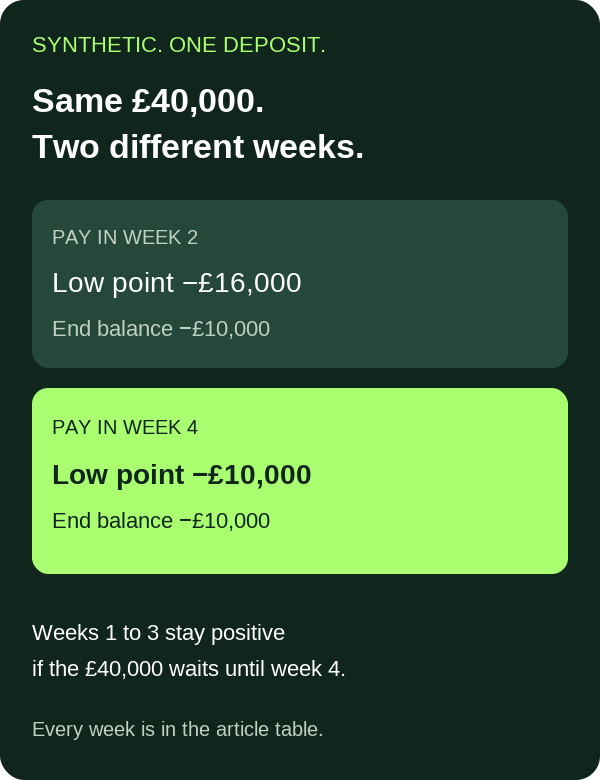
Leave £30,000, £12,000, £15,000, £24,000, £40,000, £27,000, £33,000, −£16,000, −£7,000 and −£10,000 out of any supplier email. They are not your bank and not a template. The comparison is the point: one deposit, two weeks, two low points, one end balance.
What do you tick off before you buy?
- Export the Shopify Payments activity report for the last closed month. Label it as balance activity. Shopify says it is not a statement of revenue.
- Match one payout to one bank line. Deposited means Shopify sent it, and the bank may still need 1 to 3 business days. Pending dates on that page are estimates.
- Read the UK clock before a Shopify sale is treated as this week’s cash. The UK minimum settlement time is 3 business days, the bank may take another 1 to 3 days after the payout, and a daily, weekly or monthly schedule is the choice Shopify describes, unless the account is on a longer custom schedule.
- Write down Amazon’s next disbursement date and the estimated amount from the Payments dashboard. Amazon withholds a reserve, pays a deferred transaction at a future date, and the cash can take up to five business days after it initiates the payment.
- Read the TikTok Shop commission off the live statement. It is deducted from the order settlement, and the policy page says the screenshots are mock-ups.
- Where any of those files is missing, buy the hours. The list to finish is the month-end pack. The clean-up, when the pack fails, is Unfck Your Books.
- Where the files exist and a deposit, a hire or a channel restock is the open question, brief a fractional CFO. Fractional CFO support is the forecast and the scenario on top of a pack you already trust.
- Build that forecast from your own payout dates and your own supplier date. The figures on this page stay here.
Frequently asked questions
Does £1m or £5m mean it is time for a fractional CFO?
£1m and £5m are the range this page is written for. The test inside that range is a month-end pack you can hand over, plus a cash decision that pack does not make: the deposit, the hire, or the channel restock. A round number on its own leaves the buy as bookkeeping.
Do we replace the bookkeeper with a fractional CFO?
Keep the bookkeeping. The files in the first table are that job, and a forecast built on a payout that will not tie is a story. The fractional brief sits on a pack you can hand over. Fractional CFO support is that next layer. Unfck Your Books is the layer when the pack is the problem.
Is this the 13-week cash forecast?
The cashflow guide is how to lay thirteen weeks out. This page is the buying question in front of that model: another block of hours on last month, or a brief whose output is the week the deposit lands. The four-week table is an illustration of that choice. It is not the thirteen-week build.
How is this different from the controller guide, or the supplement and sports CFO pages?
Controller versus accountant is who keeps the monthly pack true. The supplement page and the sports page are those sectors’ first-CFO questions, including stock, creators, wholesale and kit commitments. This page stays on one myth. Once those files exist, more bookkeeping hours do not answer the cash decision.
Where does the decision go?
Finish the file where the file is the gap. The month-end pack names each file, and the systems between £1m and £5m are what stops the next month arriving as a pile. Once the pack holds, the stock deposit and the channel choice are a fractional CFO conversation. Fractional CFO support turns that pack into a forecast and a scenario, so the week you pay the supplier is a week you have already looked at.
Prepared by Social Commerce Accountants editorial with AI assistance. The four-week cash is synthetic and the arithmetic is checked. This is not a claim of human professional review, a hiring standard, or personalised advice.