
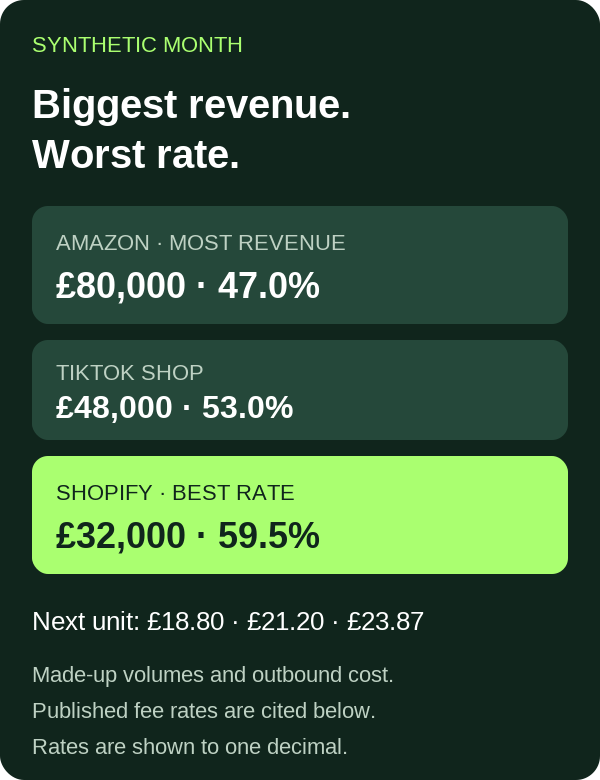
Your biggest-revenue channel is not your best contribution margin. In this synthetic month Amazon has the most revenue and the most contribution pounds, and the worst rate. The next unit leaves £23.87 on Shopify, £21.20 on TikTok Shop and £18.80 on Amazon.
This is a decision sum for a founder-led UK brand selling on all three. Contribution, on this page, is revenue minus product cost, the platform fees, the month’s plan fee and an outbound cost. Contribution margin is that contribution divided by revenue. Advertising, creator commission, storage and overhead are left out, so the difference you can see is the platform fee. The £40 price, the £12 unit cost, the volumes and the £3.20 outbound cost are made up. A percentage is used only where the linked page states it.
Four older guides answer different questions. Amazon versus DTC margin for a supplement brand is one sector’s Amazon-and-own-site comparison. Wholesale versus D2C margin for a sports brand is a trade-account comparison, not a marketplace fee stack. Net profit versus ROAS is about advertising return, and this page stops before ads. Why Amazon dashboard profit differs from the accounts is the bridge from an Amazon profit screen to the ledger. Fill this template from settlements. Do not paste it into a journal.
What goes on the channel template?
Use one month, one currency, and the same unit cost on every channel. Revenue is the item price of the orders in that month. The platform columns are filled from the payout, the settlement or the statement, not from a revenue dashboard.
| Line | Fill it from |
|---|---|
| Revenue at item price | Orders in the month |
| Product cost | Your unit cost times units sold |
| Percentage platform fee | The payout, settlement or statement |
| Fixed fee per order | The payout |
| Plan fee for the month | The subscription bill |
| Outbound or fulfilment | The carrier invoice, or the fulfilment fee for that unit |
| Refunds, and any fee kept on a refund | The settlement |
| Advertising and creator commission | The ad invoice, and the rate you agreed |
| Contribution | Revenue minus the lines above |
| Contribution margin | Contribution divided by revenue |
Which figures are published, and which are made up?
| Line in the example | What it is |
|---|---|
| Shopify 1.7% + 25p, and the £49 plan | Grow prices on Shopify’s UK pricing page, used as stated below |
| Amazon 15%, and the £25 plan | Clothing and Accessories above £20, and the Professional plan, on Amazon’s UK pricing page |
| TikTok Shop 9% | The commission rate those two TikTok Shop UK pages state, before a reduction |
| £40, £12, the order counts, and £3.20 outbound | Illustrative. Not a fee schedule |
| Refunds, storage, advertising, creator commission | Set to zero so they do not disguise the fee difference |
Do not copy £40, £12, £3.20, the order counts or the contribution pounds into a fee card or a journal. They are not a client result. Where a percentage is cited, it is the rate on that page applied to this made-up month. The live fee is the fee on the payout.
What does the Shopify column use?
Shopify’s UK pricing page lists Grow at £49 a month on yearly billing and £65 a month on monthly billing. The same table lists Grow’s online standard card rate as 1.7% + 25p, and Grow’s online international card rate as 2.7% + 25p. The Grow card on that page says card rates from 1.7% + 25p. The page also shows an introductory price. This illustration uses the £49 yearly price for one month, and the online standard rate. It does not use the introductory price, the £65 monthly price, or the international rate.
Shopify says that, aside from the card rate and the subscription, Shopify Payments has no monthly fee, no hidden fee and no setup fee. When Shopify Payments is the only payment provider, Shopify says there is no third-party transaction fee. The pricing page lists Grow’s third-party transaction fee at 1%. The same help page says that if Shopify Payments is used alongside a third-party provider, transactions processed by Shopify Payments, such as Shop Pay and local payment methods, are charged at the standard rates plus a 1.25% premium. This illustration assumes Shopify Payments is the only provider, so the 1% fee and the 1.25% premium are both £0.
Shopify says that, after Visa and Mastercard changed how they classify UK and EU transactions, Shopify classifies those transactions as international and charges the current international rate for the region. That is why the 1.7% rate is an assumption of this example, not a description of every card. The same page says card transaction fees are not returned when you issue a refund. Refunds in the example are £0, so that rule changes nothing in the arithmetic. On a live store, Shopify says you pay the card rate and you do not pay a transaction fee when you use Shopify Payments. The rates for that store are under Settings, then Payments, then Manage, under Standard rates: Domestic, and Rest of World.
What does the Amazon column use?
Amazon’s UK pricing page says the Professional plan costs £25 (excl. VAT) per month, and the Individual plan costs £0.75 per unit sold. A FAQ on that page describes both amounts as excluding VAT. The illustration uses the £25 figure and does not add a tax amount. The live plan charge is the amount on the bill. Referral fees are in addition to the selling-plan fee.
The same page says the referral fee is a percentage of the total price, including the item price, shipping and gift wrap, or a minimum, whichever is greater. It defines the total sales price as the amount the buyer pays, including the item price and any delivery or gift-wrapping charges. A FAQ on that page also says the referral fee is a percentage of the total price excluding any taxes. In this illustration the delivery and gift wrap are £0, and no tax amount is added or removed. The base is the £40 item price. On a live order, use the referral fee on the settlement.
For Clothing and Accessories, the page lists 5% at or up to £15, 10% between £15 and £20, and 15% above £20, with a per-item minimum of £0.25. A further split, 15% up to £40 and 7% above £40, is stated for FBA and Seller Fulfilled Prime when the total price is above £40. The item price here is £40, which is above £20 and not above £40, so the rate used is 15%. Fifteen per cent of £40 is £6, which is greater than the £0.25 minimum, so the percentage is the fee. Most referral fees on that page are between 8% and 15%, and other categories use other percentages. This column is the clothing schedule only.
The page says an FBA fulfilment fee is a flat fee per unit based on product type, dimension and weight, and that storage is charged per cubic foot per month. It also says that from 2 November 2026 the fuel and logistics surcharge on FBA fulfilment fees rises from 1.5% to 2% in the UK store. The £3.20 in this column is not that fee and does not include that surcharge. It is the same made-up outbound cost used on the other two channels, so the published percentage is what moves the rate. Storage is £0 for the same reason. Read the size-band fee before you use a live unit.
If you refund an order you have already been paid for, Amazon says it refunds the referral fee minus a refund administration fee, the lesser of £5 or 20% of the referral fee. Its example is a £10 total sales price in a 15% category: the referral fee is £1.50 and the administration fee is £0.30. This illustration has no refunds, so that fee is £0. Advertising is also £0. The page says Amazon Advertising is an optional cost-per-click auction, and that you set the maximum you will pay for a click. That maximum is not a rate this page can fill in.
What does the TikTok Shop column use?
TikTok Shop’s UK commission policy says the commission fee rate is currently 9% before incentive reductions. The fee is ((net sales + customer-paid shipping + platform discount) − (net sales refund + platform discount refund)) × the rate. If the whole order is returned, the policy says the full commission is refunded. If part of the order is refunded, the commission on the refunded items is refunded. The policy says a reduction for specified Electronics and Beauty and Personal Care categories is an effective 5%, that other reductions are separate, and that only one reduction applies to a product at a time. Its own example is 5% on an electronics product and 9% on a fashion product. This illustration uses 9% and does not apply a reduction.
TikTok Shop’s platform commission fee page states the same formula, and says the commission fee rate, inclusive of applicable taxes including VAT, is 9%. In its fashion example, shoes with an original price of £100, a seller discount of £10 and a platform discount of £10 have net sales of £80. Adding customer-paid shipping of £5 and the platform discount of £10 produces a base of £95, and 9% of £95 is £8.55. This illustration sets the discount, the customer-paid shipping and the refunds to £0, so the base is the £48,000 of item price and the commission is 9% of that. The same page says the commission is deducted from the order settlement, and that each transaction’s fee is named “TikTok Shop commission fee” under Fees, in Seller Centre, then Finance, then Statements. It also says its screenshots are mock-ups and that the actual interface and rates differ. Use the statement.
The commission policy and the platform commission fee page do not state a creator-commission percentage. The creator line in the template stays at zero here. Add the rate from the agreement you set, on its own line.
What does one synthetic month add up to?
Synthetic example, labelled as such. One item at £40. Unit cost £12. One unit per order. Delivery and gift wrap £0. Refunds £0. Outbound cost £3.20 on every order, made up, and the same on every channel. Shopify is the Grow yearly plan and the online standard card rate, with Shopify Payments as the only provider. Amazon is the Professional plan and the Clothing and Accessories 15% rate. TikTok Shop is the 9% rate before a reduction.
| One order | Shopify | Amazon | TikTok Shop |
|---|---|---|---|
| Item price | £40 | £40 | £40 |
| Product cost | £12 | £12 | £12 |
| Percentage fee | £0.68 | £6.00 | £3.60 |
| Fixed card fee | £0.25 | £0 | £0 |
| Illustrative outbound cost | £3.20 | £3.20 | £3.20 |
| Left, before the monthly plan | £23.87 | £18.80 | £21.20 |
Shopify: 1.7% of £40 is £0.68, plus 25p is £0.93. £40 − £12 − £0.93 − £3.20 = £23.87. Amazon: 15% of £40 is £6. £40 − £12 − £6 − £3.20 = £18.80. TikTok Shop: 9% of £40 is £3.60. £40 − £12 − £3.60 − £3.20 = £21.20.
| The month | Shopify | Amazon | TikTok Shop |
|---|---|---|---|
| Orders | 800 | 2,000 | 1,200 |
| Revenue | £32,000 | £80,000 | £48,000 |
| Product cost | £9,600 | £24,000 | £14,400 |
| Percentage fee | £544 | £12,000 | £4,320 |
| Fixed card fee | £200 | £0 | £0 |
| Plan fee | £49 | £25 | £0 |
| Illustrative outbound cost | £2,560 | £6,400 | £3,840 |
| Contribution | £19,047 | £37,575 | £25,440 |
| Contribution margin, to one decimal | 59.5% | 47.0% | 53.0% |
Orders times £40: 800 × £40 = £32,000, 2,000 × £40 = £80,000, 1,200 × £40 = £48,000. Product cost is the same counts times £12. Shopify’s percentage fee is 1.7% of £32,000 = £544, and 800 × 25p = £200. Amazon’s referral fee is 15% of £80,000 = £12,000. TikTok Shop’s commission is 9% of £48,000 = £4,320. Outbound cost is the order count times £3.20.
Shopify contribution: £32,000 − £9,600 − £544 − £200 − £49 − £2,560 = £19,047. Amazon: £80,000 − £24,000 − £12,000 − £25 − £6,400 = £37,575. TikTok Shop: £48,000 − £14,400 − £4,320 − £3,840 = £25,440. The check from the per-order line: 800 × £23.87 − £49 = £19,047. 2,000 × £18.80 − £25 = £37,575. 1,200 × £21.20 = £25,440.
£19,047 / £32,000 = 59.521875%, shown as 59.5%. £37,575 / £80,000 = 46.96875%, shown as 47.0%. £25,440 / £48,000 = 53% exactly. The plan fee is the gap between the per-order line and the month: 800 × £23.87 = £19,096, and £19,096 − £49 = £19,047. 2,000 × £18.80 = £37,600, and £37,600 − £25 = £37,575. That gap does not change the order of the channels.
Why does revenue rank the channels the wrong way?
Revenue order is Amazon, TikTok Shop, Shopify. Contribution pounds follow the same order, because 2,000 Amazon orders still leave £37,575 after the heavier fee. Contribution rate runs the other way: Shopify 59.5%, TikTok Shop 53.0%, Amazon 47.0%. The next unit follows the rate, not the revenue.
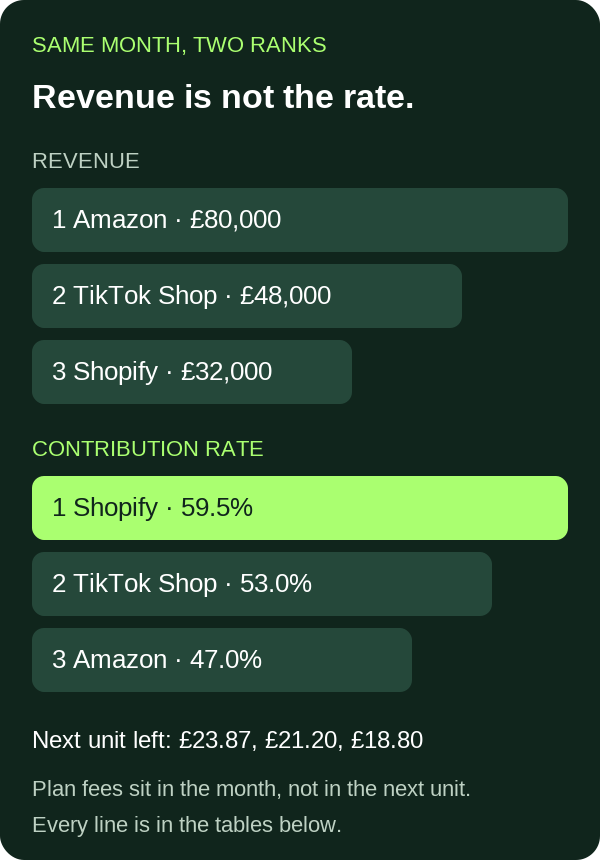
Do not close the biggest channel because its rate is the worst. In this illustration it still produces the most contribution pounds. Do not send the next unit there because the revenue is the biggest. The rate on that unit is the smaller one.
What do you tick off before you trust the ranking?
- Use one month, one currency, and orders rather than a dashboard total. An Amazon order-date profit and the accounts are allowed to disagree.
- Read the Shopify rates on the store: Settings, then Payments, then Manage, under Standard rates. Shopify labels them Domestic and Rest of World. The pricing page lists Grow’s online standard rate and a higher online international rate separately.
- Confirm whether Shopify Payments is the only provider before you drop the third-party fee. Shopify says the third-party fee is not charged when Shopify Payments is the only provider.
- Take the Amazon referral fee from the settlement. The clothing percentage depends on the price band, and other categories on the same page use other percentages.
- Replace the £3.20 outbound line with the carrier invoice, or with the FBA fee for that unit’s size band. Amazon says the fulfilment fee depends on product type, dimension and weight, and states a surcharge on FBA fulfilment fees.
- Read the TikTok Shop commission on the statement, under Fees, named “TikTok Shop commission fee”. That page says the screenshots are mock-ups and the live rates differ.
- Put a category reduction on the TikTok line only when the statement shows it. The policy says only one reduction applies at a time.
- Keep the monthly plan on the month. Take it off when the question is the next unit. The £49 and the £25 above are the published plan prices, spread across the made-up orders.
- Add advertising and creator commission on their own lines, from the invoice and the rate you set. Both are zero in this illustration.
- Add refunds before you rank the channels. Shopify says the card fee is not returned on a refund. Amazon refunds the referral fee minus the refund administration fee. TikTok Shop refunds the commission on the returned goods.
Frequently asked questions
Is the biggest-revenue channel the most profitable one?
Not by the rate. In this synthetic month Amazon’s £80,000 is the largest revenue and its 47.0% contribution margin is the worst. Amazon still contributes the most pounds, £37,575. The next unit leaves £23.87 on Shopify, £21.20 on TikTok Shop and £18.80 on Amazon. Rank the rate and the pounds separately.
Can these rates be copied onto a live settlement?
No. The 1.7% + 25p, the £49, the 15%, the £25 and the 9% are the published figures cited above, applied to made-up orders. Shopify’s live card rate is the one in the admin. Amazon’s live referral fee depends on the category and the total sales price. TikTok Shop says the statement rate can differ from the screenshot. The £40, the £12, the volumes and the £3.20 are illustrative.
Does this replace the supplement, sports or ROAS guides?
No. The supplement guide compares Amazon with that brand’s own site. The sports guide compares wholesale with D2C. The ROAS guide is about advertising return. This page is the fee stack on Shopify, Amazon and TikTok Shop, before ads and before overhead.
Where do advertising and creator commission go?
On their own lines, under the platform fee. Amazon describes advertising as an optional cost-per-click price you set. The TikTok Shop commission pages linked above state the platform commission and do not state a creator-commission percentage. Both lines are zero in the illustration, so the ranking is the platform fee only.
Where do you take the ranking?
The template is the trust check. Fill it from the payouts, then look at the rate and the pounds side by side. The next stock buy is a different decision from the revenue league table. Fractional CFO support is where that ranking becomes a stock and cash plan.
Prepared by Social Commerce Accountants editorial with AI assistance. The example is synthetic and independently checked. This is not a claim of human professional review or personalised tax advice.