
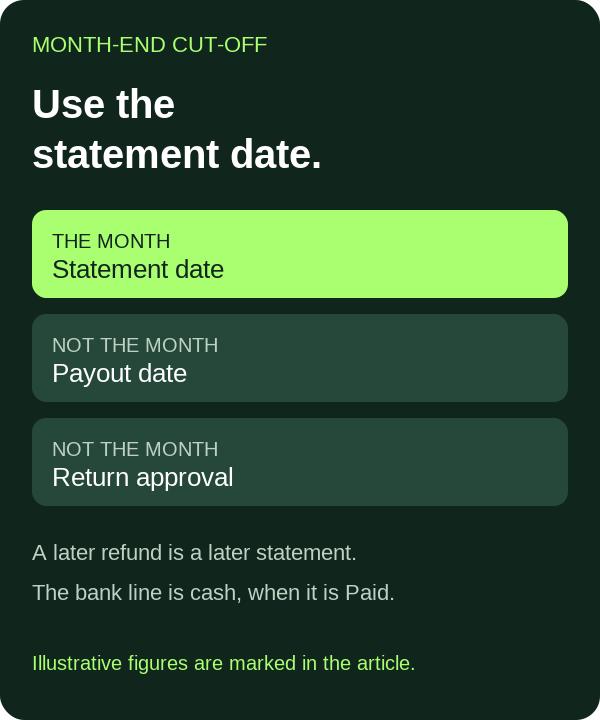
Use the statement date. A TikTok Shop refund, return or adjustment changes the month when TikTok records the statement. It does not change the month because the payout has reached the bank, and it does not change the month because someone approved the return. Statement date and order creation date are different filters on Finance, then Statements. TikTok’s statement guidebook says the settlement amount follows settlement time, when an order finishes its payout cycle, not order time.
This is the cut-off for a founder-led UK brand. Posting each line in Xero is the TikTok Shop settlement reconciliation. Matching the deposit to the bank is the payout reconciliation. The fee names sit on the fee reconciliation. The files to have open in the week of 27 November are the Black Friday file check. Doing the close for the shop is TikTok Shop accounting.
Which date is the month?
| Clock | Where TikTok shows it | What it is |
|---|---|---|
| Statement recorded | Statement date | The date the statement was recorded. Filter this for the month. |
| Order recorded | Order creation date | A different filter, on View by orders. It is not the statement date. |
| Money released | Payment settlement period | Time from delivery to the day funds are released. 1, 3, 8 or 31 days, depending on the period TikTok applies. |
| Bank | Paid | Paid means the amount has been paid to the seller’s bank account. Processing means the bank is still processing the payout. |
The account finance policy, updated 29 September 2026, lists five settlement periods. Introductory, for newly onboarded sellers or sellers in probation, releases funds 31 days from the delivery date. Standard, the default for sellers out of probation who do not qualify for a faster tier, releases funds 8 days from delivery. Accelerated, with eligibility set by shop performance, releases funds 3 days from delivery. Express, also assigned on shop performance, releases funds 1 day from delivery. Deferred, while TikTok runs platform or seller security checks, releases funds 31 days from delivery. One November delivery on a 31-day period is already in December: 1 November plus 31 days is 2 December, and a later November delivery is later still.
The settlement page says that after the settlement period, if the balance is positive and the bank details and withdrawal method are in Seller Center, TikTok initiates a transfer. It says it usually takes 3 business days from the end of the settlement period, and the platform initiates a transfer, before the funds are credited. The guidebook’s Processing status has a typical duration of 1 to 3 business days, and Paid means the funds are in the bank account. Social Commerce Accountants’ practical approach for the management month keeps the sales figure on the statement date and treats the credit as cash when the status is Paid. That approach is not a TikTok rule and it is not a statutory rule.
When can a November return become a December statement?
The returns guide says its policies and examples are not exhaustive, and that TikTok’s policies change. The £90, £5 and £10 figures are the ones on that guide, opened on 25 November 2026. The worked example further down is not an automated returnless refund.
The same order can settle more than once. TikTok’s guidebook says that is normal: an original entry, a later refund reversal, and a separate compensation line can each be dated on their own.
Which formula do you close to?
The guidebook, updated 18 June 2026, writes Settlement Amount = Net Sales − Shipping − Fees + Adjustments. The finance report guide uses that same plus in front of adjustments on the statement view. On View by orders, the same finance report guide writes Net sales − Shipping − Fees, with no adjustments in the formula. Further down, its explanation of total settlement amount writes Net sales − Shipping − Fees − Adjustments, a minus in front of adjustments.
Close to the settlement amount printed on the statement. Where adjustments are zero, the plus and the minus give the same number. Where a row has an adjustment, use the print. The illustration below sets adjustments to £0.00 on the order so the sign does not move the arithmetic.
What comes back on a refund, and what can stay gone?
The commission rate policy says that if the entire order is returned, the full commission fee is refunded to the seller, and if part of the order is refunded, only the commission fee on the refunded items is refunded. The guidebook’s fee table says platform commission is refunded pro rata when an order is refunded.
Opened on 25 November 2026, that policy says the commission fee rate is currently 9% before incentive reductions. It says specified Electronics and Beauty & Personal Care categories have an effective rate of 5%. The guidebook says the platform commission rate shown on the statement is already inclusive of VAT, and that VAT on commission is not a separate line. The £16.50 below is neither 9% nor 5%. It is a chosen fee. This page does not deal with the VAT return.
For orders created after 1 April 2025, the finance report guide says creators are paid 15 days after delivery. If the seller’s settlement period is longer than 15 days, it says creators are paid when the seller is paid. A refund or return before the creator is paid refunds the commission to the seller. After the creator is paid, the commission is not refundable. The guide says this covers affiliate commission, affiliate partner commission and affiliate shop ads commission. The guidebook says the same split: reversed in full before the creator’s settlement, and not refunded after it. The same guidebook also says a paired reversal nets that order to zero. Read the lines. If the affiliate fee has not been reversed, the order does not net to zero. The illustration is that case.
What does one synthetic November order do?
Illustrative figures. The dates are chosen. The amounts are made up. The months in this example are Social Commerce Accountants’ practical approach for a management close: the statement date for the figure, the Paid date for the cash. That approach is not a statutory rule, and it is not a TikTok rule. The same label sits again before the checklist. One order, created 18 November, delivered 20 November. The statement date of the earnings is chosen as 28 November. It is not worked out from a settlement period. Paid is chosen as 2 December. This is not an automated returnless refund, and the shop in the illustration is not on a 31-day settlement period.
| Line on the 28 November statement | Illustrative amount |
|---|---|
| Net sales | £200.00 |
| Shipping | £0.00 |
| Platform commission, inside fees | £16.50 |
| Affiliate commission, inside fees | £12.00 |
| Adjustments | £0.00 |
| Settlement amount | £171.50 |
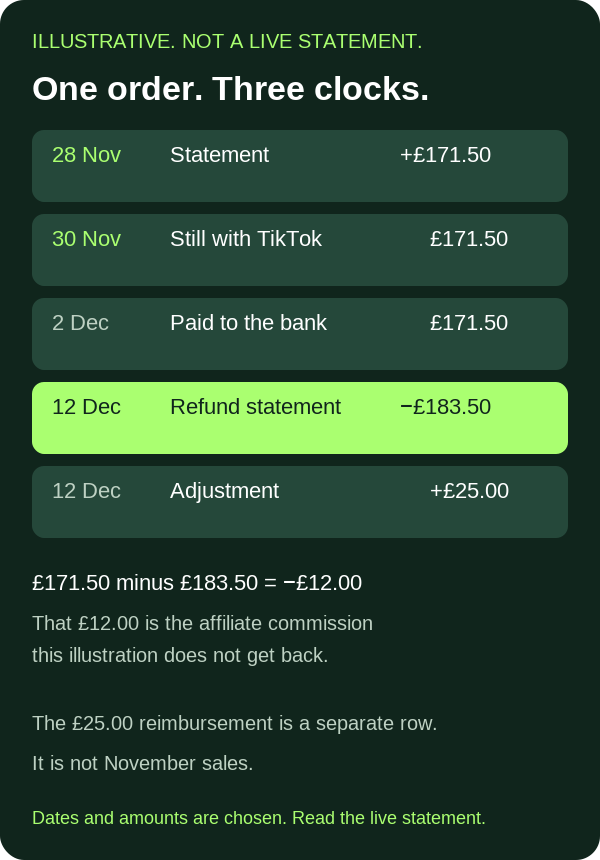
£200.00 − £0.00 − £16.50 − £12.00 + £0.00 = £171.50. That uses the guidebook’s plus in front of adjustments. The finance report’s minus in front of adjustments does not change a £0.00 adjustment. The guidebook says a standard TikTok-logistics order can net shipping to zero, because the shipping fee, the incentive and the customer shipping fee cancel. The £0.00 here is still chosen. A live statement may not be zero.
At 30 November the £171.50 has a statement date inside November, and the chosen Paid date is 2 December. For the management month, November holds the £171.50 statement, and the £171.50 is still with TikTok. December cash holds the £171.50 when it is Paid. The sales figure does not move to December with the bank line.
TikTok’s own example of the 15-day creator rule counts 1 January to 16 January. The same count takes the chosen delivery date, 20 November, to 5 December. The illustration assumes the settlement period is not longer than 15 days, so that 5 December is the creator payout. The refund statement date is chosen as 12 December, after that payout, so the affiliate commission is not refunded. A refund statement dated 4 December, before that payout, would be the other branch of the same rule, and the £12.00 would come back. A shop on the 31-day period does not use this 5 December date: creators are then paid when the seller is paid.
| Line on the 12 December refund statement | Illustrative amount | Why the illustration uses it |
|---|---|---|
| Net sales | −£200.00 | Paired reversal of the £200.00 |
| Shipping | £0.00 | Chosen |
| Platform commission, inside fees | −£16.50 | Full fee back, because the entire order is returned. Shown as a negative fee so the formula adds it back. |
| Affiliate commission, inside fees | £0.00 | Not reversed. In this illustration the creator has already been paid. |
| Adjustments | £0.00 | Chosen |
| Settlement amount | −£183.50 | −£200.00 − £0.00 − (−£16.50) + £0.00 |
£171.50 + (−£183.50) = −£12.00. The −£12.00 is the affiliate commission that stayed with the creator. The negative fee is how this illustration fits a refunded platform fee into the formula. On a live file, book the settlement amount the export prints.
The same chosen 12 December also has a separate adjustment, not a line inside the refund. The finance report guide names TikTok Shop reimbursement as an adjustment reason: reimbursement for losses due to the return and refund rules, or other issues. The amount in the illustration is £25.00, and it is made up. It is a December statement because its statement date is 12 December. It is not November net sales, even where a related order ID points at the November order.
| What the management month contains | November | December |
|---|---|---|
| Statements dated in the month | £171.50 | −£183.50 refund, and +£25.00 adjustment |
| Those December statements, added | — | −£158.50 |
| Bank, from the November statement | £0.00 | £171.50 on the chosen Paid date |
| Still with TikTok at the month end, from the November statement | £171.50 | The refund’s Paid date, and the adjustment’s Paid date, are not set in this illustration |
Leave £200.00, £0.00, £16.50, £12.00, £171.50, −£183.50, −£12.00, £25.00, −£158.50, 18 November, 20 November, 28 November, 2 December, 5 December and 12 December out of any live file. They are illustrative. On the close, use the export in front of you.
Where does an adjustment go?
An adjustment has its own order or adjustment ID, its own statement date, and a type. The finance report guide’s reasons also include logistics reimbursement, policy violation deduction, TikTok fees adjustment, promotion adjustment, adjustment from settlement account, and chargeback. The guidebook describes adjustments as money settled outside a specific sale. A positive line is money paid back. A negative line is an amount deducted. The management month follows the adjustment’s statement date, which is why the illustrative £25.00 sits in December.
Where the seller appeals a chargeback, the account finance policy says the fee is £10 per chargeback, deducted from monies due to the seller, whether or not the payment provider upholds the appeal. It says an appeal can take up to 3 months from the date the customer raises the chargeback. That £10 is the fee the policy states. The statement that carries it can fall months after the order. On the management close below, the month is that statement’s date.
What is still open at midnight on the last day?
On Hold means the order is paid for and not yet eligible for payout. The guidebook gives three common reasons: the carrier has not confirmed delivery, delivery is confirmed but the settlement window has not finished, or a return or refund is still open. The guidebook’s worked example, still On Hold, says there is no payout yet and shows net sales pre-recorded at £56.
A second order in the illustration is created on 30 November and is still On Hold that night. It is not in the £171.50. It does not get a guessed figure from shop GMV. The guidebook says GMV uses the customer’s payment time, and the statement uses settlement time, which is why the two totals differ. Write the order on a list of amounts not yet on a statement.
Reserve, on that settlement page, is order settlement funds withheld for 30 calendar days after delivery, for sellers who do not meet the Seller-Fault Cancellation Rate criteria. The amount is on Finances Summary, including the On-hold tab. TikTok says the screenshots on that page are only for reference, and that the interface, amounts and rates can differ. This illustration assumes the shop is not in that reserve policy. Where the tab shows a reserve, Social Commerce Accountants’ practical approach for the management month keeps it as funds still held. On that approach it is not a reduction of the month’s sales. That approach is not a TikTok rule and it is not a statutory rule.
What does company law say about the bank date?
Where a company prepares its individual accounts under the Small Companies and Groups (Accounts and Directors’ Report) Regulations 2008, Schedule 1, paragraph 14 says all income and charges relating to the financial year must be taken into account, without regard to the date of receipt or payment. That is why a 2 December bank credit does not, by itself, move a 28 November statement into December for those accounts. Paragraph 14 does not name a TikTok field. It says the date the money arrives is not the test. This page does not decide which companies prepare their accounts under those regulations.
Paragraph 13 says the amount of any item must be determined on a prudent basis, and in particular only profits realised at the balance sheet date are included in the profit and loss account. It also says all liabilities which have arisen in respect of the financial year, or a previous financial year, must be taken into account, including those which only become apparent between the balance sheet date and the date the accounts are signed. A refund or a chargeback that surfaces after the year end, and before signing, is one of the things those accounts look at. This page does not decide that every December refund of a November order is one of those liabilities.
The management-month method below is Social Commerce Accountants’ practical approach. It is not a statutory rule, and it is not TikTok’s rule. For the monthly close, use the statement date, and do not reopen a locked month because a later statement names an older order. When the statutory accounts are prepared, paragraphs 13 and 14 are the test, not the monthly lock.
What do you tick off at the close?
- Export Finance, then Statements, filtered on statement date for the month. Read the printed settlement amount.
- On View by orders, read order creation date beside statement date. Keep them apart.
- For each refund, see whether the platform commission reversed, and whether the affiliate commission reversed. Use the lines. A full return of the goods, and an automated returnless refund for an applicable product at £5 and below, are not the same case.
- Read each adjustment on its own statement date, including a chargeback fee that arrives months later.
- List orders still On Hold. Leave them off the statement total.
- If Finances Summary shows a reserve, keep that amount as funds still held.
- Match Paid amounts to the bank on the payout page. Leave that match out of the sales figure.
Frequently asked questions
Does the payout date decide the month?
No. Paid means the amount has been paid to the bank. The statement amount follows settlement time, not the day cash arrives. For companies preparing individual accounts under those regulations, paragraph 14 takes income and charges of the financial year into account without regard to the date of receipt or payment. The management close on this page uses the statement date.
Does approving a return put the refund in that month?
No. Approving the return does not approve the refund, and the refund waits for proof of return or for the product to arrive, unless it is returnless. Date the statement that records the refund. A speedy refund is processed when the buyer hands the parcel over, and it is not available at £90 and above.
Does a full return bring the affiliate commission back?
The platform commission fee comes back in full if the entire order is returned, and only on the refunded items if the refund is partial. The affiliate commission comes back if the refund happens before the creator is paid, and it does not come back after the creator is paid. For orders created after 1 April 2025, that guide puts creator payment at 15 days after delivery, or at the seller’s settlement if that period is longer than 15 days.
The adjustment names last month’s order. Which month is it?
The adjustment has its own statement date. For the management month, use that date. A TikTok Shop reimbursement, a policy deduction or a chargeback can name an older order and still be a later statement. The statutory accounts then look at paragraph 13, including liabilities that become apparent before the accounts are signed.
The order is still on hold. Which figure do I enter?
None, until it has a statement. On Hold means it is not yet eligible for payout, and GMV is a different clock from the statement. List the order. Leave it out of the month’s statement total.
Where does the cut-off go next?
The month’s TikTok figure is the statements whose statement date falls in the month, plus a list of what is still On Hold, plus any reserve still held. The bank match stays on the payout reconciliation. The lines, once they are being posted, stay on the Xero settlement reconciliation. The fee names stay on the fee reconciliation. The file list for the week of 27 November stays on the Black Friday file check. The close for the shop is TikTok Shop accounting.
Prepared by Social Commerce Accountants editorial with AI assistance. The example is synthetic and independently checked. This is not a claim of human professional review or personalised tax advice.