

If there is one thing that ruins the dopamine hit of a "Cha-ching" notification from the Shopify app, it’s the looming thought of Value Added Tax (VAT).
Shopify makes it incredibly easy to start a brand. You pick a theme, upload your products, and you can be selling in minutes. But Shopify’s "taxes" settings are not a replacement for a qualified accountant. Ticking a box in your backend doesn’t mean you are compliant with HMRC.
As specialist accountants for ecommerce brands, we see the same issues repeatedly. Sellers mix up gross and net profit, they miss the registration threshold, or they get tangled up in international rules.
This guide covers everything you need to know about VAT for Shopify sellers for the 2026/27 tax year. We will cut through the jargon and explain exactly what you need to do to stay compliant and profitable.
Do Shopify sellers need to pay VAT?
The short answer is: It depends on your turnover.
Many new sellers assume that because they run an "online business," tax rules are different. They aren't. Whether you have a brick-and-mortar shop in Shoreditch or a dropshipping store on Shopify, the UK VAT rules apply the same way.
You generally do not need to register for or pay VAT if your taxable turnover is below the VAT registration threshold. However, once you hit that number, you become an unpaid tax collector for HMRC.
The VAT Registration Threshold
Currently, the mandatory registration threshold in the UK is £90,000.
If your taxable turnover (that is your total sales, not just profit) goes over £90,000 in a rolling 12-month period, you must register.
Expert Note: "Rolling 12-month period" does not mean the tax year (April to April) or the calendar year. It means any consecutive 12 months. If you had a viral month on TikTok Shop in November that pushed your total sales from last November to this November over £90k, you have 30 days to register.
Voluntary Registration
Even if you are below £90k, you might choose to register voluntarily. Why?
- Reclaiming VAT: If you sell zero-rated items (like children’s clothing) or have high startup costs (stock, ads, laptop), you can reclaim the VAT you pay to suppliers.
- Perception: Being VAT registered makes your brand look larger and more established.
When to register for VAT Shopify?
Timing is everything. Registering late triggers penalties. Registering too early (when you don't need to) can eat into your margins if your customers are price-sensitive.
There are two tests to determine when you must register:
- The Backward Look: You have exceeded the £90,000 threshold in the past 12 months.
- The Forward Look: You expect to exceed the threshold in the next 30 days alone.
Scenario: You are launching a new product with a massive online seller campaign. You have £100k of stock ready to go. You know you are going to sell out in week one. You need to register before you make those sales.
What this means for you: Keep a close eye on your rolling turnover. Most accounting software (like Xero) has a VAT threshold monitor. If you are just using a spreadsheet, be careful. The moment you cross the line, you must start charging VAT on your Shopify store, even if your VAT number hasn't arrived yet.
Shopify VAT vs sales tax explained
This is where the confusion usually starts. We often have clients ask, "Do I need to charge sales tax?"
If you are a UK business selling to UK customers, the term is VAT. If you are selling to customers in the USA, the term is Sales Tax.
They are fundamentally different systems.
- UK VAT: A national tax. The rate is usually 20% across the board (with some exceptions like books or kids' clothes).
- US Sales Tax: A state-level tax. There are over 12,000 different tax jurisdictions in the US. You only collect it if you have "nexus" (a physical presence or significant economic activity) in a specific state.
VAT vs. Sales Tax Snapshot:
- VAT: Value Added Tax. Used in the UK/EU. Paid at every stage of the supply chain.
- Sales Tax: Used in the USA. Only paid by the final consumer.
If you are a UK Shopify seller shipping to the US, you generally do not charge UK VAT. However, you might become liable for US Sales Tax if you hit "economic nexus" thresholds (often $100k sales or 200 transactions in a single state).
Is Shopify price inclusive of VAT?
This is a setting in your Shopify backend that causes endless headaches if set up incorrectly.
In the UK, B2C (Business to Consumer) prices must be displayed inclusive of VAT. If you sell a hoodie for £50, the customer pays £50. If you are VAT registered, that £50 includes £8.33 of VAT which you owe HMRC.
In your Shopify Admin settings (Settings > Taxes and duties), you will see a checkbox: "All prices include tax."
- If you tick this: Shopify calculates the VAT backwards from your selling price. (Great for B2C).
- If you leave it unticked: Shopify adds VAT on top of your price at checkout. (Great for B2B, bad for consumers who hate surprise fees).
The Margin Trap
If you register for VAT but forget to adjust your pricing or settings, you essentially take a 16.67% pay cut.
- Before VAT: You sell for £50. You keep £50.
- After VAT (same price): You sell for £50. HMRC takes £8.33. You keep £41.67.
You need to decide if you will absorb that cost or increase your prices to £60 to maintain your margin.
VAT Rules for Shopify Sellers: Digital vs Physical
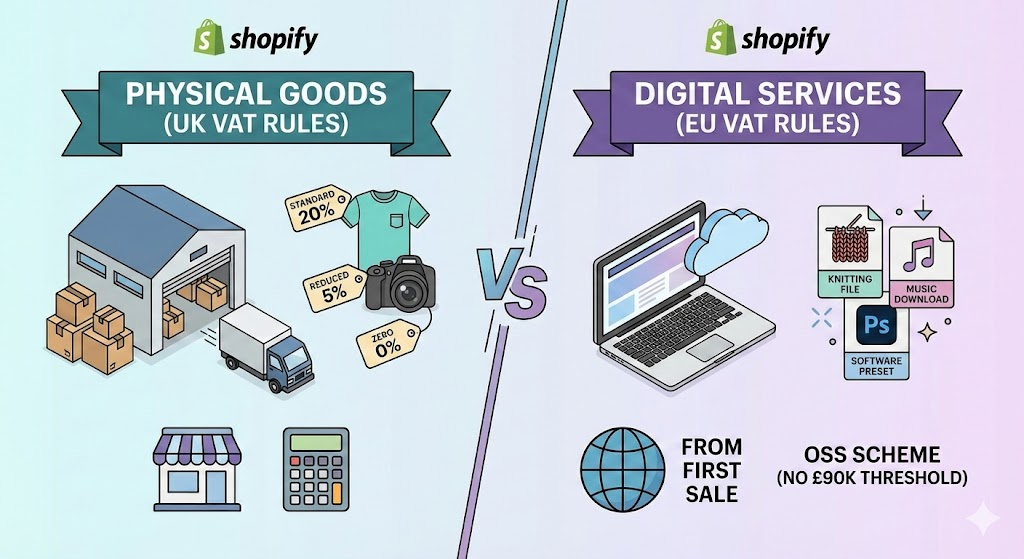
The rules change depending on what you are selling.
Physical Goods
Standard UK VAT rules apply. You ship a product from your warehouse (or dropshipper) to the customer. The VAT rate is determined by the product type (Standard 20%, Reduced 5%, or Zero 0%).
Digital Services
If you sell digital downloads, knitting patterns, or presets via Shopify, the rules are stricter.
If you sell digital products to customers in the EU, you are subject to EU VAT rules from your very first sale. There is no £90k threshold for cross-border digital sales. You may need to register for the OSS (One Stop Shop) scheme to handle this without registering in every single EU country.
Shopify VAT guide for small business
If you are a small business owner feeling overwhelmed, here is your survival checklist. This is how we manage it for our clients at Social Commerce Accountants.
1. Get the Tech Stack Right
Do not try to calculate VAT using Shopify reports alone. Shopify reports sales based on the time of the order. HMRC cares about the tax point (which can differ) and the actual money received.
- Recommendation: Connect Shopify to Xero.
- The Bridge: Use a connector tool like A2X or Link My Books. These tools group your daily sales and separate the VAT, shipping income, and payment fees automatically.
2. Check Your Product Codes
Ensure your products are categorised correctly in Shopify. If you sell baby clothes (Zero-rated) but Shopify treats them as standard apparel (20%), you will end up overpaying thousands in tax to HMRC.
3. Keep Proof of Export
If you sell goods to customers outside the UK, you do not charge UK VAT (this is called "zero-rating for export"). However, to prove to HMRC why you didn't charge tax, you must keep valid proof of export (tracking numbers, shipping manifests) for every single order.
4. Separate Your Funds
We always advise opening a separate savings pot (Monzo and Starling make this easy). Every time Shopify sends a payout, transfer 20% of it into that pot. When the VAT bill lands, the cash is there.
Do I need a VAT accountant for Shopify seller accounts?
You can file your own VAT returns. But with the complexity of Shopify payouts (where fees are deducted before the money hits your bank) and the potential for cross-border errors, it is risky.
A generic high-street accountant often doesn't understand the Shopify ecosystem. They might look at your bank deposit of £8,000 and assume that is your sales figure. But actually, you sold £10,000 worth of goods, and Shopify took £2,000 in fees, ads, and refunds.
If you just pay VAT on the £8,000, you are under-reporting sales and over-claiming relief. That is a compliance disaster waiting to happen.
At Social Commerce Accountants, we specialise in untangling the web of e commerce transactions to ensure you pay exactly what you owe—no more, no less.
Ready to get your Shopify finances in order?
This guide is not financial advice. All content is for educational purposes only. Please consult a qualified accountant or financial advisor to discuss how these strategies apply to your specific business circumstances before making any financial decisions.