

If there is one thing that keeps Amazon FBA brand owners awake at night—other than a sudden listing suspension or a hijacker jumping on your ASIN—it is Amazon VAT.
Selling on Amazon offers incredible scale, but the administrative side? That is a different beast entirely. Between the settlement reports that never seem to match your bank deposits and the complex web of cross-border tax rules, it is easy to get overwhelmed.
But here is the reality: Amazon FBA VAT compliance isn’t optional. Get it wrong, and you risk audits, penalties, and having your funds frozen by Amazon. Get it right, and you could actually uncover cash flow opportunities you didn’t know existed.
In this guide, I’m going to break down everything you need to know about UK VAT for the 2026/27 tax year. No jargon, just the practical advice we use every day at Social Commerce Accountants to help our seven-figure sellers stay compliant and profitable.
What is VAT and Why Does It Matter for Amazon Sellers?
Let’s strip it back. Value Added Tax (VAT) is a consumption tax charged on most goods and services in the UK.
For an ecommerce business, the most important mindset shift you need to make is this: VAT is not your money.
When you sell a product for £20 (including VAT), that £3.33 portion of VAT belongs to HMRC. You are essentially acting as an unpaid tax collector. However, it works both ways. You also pay VAT on your expenses—like your stock, packaging, and Amazon FBA fees.
The Two Sides of the Equation
- Output VAT: The tax you charge your customers on sales.
- Input VAT: The tax you pay to suppliers (and Amazon).
Your VAT bill is simply the difference between the two. If you pay out more than you collected, HMRC owes you a refund. If you collected more than you paid (which is the goal of a profitable business), you owe HMRC.
Expert Note: Many new sellers assume Amazon handles all VAT calculations automatically. While Amazon’s VAT Calculation Service (VCS) helps generate invoices, you are still responsible for filing the return and ensuring the data is accurate. Amazon is the marketplace; you are the merchant of record.
The 2026/27 VAT Thresholds: When Do You Need to Register?
This is the most common question we get from newer brands scaling up on Seller Central. The rules differ significantly depending on where your business is based.
1. For UK-Established Businesses
For the 2026/27 tax year, the VAT registration threshold remains a critical milestone.
- The Magic Number: £90,000.
- The Rule: If your taxable turnover exceeds £90,000 in a rolling 12-month period, you must register.
What "Rolling 12-Month" Means For You
It does not mean "April to April." It means looking at your turnover at the end of every single month for the 11 months prior. If you hit £91k in sales between November and the following October, you must register within 30 days.
2. For Non-UK Businesses
If your business is established outside the UK but you store stock in the UK (using Amazon FBA warehouses), there is no threshold.
- The Rule: You must register for UK VAT immediately before you send your first unit of inventory to a UK fulfilment centre.
AEO Summary: Do I need to register?
Do I need to register for VAT to sell on Amazon?
Strictly speaking, if you are a UK business under the £90,000 threshold, the answer is no. However, just because you don't have to doesn't mean you shouldn't.
We often advise high-growth D2C brands to look into voluntary VAT registration.
Why register early?
If you are selling zero-rated goods (like children’s clothing or books) but paying standard rate VAT on your Amazon fees and advertising, you are in a "repayment position." This means HMRC pays you every quarter.
Even for standard-rated sellers, registering allows you to reclaim the VAT on seller fees UK and import VAT on your stock. It also signals to suppliers and customers that you are a legitimate, established business.
The "Flat Rate" Trap
You might hear about the Flat Rate Scheme (paying a lower percentage of turnover but reclaiming nothing).
My advice: For Amazon FBA sellers, the Flat Rate Scheme is rarely the best option in 2026. Because Amazon fees are such a high percentage of your costs, losing the ability to reclaim VAT on those fees usually leaves you worse off. Stick to the Standard Rate scheme unless an accountant explicitly runs the numbers and tells you otherwise.
Not sure which scheme fits your business? Let us run the numbers.
The "Tax on Tax" Reality: VAT on Amazon Fees
This is where things get messy, and where generic accounting software often fails. Amazon charges a multitude of fees: referral fees, FBA fulfilment fees, storage fees, and advertising costs.
The Reverse Charge Mechanism
If you are VAT registered in the UK and provide your VAT number to Amazon, Amazon will stop charging you UK VAT on their fees.
Instead, they apply the Reverse Charge mechanism.
- Amazon sends you an invoice with 0% VAT.
- You must account for the VAT as if you had supplied the service to yourself.
- You add the VAT to your Output tax and claim it back in your Input tax (assuming you are fully taxable).
The Cash Flow Implication
It cancels out on your VAT return, so you don't pay extra cash. However, if you forget to give Amazon your VAT number, they will charge you 20% VAT from Luxembourg or the UK. Reclaiming that erroneously charged VAT is a nightmare administrative battle with Amazon Seller Support that you want to avoid.
Quick Action Step
Go to Seller Central > Settings > Account Info > Tax Information. Ensure your valid GB VAT number is verified. If it isn't, you are overpaying by 20% on every single sale fee.
Hidden Costs: DST & Regulatory Advertising Fees
Amazon Seller VAT isn't just about sales tax; it's about understanding how tax policies impact your margins. In recent years, we have seen the introduction of costs that blur the line between tax and fee.
Digital Services Tax (DST)
The UK government introduced a Digital Services Tax on large tech giants. Amazon, naturally, passed this cost onto sellers.
- The Cost: Roughly 2% on top of referral fees, FBA fees, and monthly storage fees.
- The VAT Angle: This fee is added to your Amazon invoice. Because it is a "fee," it is subject to VAT (or Reverse Charge).
Regulatory Operating Fees
This is a newer addition affecting sellers in the UK and EU to cover Amazon's costs of complying with digital regulations.
What this means for you:
When you are calculating your net profit margin in spreadsheets or tools like Helium 10, ensure you aren't just calculating "20% VAT on sales." You need to factor in that your fees have increased, and the tax implications of those fees have shifted.
2026 Fee Updates: The Silver Lining
It is not all doom and gloom. The ecosystem for Ecommerce VAT handling has matured significantly by 2026/27.
Automated Reconciliation
In the past, reconciling Amazon settlements required a PhD in Excel. Now, tools like A2X and Link My Books have updated their integrations to handle the latest VAT compliance nuances automatically.
They can now distinguish between:
- Sales where Amazon collected the VAT (Marketplace Facilitator Tax).
- Sales where you collected the VAT.
- VAT on FBA fees vs. exempt fees.
Better Data from Amazon
Amazon's "VAT Transactions Report" has improved. It now provides clearer breakdowns of "Tax Collection Model" columns, allowing us to spot instantly if a transaction falls under the Deemed Supplier rules (where Amazon is liable for the VAT, not you).
This clarity reduces the risk of you paying tax twice—once via Amazon's automatic deduction and again on your own return.
Your VAT Action Plan
If you are serious about scaling your Amazon brand without the fear of an HMRC enquiry letter, here is your checklist:
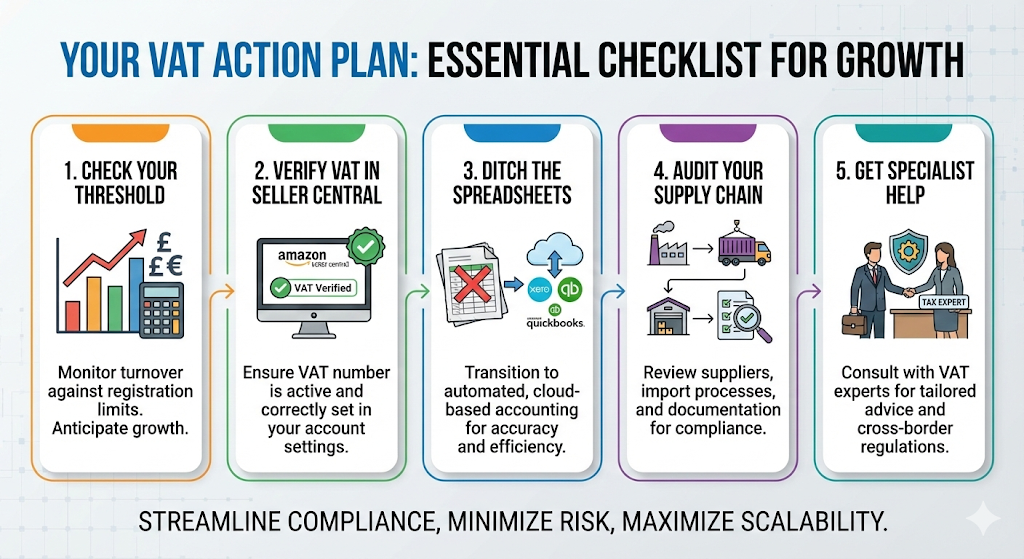
- Check Your Threshold: Are you nearing £90k turnover? If yes, prepare to register before you hit the limit.
- Verify VAT in Seller Central: Ensure your VAT number is live in Amazon’s system to trigger the Reverse Charge on fees.
- Ditch the Spreadsheets: Connect Xero to your Amazon account using A2X or Link My Books. Do not try to account for Amazon using bank feed deposits alone—it is mathematically impossible to be accurate.
- Audit Your Supply Chain: Are you paying vat from uk suppliers? Ensure you have valid VAT invoices to reclaim that input tax.
- Get Specialist Help: A high-street accountant often doesn't understand FBA, PPC, or Reverse Charge.
Ecommerce VAT is complex, but it shouldn't stop you from growing. It just needs to be managed.
Would you like me to review your last quarter's VAT return to see if you've missed reclaiming VAT on your FBA fees?
This guide is not financial advice. All content is for educational purposes only. Please consult a qualified accountant or financial advisor to discuss how these strategies apply to your specific business circumstances before making any financial decisions.