
Hearing that specific "ka-ching" notification from a customer in Berlin, New York, or Sydney is easily the best dopamine hit in eCommerce. It’s proof your brand has legs beyond the UK.
But if you’re anything like the store owners I work with, that excitement usually lasts about five minutes before the panic sets in: Wait, did I just accidentally commit tax fraud in Germany?
As an accountant specialising in the Shopify ecosystem, I spend half my life fixing this exact problem. You start out selling locally, and everything is fine. Then you toggle that "International Shipping" switch, and suddenly you’re walking through a minefield of distance selling thresholds, IOSS schemes, and US Nexus laws.
Shopify is brilliant at helping you sell globally, but it is not an accountant. It won't stop you from racking up a tax bill in Ohio or getting your goods held at French customs unless you tell it exactly what to do.
Here is the reality of managing international VAT right now, without the jargon.
The Home Turf: UK VAT Rules
Let’s kill a common myth immediately: Just because you have a Shopify store does not mean you charge VAT on everything.
If you are a UK-based business, the magic number for the 2025/26 tax year is £90,000. Until your taxable turnover hits that ceiling, you generally don't need to register, and you shouldn't be charging UK customers that extra 20%.
The Trap: That £90k safety net only applies to the UK. The moment you ship a parcel to Paris or upload a PDF for a customer in Munich, you are playing by their rules, not HMRC’s.
Selling to the EU (The Post-Brexit Headache)
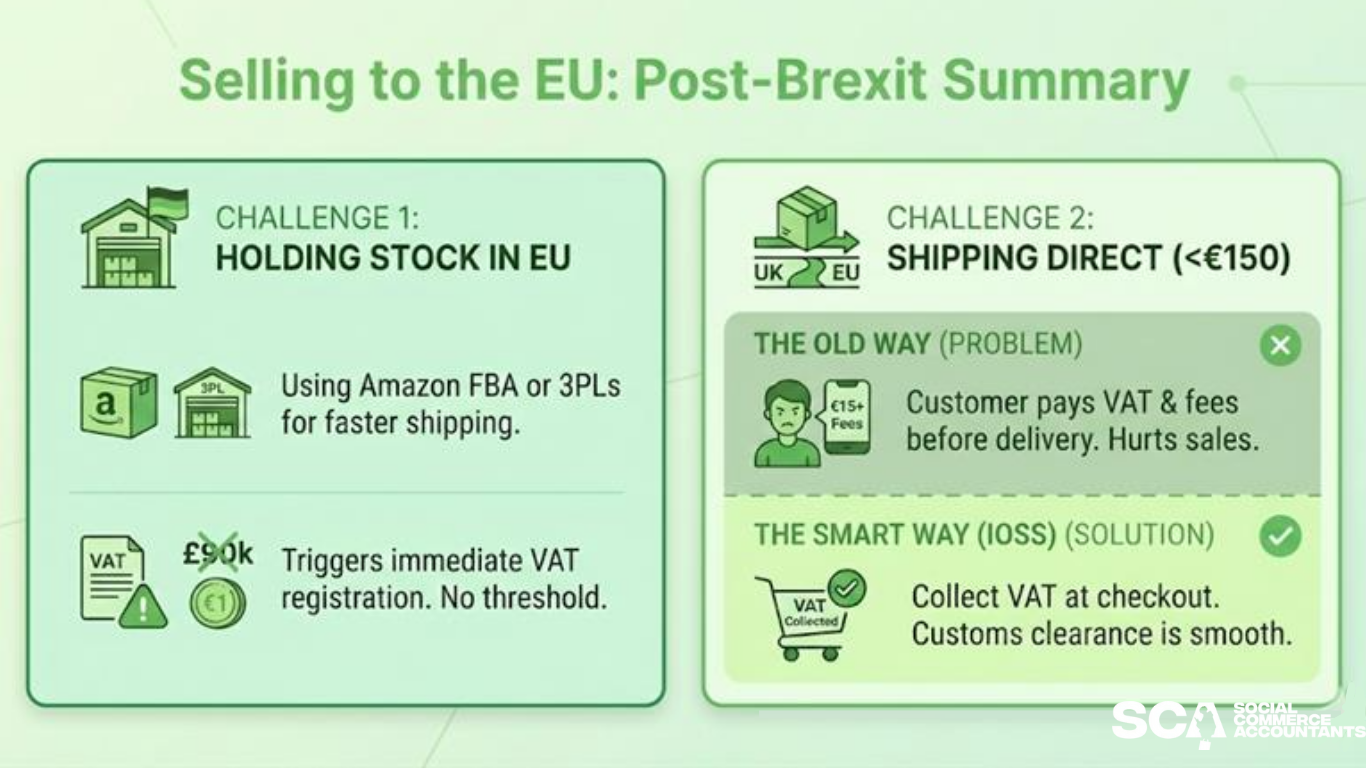
Since Brexit, the EU treats us as a "third country." That changes the game in two ways:
- Holding Stock: If you use Amazon FBA in Germany or a 3PL in France to speed up shipping, you usually trigger an immediate need to register for VAT in that country. There is no £90k threshold there—you are liable from the first Euro.
- Shipping Direct (IOSS): When you ship goods under €150 from the UK to the EU, you have two choices.
- The Old Way: You ship it. The customer gets a nasty surprise email from the courier asking for VAT plus a handling fee (often €15+) before they deliver. This is the fastest way to ensure that customer never buys from you again.
- The Smart Way (IOSS): You register for the Import One-Stop Shop scheme. You collect the VAT at checkout on Shopify, and the parcel sails through customs with a digital "tax paid" stamp. If you are serious about EU sales, IOSS isn't really optional anymore; it's a hygiene factor.
The USA: It’s Not VAT, It’s "Nexus"
The US system is entirely different. They don’t have a national VAT; they have Sales Tax, which is decided state-by-state.
For years, we told clients to watch out for the "200 transaction" rule. But as we move through 2026, many states (like Illinois and California) are dropping that transaction count. Now, the main trigger to watch is Revenue.
The Golden Rule: Generally, if you sell over $100,000 USD into a single state, you likely have "Economic Nexus" there and need to register. If you’re a smaller UK brand, you probably won't hit this immediately, but you need to monitor your top-performing states. Don't ignore it—state tax departments are becoming surprisingly aggressive with digital sellers.
Digital Goods: The "Hidden" Liability
This is where I see the most mistakes. If you sell physical t-shirts, tax is usually based on where the item ships from. But if you sell digital files (e-books, presets, courses), tax is based on where the customer lives.
Strictly speaking, even if your UK turnover is £0, selling a £10 PDF to a customer in Spain requires you to account for Spanish VAT.
Most people handle this by registering for the "Non-Union OSS" scheme, which lets you report all those little EU digital sales in one return. Just make sure your Shopify product settings clearly distinguish between "Physical" and "Digital," or your tax reports will be a mess.
How to Actually Set This Up
You don't need a developer, but you do need to be precise.
- Shopify Settings: Go to Settings > Taxes and duties.
- IOSS Entry: If you have an IOSS number (which we can arrange), enter it here. This is the signal Shopify sends to customs so your customer doesn't get double-charged.
- Pricing Strategy: Use "Dynamic tax-inclusive pricing." This feature is a lifesaver. It automatically adjusts your base price so that a customer in France pays the correct VAT rate without eating into your profit margin.
A Note on "Duties" (DDP vs DDU)
If you sell high-ticket items (over €150), VAT isn't your only problem—Customs Duty kicks in.
- DDU (Delivered Duty Unpaid): You ship it, and the customer has to pay the courier to release the package. Avoid this. It leads to refused parcels and return shipping costs that you have to eat.
- DDP (Delivered Duty Paid): You use a tool (like Zonos or Shopify’s advanced shipping settings) to calculate and charge the duty at checkout. You pay the courier, and the customer gets a seamless delivery.
The Verdict on Apps
Do you need expensive tax software? Maybe.
- Avalara / TaxJar: The industry standard. They are brilliant but can be pricey for smaller stores.
- The "Bootstrap" Method: If you are running a lean setup, you might not need the enterprise tools yet. Many of our clients use a mix of native Shopify settings and Xero, managed by an accountant who knows how to manually file an OSS return.
The Bottom Line: International tax is complex, but it shouldn't stop you from growing. You just need to organise the backend correctly before you scale, not after you get a letter from the tax office.
If you need a pair of eyes on your tax settings—or need help registering for IOSS before the next quarter—we’re here to help.
This guide is not financial advice. All content is for educational purposes only. Please consult a qualified accountant or financial advisor to discuss how these strategies apply to your specific business circumstances before making any financial decisions.