
For the last few years, Making Tax Digital for Income Tax (MTD ITSA) has felt like a can being kicked further and further down the road. But the kicking has stopped.
If you are a sole trader, online seller, or ecommerce seller, the theoretical deadline is now a stark reality. As of January 2026, we are roughly 90 days away from the biggest shift in UK tax reporting since Self Assessment began.
For many online sellers—whether you are flipping on Amazon FBA or running a high-volume TikTok Shop—this is crunch time. The "annual panic" in January is about to be replaced by a quarterly digital requirement.
If you are looking for an ecommerce accountant in England to help you navigate this transition, you are in the right place. Let’s strip away the jargon and look at exactly what you need to do before April.
What is MTD for Income Tax?
Definition: MTD ITSA requires self-employed individuals and landlords with a qualifying income to keep digital records and send income and expense summaries to HMRC four times a year, plus a final declaration, using compatible software.
The £50k Threshold: Does Your 2024/25 Tax Return Trigger MTD?
Many sellers are confused about when they qualify. The answer lies in the tax return you are likely filing right now.
To join the mandated first wave in April 2026, your qualifying income must exceed £50,000.
Here is the crucial part that catches Amazon and Shopify sellers out: This is based on gross turnover, not profit.
If you run a high-volume, low-margin dropshipping business or an Amazon FBA brand, your turnover might easily sit at £80k while your actual profit is £30k. In HMRC’s eyes, you are over the threshold.
The Rule of Thumb: If the Self Assessment return for the 2024/25 tax year (which you are filing by 31 January 2026) shows gross income over £50k from self-employment and property combined, you must comply with MTD for Income Tax starting 6 April 2026.
If your income is between £30,000 and £50,000, your start date is currently set for April 2027—but you should start preparing your digital habits now.
90 Days to Go: The Key Dates You Cannot Miss
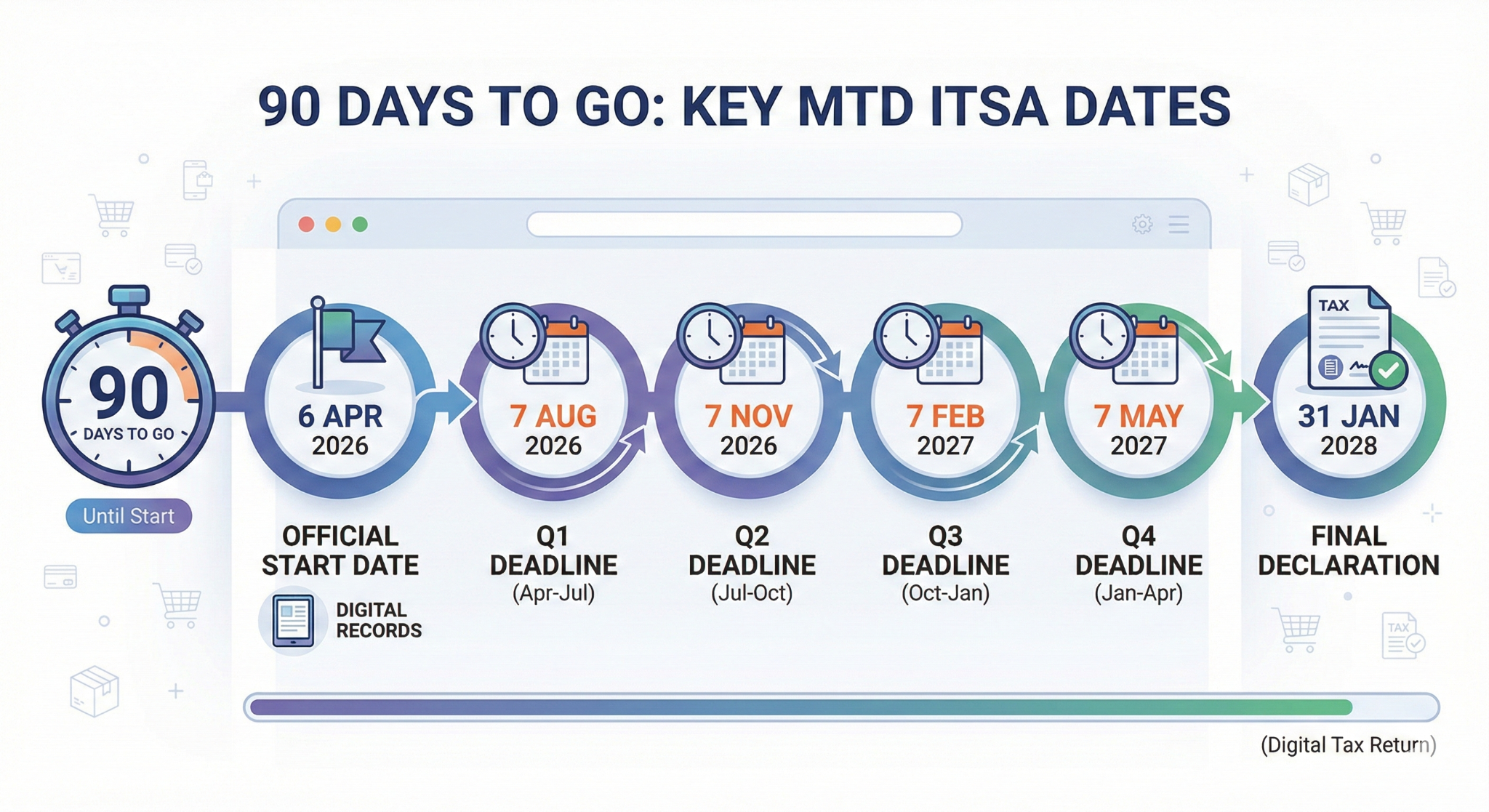
Deadlines in ecommerce are usually dictated by Amazon settlements or Black Friday shipping cut-offs. Now, you need to add HMRC’s quarterly dates to your calendar.
Because this system starts on 6 April 2026, your first year of MTD ITSA will look like this:
- 6 April 2026: The official start date. You must start keeping digital records from day one.
- 7 August 2026: Deadline for Quarter 1 update (covering 6 April – 5 July).
- 7 November 2026: Deadline for Quarter 2 update (covering 6 July – 5 October).
- 7 February 2027: Deadline for Quarter 3 update (covering 6 October – 5 January).
- 7 May 2027: Deadline for Quarter 4 update (covering 6 January – 5 April).
- 31 January 2028: Final Declaration (the digital replacement for the old tax return).
What this means for you
You can no longer wait until January to find your invoices. If you miss the August 7th deadline, you enter the penalty points system immediately.
Quarterly Updates Explained: No More "Once a Year" Panic
The biggest fear I hear from clients is, "Sam, does this mean I have to do four tax returns a year?"
Short answer: No.
Long answer: You are filing quarterly updates. These are not full tax returns. You do not need to make accounting adjustments (like capital allowances or stock valuation) four times a year unless you want to.
A quarterly update is simply a statement of your transaction data:
- Total income for the period.
- Total expenses for the period.
For an ecommerce accountant in London, this is standard practice. But for a seller used to downloading a CSV once a year, this requires a mindset shift.
The hidden benefit here is cash flow visibility. By forcing you to look at your numbers quarterly, you spot trends in your ad spend and platform fees (especially those hidden TikTok Shop referral fees) much faster than before.
Software Options: Bridging Software vs. Full Suites
This is where things get tricky for the seller economy and modern sellers. MTD requires "compatible software."
The Problem for Online sellers
If you are an online seller or channel marketer, you probably know that "seller-specific" accounting integrations barely exist. Most platforms do not sync neatly with UK tax software yet. You are often left dealing with messy PDF remittance advice notes from agencies or platforms.
Your Options
1. Full Accounting Suites (Recommended) Xero or QuickBooks Online. These connect directly to your business bank account.
- Pros: Automation, bank feeds, and they handle the MTD submission natively.
- Cons: Monthly subscription cost.
- Best for: Amazon FBA, Shopify, and serious Content Online sellers.
2. Bridging Software This allows you to keep using spreadsheets but use a piece of software to "bridge" the data to HMRC.
- Pros: Cheap; allows you to stick to Excel.
- Cons: High risk of error. It does not help you organise your receipts or automate bank feeds.
- Best for: Very low transaction volume businesses (rare in ecommerce).
If you are looking for the best accountant for ecommerce business London based, they will almost certainly steer you toward Xero. Why? Because manual entry on a spreadsheet for a high-volume seller is a recipe for disaster under MTD.
How to Avoid Penalties During the Transition Period
HMRC has introduced a points-based penalty system for MTD. This is designed to be fairer than immediate fines, but it still has teeth.
- Late Submission: You receive 1 point for every missed deadline.
- Threshold: Once you reach a certain number of points (4 points for quarterly updaters), you receive a £200 fine.
- Late Payment: Separate from submission penalties, interest and surcharges apply if you don't pay your tax by 31 January.
The "Soft Landing" Myth
Do not rely on HMRC being lenient. While they have discussed a "soft landing" regarding penalties for digital links in the past, the requirement to file the update itself is strict.
If your digital records aren't ready by April, you can't file. If you can't file, you get points.
Next Steps
The 90-day countdown is real. If your turnover is over £50k, the shoebox method is legally dead as of April 2026.1
If you need a partner who understands platform fees, inventory accounting, and MTD compliance, let's talk.
Would you like me to audit your current 2024/25 turnover to confirm if you are liable for the April 2026 start date?
MTD for Income Tax: Quick FAQ
Does MTD apply to Limited Companies? No. MTD for Income Tax currently only applies to sole traders and landlords. Limited Companies have different MTD rules (mostly for VAT right now).
Can I use spreadsheets for MTD? Only if you use "Bridging Software" to submit the data to HMRC. You cannot send a spreadsheet directly to HMRC.
What if my income drops below £50k next year? Once you are in MTD, you generally have to stay in for a period of time (usually until you meet specific exit criteria), even if your income dips.