
.png&w=3840&q=75)
Let’s be honest: you didn't start an e commerce business because you love filling out HMRC forms.
You started it to build a brand, curate products, or leverage an audience. You started it to solve a problem or share a passion. But whether you’re shifting units on Amazon FBA, dropping collections on Shopify, or pushing products as a TikTok affiliate, the taxman is always your silent partner.
Navigating UK ecommerce tax is difficult because the rules were originally written for high street shops—brick-and-mortar stores with physical tills and local customers. They were not written for algorithms, digital wallets, global supply chains, and dropshipping models.
At Social Commerce Accountants, we see the same scenario play out constantly: a brand hits £100,000 in revenue, feels on top of the world, and then realises their backend numbers are a mess because they didn't understand the difference between a "Net Payout" and "Gross Income."
This guide breaks down exactly what you need to know to stay compliant and keep more of your profit, regardless of which platform you sell on.
The Threshold: Hobby vs. Business
One of the most common questions we get—especially from Vinted sellers, Etsy creators, and new TikTok affiliates—is: "Do I even need to register?"
There is a pervasive myth that if you don't earn enough to pay tax, you don't need to tell HMRC you exist. This is false.
The "Badges of Trade"
There is no strict financial threshold that magically turns a hobby into a business in the eyes of the law. Instead, HMRC looks for "Badges of Trade." You are likely trading (and therefore a business) if:
- Intent: You buy goods with the specific intention of selling them for a profit (e.g., buying clearance stock to flip on eBay).
- Frequency: You sell regularly and systematically, rather than just clearing out your attic once a year.
- Modification: You modify items to increase their value before selling (e.g., buying plain t-shirts and printing designs on them).
- Finance: You borrowed money to buy the stock.
If you are just selling your own old clothes on Vinted, that is not a business. If you are buying clothes from charity shops specifically to resell them on Vinted at a markup, that is a business.
The £1,000 Trading Allowance
If you are a casual seller or a small creator, you have a safety net called the Trading Allowance.
- If your Gross Income (total sales before fees) is under £1,000 in a tax year (6 April to 5 April), you do not need to register or pay tax.
- Once you cross £1,000 in gross sales, you must register with HMRC.
Crucial Note: This is based on Gross Sales, not profit. If you sell £1,500 worth of stock but your expenses were £1,200 (leaving you only £300 profit), you still have to register because your revenue exceeded £1,000.
Choosing Your Structure: Sole Trader vs. Limited Company
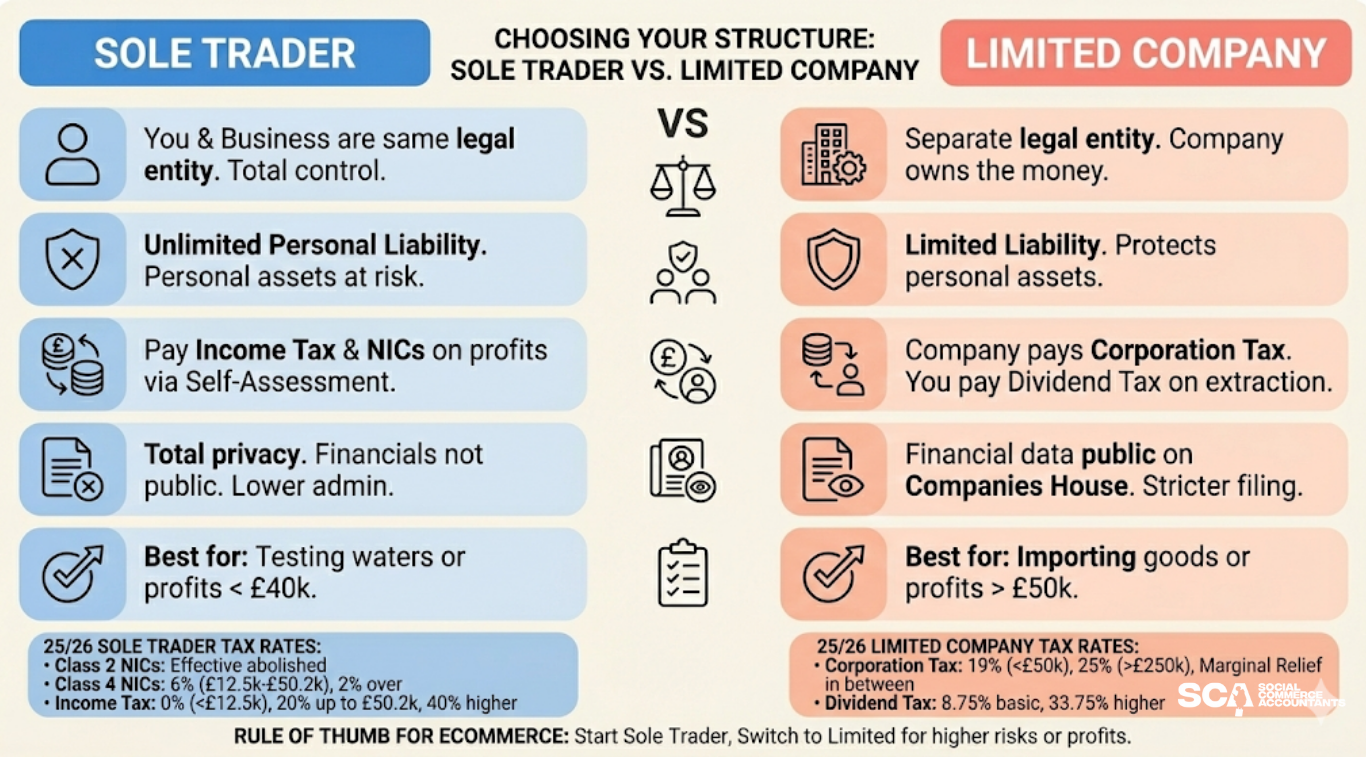
Once you’ve established you are a business, you must choose a legal structure. This decision impacts your liability, your admin workload, and crucially, your tax efficiency.
Sole Trader
This is the default for most new sellers. You and the business are the same legal entity.
- The Tax: You pay Income Tax and National Insurance on your profits.
- Class 2 NICs: Effectively abolished for most. If your profits are over £6,845 (25/26 rates), you are treated as having paid without paying a penny.
- Class 4 NICs: 6% on profits between £12,570 and £50,270; 2% on profits above that.
- Income Tax: 0% on the first £12,570; 20% up to £50,270; 40% (Higher Rate) above that.
- Pros: Easy to set up; low accounting fees; total privacy (financials aren't public).
- Cons: Unlimited Liability. If your dropshipping product injures someone and you are sued, your personal house and car are at risk.
Limited Company (Ltd)
A separate legal entity. The company owns the money, not you.
- The Tax: The company pays Corporation Tax on profits.
- 19% for profits under £50,000.
- 25% for profits over £250,000.
- A "Marginal Relief" sliding scale applies between £50k and £250k.
- Extraction: You then pay personal tax on the dividends you take out (8.75% basic rate, 33.75% higher rate).
- Pros: Limited Liability (protects personal assets); often more tax-efficient once profits exceed £50,000; looks more professional to suppliers.
- Cons: Stricter filing deadlines; higher accountancy fees; financial data is public on Companies House.
Which should you choose?
As a rule of thumb for ecommerce:
- Start as a Sole Trader if you are testing the waters or your profit is under £40k.
- Switch to Limited if you are importing goods (liability risk) or your profits exceed £50k (tax savings).
The "Silent Killer": Gross Sales vs. Net Payouts
If you take only one thing from this guide, let it be this section. Do not do your accounting based on your bank deposits.
This is the single most dangerous trap for sellers on Shopify, Amazon, TikTok Shop, and Etsy.
The Scenario
Imagine you sell a product on Amazon for £20.00.
- Amazon charges a Referral Fee of £3.00.
- Amazon charges an FBA Fee of £4.00.
- Amazon deposits £13.00 into your bank account.
The Mistake
Most new sellers look at their bank statement, see £13.00, and record that as their income.
The Reality
Your Turnover is £20.00. Your Expenses are £7.00.
Why does this matter?
- VAT Thresholds: HMRC monitors your Turnover (the £20), not your profit (the £13). If you record the net figure, you might think you are safely under the £90,000 VAT threshold when you have actually breached it. This leads to massive back-dated tax bills.
- Under-reporting: Technically, reporting net figures is incorrect accounting. You are suppressing both your income and your expenses.
The Timing Trap (Accruals Basis)
Platforms like TikTok Shop often hold cash for 14 to 30 days to cover returns. However, standard accounting works on an "Accruals Basis."
- If you make a sale on 31st March (inside the current tax year), you pay tax on it in that year.
- It does not matter if TikTok doesn't release the cash until 15th April (the next tax year). The tax liability arises when the sale is made, not when the cash lands.
VAT: It’s Not Just About the £90k Threshold
Most sellers know they must register for VAT once their taxable turnover hits £90,000 in a rolling 12-month period. However, in ecommerce, cross-border trade makes this much more complex.
The "Marketplace Facilitator" Rules
If you sell on Amazon, Etsy, or eBay, you may notice that for many sales, the platform collects the VAT and pays it to HMRC directly. This is called the Deemed Supplier model.
- The Trap: You might think, "Great, I don't need to do anything." Wrong. You still need to include these sales on your VAT return (usually as zero-rated or outside of scope, depending on the software), otherwise, your turnover looks artificially low.
- The Double-Tax Risk: If you connect Xero to Shopify/Amazon incorrectly, you might accidentally pay VAT again on sales that Amazon has already taxed.
Dropshipping & Import VAT
If you are dropshipping goods from outside the UK (e.g., China) to UK customers, the rules changed significantly after Brexit.
- Consignments under £135: Supply VAT usually applies at the point of sale (handled by the marketplace).
- Consignments over £135: Import VAT and Duty apply at the border. The carrier (DHL/FedEx) will ask for this before delivering.
Pro Tip: If you pay Import VAT, you can usually claim it back on your VAT return, but only if you have the C79 certificates from HMRC. You cannot claim VAT back using just a generic invoice from a Chinese supplier.
Postponed VAT Accounting (PVA)
If you are importing large stock orders, paying 20% Import VAT at the border hurts your cash flow. You should apply for Postponed VAT Accounting. This allows you to "account" for the VAT on your return rather than paying physical cash to customs. It is a massive cash flow win for importers.
The "New" Threat: OECD Digital Reporting Rules
The days of "flying under the radar" are officially over.
The OECD Digital Platform Reporting rules have been live since January 2024.
- What it means: Platforms like Vinted, Etsy, TikTok Shop, and Amazon are now legally required to collect data on their sellers and report it directly to HMRC.
- The Timeline: The first reports (covering the 2024 calendar year) were due to HMRC in January 2025. HMRC now possesses this data.
- The Next Wave: The next reporting deadline is 31 January 2026.
If your Self Assessment tax return does not match the data HMRC has already received from Amazon or TikTok, it will likely trigger an automated investigation (a "Compliance Check"). If you have been hiding income, now is the time to make a voluntary disclosure before they act on the data they already hold.
Platform Playbooks: Specific Advice
Every platform handles tax differently. Here is a quick breakdown of the unique headaches for the major players.
Tax for Shopify Sellers
Shopify is notorious for giving sellers a false sense of security.
- Settings Check: Just because you ticked "Charge VAT" doesn't mean Shopify is doing your tax return. It just collects the money. You still need to remit it.
- Invoicing: Shopify’s native receipt is often not a valid VAT invoice. If you sell to other businesses (B2B), you are legally required to provide a valid VAT invoice. You will likely need a third-party app like Sufio or Order Printer Pro to generate these automatically.
We can help you with this
Tax for Amazon Sellers (FBA)
Amazon is a beast of fees.
- Invoicing: We recommend using Amazon's VCS (VAT Calculation Service). It allows Amazon to generate invoices on your behalf. However, ensure your "Tax Settings" in Seller Central match your actual registration date. We have seen sellers turn this on too early and illegally collect VAT they weren't registered for.
- Commingling: If you sell across Europe (Pan-EU FBA), moving stock between Amazon warehouses in different countries (e.g., UK to Germany) triggers a VAT obligation in that country. Do not turn on Pan-EU FBA unless you are ready to register for VAT in every single country Amazon stores your stock in.
Worried about your FBA tax compliance? Contact us today to review your settings and avoid costly mistakes.
Tax for TikTok Shop Sellers
TikTok Shop is the "Wild West" of e commerce.
- The Payout Nightmare: TikTok payout statements are incredibly difficult to reconcile manually. They bundle hundreds of orders into one payment, net of obscure fees (shipping subsidies, platform discounts, affiliate commissions).
- Affiliate Commissions: If you use TikTok creators to sell your products, the commission you pay them is a business expense. Ensure you are tracking this, as TikTok deducts it before the money hits your bank.
Drowning in TikTok data? Let us automate your reconciliation so you can focus on going viral.
Tax for Etsy Sellers
- Digital VAT: If you sell digital downloads (PDF patterns, printables), Etsy acts as the reseller. They collect and remit VAT to the customer's country automatically. You generally do not receive this VAT, so you shouldn't pay it to HMRC. Check your Etsy payment reports to ensure you aren't paying tax on income that Etsy has already taxed.
Special Rules for Creators & Affiliates
If you are a TikTok Affiliate or Influencer, there is a specific tax trap you must avoid: Gifted Products.
HMRC is very clear on this. If a brand sends you a hair straightener worth £300 in exchange for a video or a post, that is not a gift. It is a Barter Transaction.
- In the eyes of the taxman, you provided a service (marketing) and were paid in goods (the straightener).
- The market value of that product (£300) counts toward your Trading Income.
The Risk: If you are a higher-rate taxpayer, receiving expensive "free" items can create a literal tax bill, even if no cash changed hands. You must track the value of these items in a spreadsheet.
Deductible Expenses for Creators: Don't forget to claim your expenses!
- Lighting and camera equipment.
- Props for videos.
- A portion of your phone bill and internet (based on business use %).
- Software subscriptions (Adobe, CapCut Pro).
The Solution: Your Tech Stack
We mentioned earlier that manual data entry is suicide for an ecommerce business. You cannot manually reconcile 500 orders a month without making errors. You need the right infrastructure.
The "Merchant" Stack (Inventory Sellers)
If you sell on Shopify, Amazon, or TikTok Shop (holding your own stock), we strongly recommend:
- Xero / QuickBooks: The central accounting engine.
- A Connector (A2X or Link My Books): These are the gold standards. They connect to your sales channel, fetch the messy settlement file, and tidy it up.
- They separate the sales, shipping income, fees, and VAT.
- They post a clean Journal Entry into Xero that matches your bank deposit exactly.
- This makes reconciliation a one-click process.
The "Creator" Stack (Affiliates)
Warning: Most connector software (like A2X) is designed for Merchants, not Affiliates. They hook into "Seller Centers," not "Creator Centers."
For our affiliate clients, these tools often fail to pull commission statements correctly. We currently use a bespoke method for affiliates, establishing a "clearing account" in Xero and manually importing commission statements via CSV. It is more manual, but it ensures your trading income is accurate until the software market catches up.
Summary: Your Compliance Checklist
- Audit your status: Are you a hobbyist or a business? (Check the "Badges of Trade").
- Check your turnover: Are you calculating based on Gross Sales or Net Payouts? If you are using Net, re-calculate immediately.
- Watch the VAT Line: If you are nearing £90,000 turnover, start preparing for VAT registration 2-3 months in advance.
- Automate: If you are doing more than 50 orders a month, get Link My Books or A2X. The time saved pays for the subscription in week one.
- Get Help: If you are scaling, speak to an accountant who understands ecommerce. A high-street accountant who usually deals with local plumbers may not understand "Marketplace Facilitator Tax" or "Postponed VAT Accounting."
Ready to get your backend in order? At Social Commerce Accountants, we specialise in the messy, high-volume world of e commerce. We don't just file your return; we build the systems that keep you compliant and profitable.
(Disclaimer: This guide is for information purposes only and does not constitute financial advice. Tax laws change frequently. Always consult a qualified accountant regarding your specific circumstances.)
This guide is not financial advice. All content is for educational purposes only. Please consult a qualified accountant or financial advisor to discuss how these strategies apply to your specific business circumstances before making any financial decisions.