

Navigating the UK tax landscape as an Amazon FBA seller is complex, involving strict rules on VAT, corporation tax, and accurate inventory valuation. This expert guide simplifies the essential tax and compliance knowledge you need to grow your e-commerce business without regulatory stress.
If you're an Amazon seller, you're not just moving boxes; you're running a serious, high-growth business. Yet, the sheer complexity of the UK tax system—especially when combined with global sales—can halt that growth dead in its tracks. Your traditional accountant doesn’t understand modern social commerce. We do.
Tax compliance in the e-commerce world requires specialist knowledge. It’s not just about filling in a self-assessment form; it’s about strategic VAT management, correct inventory valuation, and knowing how to handle international transactions. Get this wrong, and you’re exposed to penalties from the UK tax authority. Get it right, and you unlock serious profit potential.
Is Amazon FBA Income Taxed Differently in the UK?
No, Amazon FBA income is taxed using the same UK rules as any other business income, but the calculation of taxable profit is significantly more complex due to international VAT rules, intricate inventory movements, and high transaction volumes.
While the underlying structure (Self-Assessment for sole traders or Corporation Tax for limited companies) remains the same, the sheer volume of data and the nature of global FBA operations introduce unique complexity.
The Three Pillars of Amazon Seller Tax
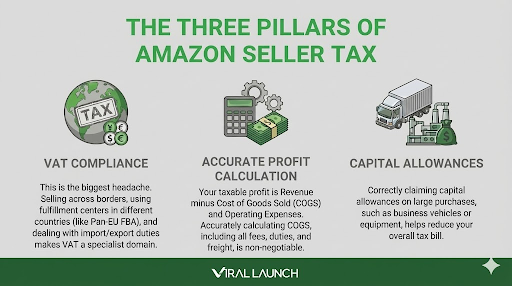
To ensure compliance and maximize profit, you must master these three pillars:
- VAT Compliance: This is the biggest headache. Selling across borders, using fulfillment centers in different countries (like Pan-EU FBA), and dealing with import/export duties makes VAT a specialist domain.
- Accurate Profit Calculation: Your taxable profit is Revenue minus Cost of Goods Sold (COGS) and Operating Expenses. Accurately calculating COGS, including all fees, duties, and freight, is non-negotiable.
- Capital Allowances: Correctly claiming capital allowances on large purchases, such as business vehicles or equipment, helps reduce your overall tax bill.
The International VAT Maze: What UK Amazon Sellers Must Know
For UK Amazon sellers, VAT compliance is complicated by distance selling rules, potential foreign VAT registration requirements (especially in the EU), and the proper handling of Import VAT and duties.
This is where the generalists panic. Post-Brexit, the rules for selling into the EU are complex, and the UK tax authority expects you to comply.
1. Selling within the UK
- Registration: If your VAT-taxable turnover (sales) exceeds the current registration threshold (a figure set by the UK tax authority), you must register for VAT.
- Flat Rate Scheme: Some smaller sellers benefit from the Flat Rate Scheme, but the rules are highly restrictive for businesses buying and selling goods internationally. We generally advise against it for high-growth FBA sellers.
2. EU Sales and Pan-European FBA
If you sell goods from the UK to consumers in the EU, you are usually dealing with complex rules.
- OSS (One Stop Shop): This is a critical simplification for business-to-consumer (B2C) sales within the EU, often allowing you to report all EU VAT in one place. However, you must first understand if and where you need to be VAT registered.
- Inventory Storage: If you store inventory in an EU fulfilment center (e.g., using Pan-European FBA), you create a Permanent Establishment in that country, which automatically triggers a local VAT registration requirement. This is non-negotiable.
- Import VAT Recovery: When importing goods into the EU to stock FBA warehouses, you pay Import VAT. A specialist accountant will know the correct procedure to account for and recover this VAT, which is a major cash flow issue for many sellers.
- Expert Commentary: Here’s where sellers slip up: confusing the UK VAT threshold with the need to register in EU countries. If your stock touches an EU warehouse, the EU VAT registration requirement starts immediately, regardless of your sales volume.
How Do You Accurately Calculate Cost of Goods Sold (COGS)?
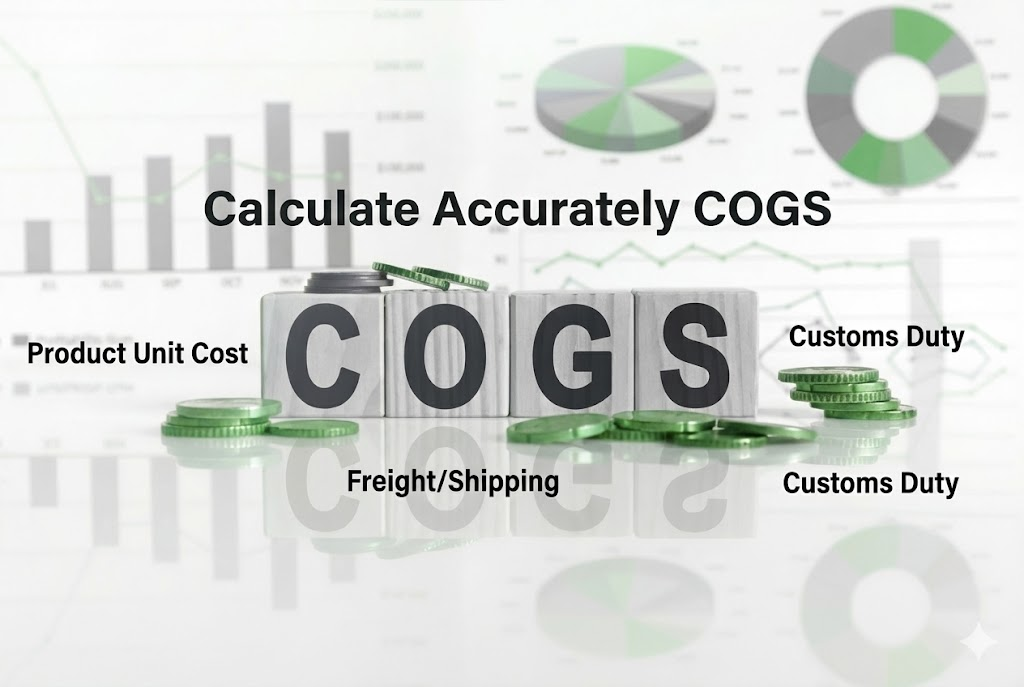
Accurate COGS calculation for Amazon FBA requires specialist accounting software to capture every cost associated with getting the product ready for sale, including freight, customs duty, quality control, prep fees, and marketplace commissions.
Your inventory valuation is the single biggest factor affecting your profit margin and, subsequently, your tax bill.
Components of Accurate COGS
Your COGS is not just the unit price you pay your supplier. It must also include:
- Product Unit Cost: The cost from your manufacturer.
- Freight/Shipping: Cost of transporting the goods to the UK/EU.
- Customs Duty: Taxes paid at the border for importing the goods.
- Landing Costs: Any other costs to get the inventory landed, such as warehousing, inspection, or prep services.
- FBA Fees: While typically operational expenses, some fees are directly tied to the sale (like variable closing fees) and must be tracked meticulously.
A generic accounting setup cannot handle this complexity. Our methodology relies on dedicated specialised reconciliation tools, like A2X, which automatically map the complex settlement reports into your cloud accounting software, ensuring every fee is correctly categorized and COGS is precise.
Software, Systems, and Reporting for Amazon Sellers
The backbone of successful tax compliance for Amazon FBA is a modern tech stack that automates data flow from the marketplace to the accounting software, leveraging specialized reconciliation tools to ensure accuracy.
Relying on spreadsheets for high-volume Amazon sales is a guarantee of future tax problems.
Key Reporting Requirement: The Marketplace Settlement Report
The Amazon Seller Central Settlement Report bundles sales, fees, refunds, and advertising spend into one net payment. The biggest mistake sellers make is treating this net payment as simple revenue. A specialist accountant uses A2X to split this into hundreds of clean transactions, which is essential for accurate VAT and profit reporting.
Actionable Tax Advice and Compliance Tips
To stay compliant and stress-free, follow these practical steps recommended by our firm:
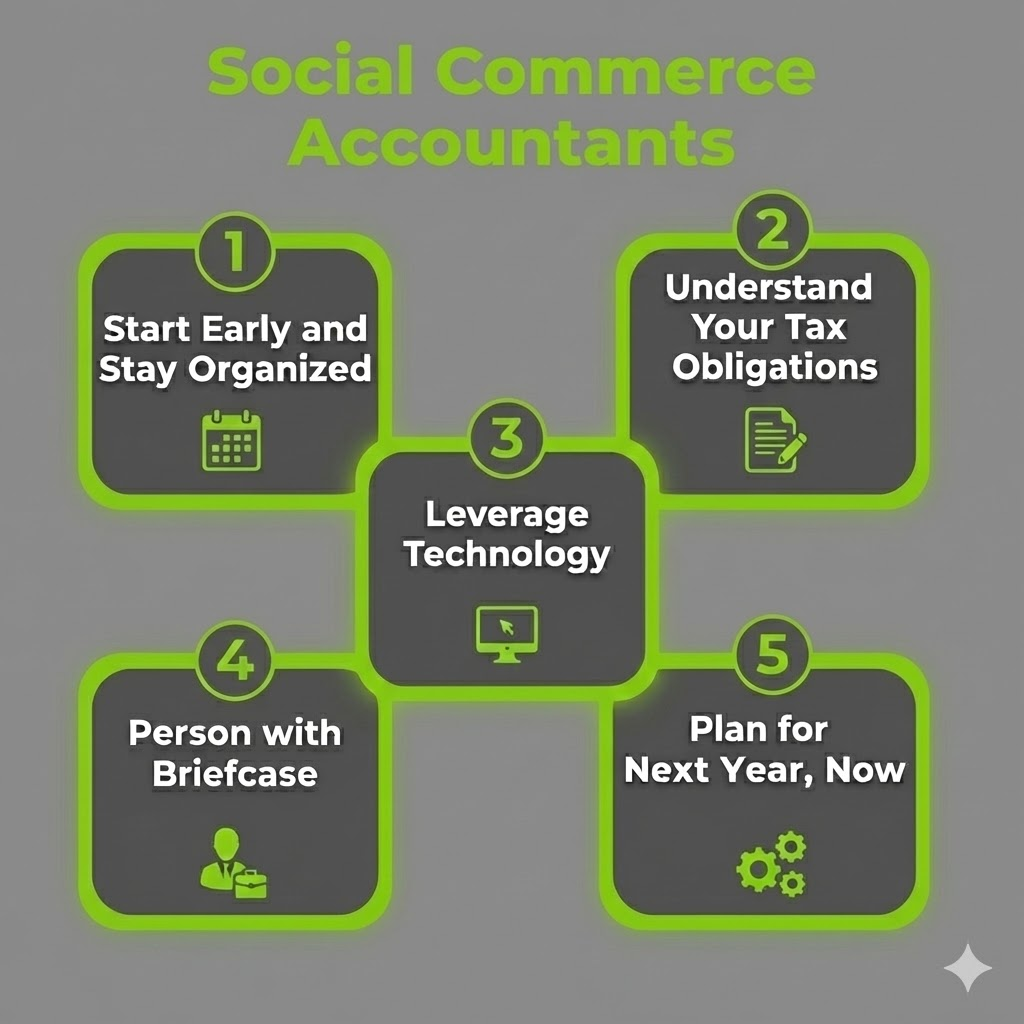
- Get Specialist Advice Early: Engage a specialist e-commerce accountant before you start selling internationally or cross the VAT threshold. Retrospective fixes are always more expensive than proactive setup.
- Document Inventory Valuation: Maintain clear records showing how you calculate landed costs and inventory valuation at year-end. This is a common focus area during UK tax authority audits.
- Separate Business Finance: Never mix your business and personal expenses. Use dedicated business bank accounts and credit cards.
- Keep MTD Compliant: Ensure your accounting system is compliant with the UK tax authority's Making Tax Digital (MTD) rules for VAT filing.
- Review Tax Structure: As your profits grow, ask your accountant to review your business structure (sole trader vs. limited company) to ensure you are maximising tax efficiency and taking advantage of beneficial rules like Entrepreneurs' Relief if applicable.
Practical Steps to Switching to a Specialist E-commerce Accountant
Switching your accountant is a straightforward process that involves communicating with your current accountant, authorising the transfer of information, and ensuring a smooth handover of your financial records to your new specialist.
Feeling like your current accountant isn't cutting it? Don't worry, switching is far less daunting than you might think. We make the process seamless for our clients.
- Initial Consultation: Chat with prospective new accountants (like us!). Discuss your business, your current challenges, and your goals.
- Engagement Letter: Once you choose, you'll sign an engagement letter outlining the services and fees.
- Letter of Professional Clearance: Your new accountant will send a 'letter of professional clearance' to your old one. This is a standard professional courtesy and formally requests the transfer of your accounting records.
- Software Setup: Your new accountant will help you set up or migrate your existing software (cloud systems, A2X, and other integration tools) to ensure everything is connected correctly from day one.
Conclusion: Take Control of Your Tax Future
Finding the right Amazon FBA tax partner in the UK is the difference between slow, stressful growth and rapid, compliant scale. Don't let outdated accounting hold back your Amazon FBA empire.
Your business deserves an accountant who speaks the language of modern online commerce, provides clear, actionable advice, and uses cutting-edge technology. It's time to get an accountant who truly understands your business.
Written by Sam Hoye, ACMA, CGMA — Founder, [Social Commerce Accountants]
As a Chartered Management Accountant, I’ve spent years working with businesses to optimise their finances and navigate complex tax landscapes. Founding this specialist e-commerce accounting firm was a direct response to the glaring need for expert support for online sellers, particularly those on platforms like Amazon FBA. We see firsthand the common pitfalls and the massive opportunities. Our methodology revolves around proactive advice, leveraging best-in-class technology like A2X and other leading cloud systems, and providing clear, jargon-free guidance. We operate strictly in line with official UK tax authority guidance and relevant UK legislation, ensuring all advice is compliant and accurate. For instance, our approach to international VAT for Amazon FBA sellers is built upon official UK tax authority documentation regarding imports and exports, as well as specific guidance on selling goods to the EU post-Brexit. We don’t speculate; we rely on authoritative sources to keep your business safe and profitable.
FAQ
Is Amazon FBA Income Taxed Differently in the UK?
No, Amazon FBA income is taxed using the same UK rules as any other business income, but the calculation of taxable profit is significantly more complex due to international VAT rules, intricate inventory movements, and high transaction volumes.
What are the main tax compliance challenges for UK Amazon Sellers?
The main tax compliance challenges include managing complex international VAT rules, accurately tracking and valuing inventory including freight and duties, and deciphering Amazon's complex settlement reports for correct profit calculation.
How do you accurately calculate COGS for Amazon FBA?
Accurate COGS calculation requires specialist accounting software to capture every cost associated with getting the product ready for sale, including freight, customs duty, quality control, prep fees, and marketplace commissions.
What to look for in a tax expert for Amazon FBA in the UK?
Prioritise tax experts with demonstrable experience in Amazon's ecosystem, proficiency with relevant software like cloud accounting tools and A2X, a deep understanding of international VAT, and a modern, proactive communication style.
This guide is not financial advice. All content is for educational purposes only. Please consult a qualified accountant or financial advisor to discuss how these strategies apply to your specific business circumstances before making any financial decisions.