
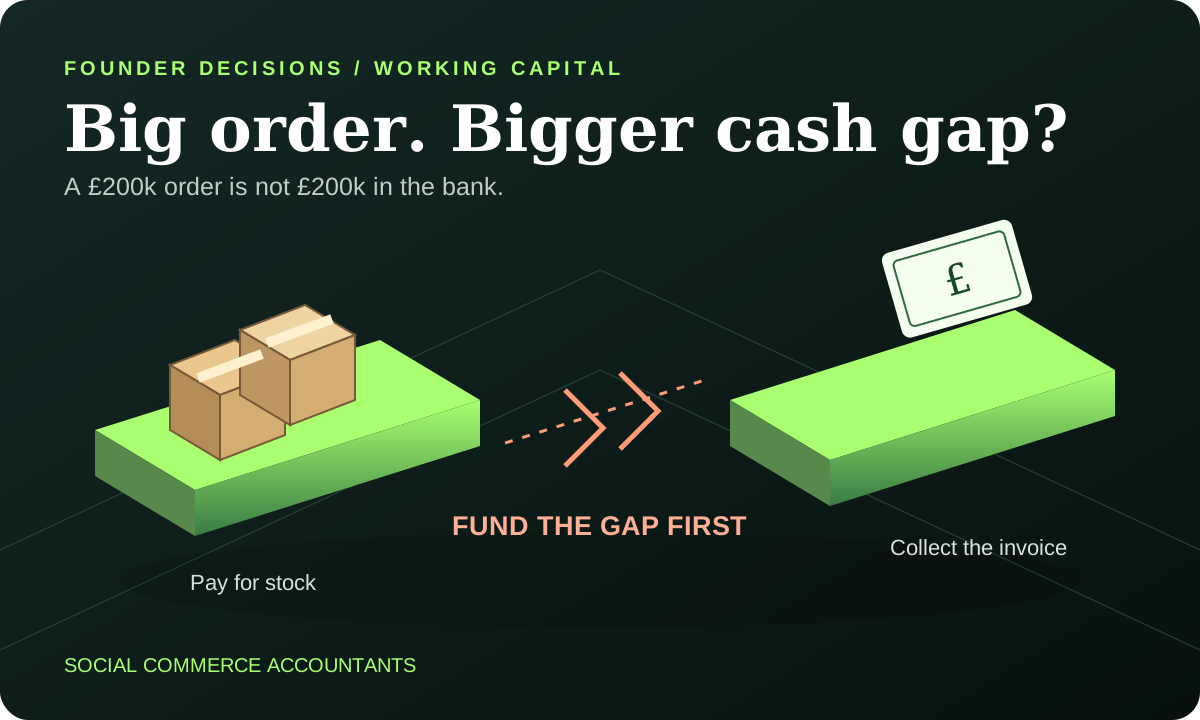
A large wholesale order is affordable only if you can fund its lowest cash point without starving the rest of your business. Calculate every payment from the first supplier deposit to the retailer's actual collection date, reserve the cash needed for existing commitments, and stress-test a late receipt. A profitable purchase order is not cash in the bank.
For a £1m–£20m brand selling through Shopify, Amazon or TikTok Shop, the tempting question is: “Will this retailer make us bigger?” The useful question comes first: “Can we deliver this order and still fund the business we already have?”
This guide is about accepting one large order, not choosing wholesale over DTC. Compare channel contribution separately; here, we turn an order into a dated cash decision.
Why a £200,000 order can leave a £75,000 hole
The British Business Bank explains the underlying problem: a business can secure a large customer order before it has the funds to pay the supplier. The size of the sale does not remove the timing gap.
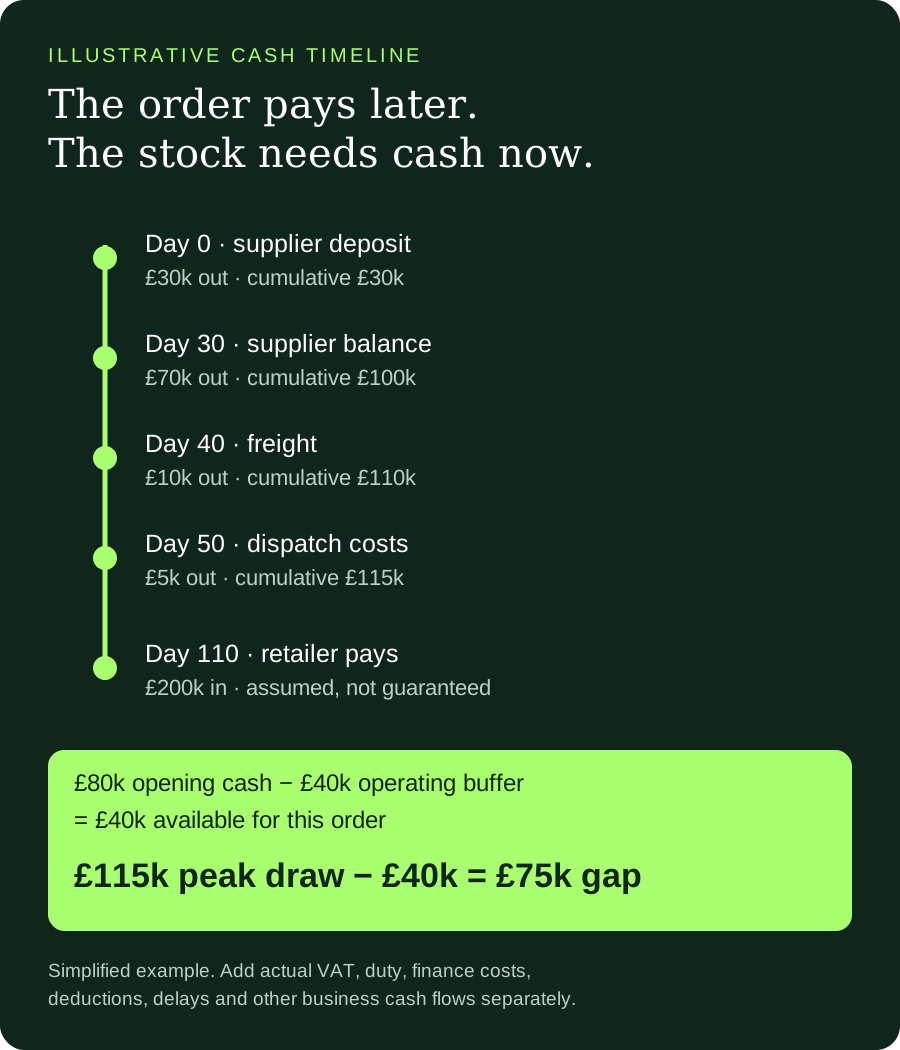
Illustrative example, not a client result: a retailer orders £200,000 of goods. The supplier requires £30,000 on order and £70,000 before shipment. Freight costs £10,000 and preparation and delivery cost £5,000. The retailer pays 60 days after accepted delivery on day 50, so the assumed collection date is day 110.
Model boundary: these are simplified cash amounts for the order alone. VAT, duty, financing charges, currency movements and additional operating costs are excluded. This is not a complete funding quote or tax calculation. Add the actual gross payments, tax settlements and other costs on their real dates before making a decision.
| Day | Event | Cash movement | Cumulative order cash |
|---|---|---|---|
| 0 | Supplier deposit | −£30,000 | −£30,000 |
| 30 | Production balance | −£70,000 | −£100,000 |
| 40 | Freight | −£10,000 | −£110,000 |
| 50 | Preparation and delivery | −£5,000 | −£115,000 |
| 110 | Retailer payment | +£200,000 | +£85,000 |
The order needs £115,000 before any retailer cash arrives. The eventual £85,000 surplus is before the excluded costs above and is not net profit.
Now suppose the brand has £80,000 in the bank, but its existing forecast shows £40,000 must remain available for payroll, tax, other suppliers and the operating buffer. That leaves £40,000 available for this order. The additional funding gap is £115,000 − £40,000 = £75,000. Using the entire bank balance would hide that shortfall by borrowing from commitments the business already has.
Start the clock before the invoice
“60-day terms” does not necessarily mean a 60-day funding requirement. In this example, the first cash leaves on day 0 and the receipt arrives on day 110. The agreement may start the payment clock at invoice date, accepted delivery, a monthly cut-off or another event. Read the actual terms rather than translating the headline into your preferred date.
Build the timeline from evidence: the purchase order, supplier quotation, deposit schedule, production lead time, freight booking, delivery requirements, invoicing rules and expected receipt date. Record who has confirmed each assumption. A buyer saying “finance normally pays quickly” is not a substitute for a clear payment process.
For existing stock, distinguish sunk purchase cost from new cash required. Stock already paid for may reduce this order's immediate cash requirement, but using it can bring forward the next replenishment payment or remove availability from your direct channels. Model that knock-on payment rather than pretending the inventory is free.
Run three versions before saying yes
- Base case: agreed quantities, quoted costs and the expected receipt date. This is your starting assumption, not a promise.
- Late-payment case: move the retailer receipt one payment cycle later. In the simplified example, a 30-day delay leaves the order-only peak at £115,000, but keeps that money tied up until day 140. Extra finance charges and continuing business commitments can increase the whole-business requirement.
- Deduction and repeat-order case: reduce the expected receipt by plausible disputed deductions and add the next stock commitment before the first invoice is collected. Use the account's actual proposed terms and your replenishment plan, not a made-up industry percentage.
For example, a hypothetical £10,000 deduction cuts the final order-only surplus from £85,000 to £75,000. It does not change the £115,000 already paid out. If a second £30,000 supplier deposit becomes due before the first retailer payment, the combined order exposure rises to £145,000 before any other changes. That is why a successful repeat order can deepen the cash gap.
Change the deal before choosing the finance
Once the gap is visible, there are more options than “accept” or “reject”. Put each proposed change back into the same timeline:
- Customer deposit: an agreed £40,000 deposit paid on day 0 reduces the example's peak order cash draw to £75,000 and the additional funding gap to £35,000, assuming the remaining £160,000 is collected on day 110.
- Smaller first order: recalculate the real minimum production run, freight and preparation costs. Do not assume every cost halves when quantity halves.
- Staged delivery and invoicing: useful only if the earlier cash actually arrives before later commitments. Multiple invoices with one final payment date do not solve the timing problem.
- Supplier credit: move only payments the supplier has genuinely agreed to defer. Check whether the new due date still falls before customer collection.
- External funding: compare eligibility, availability date, fees, repayment timing, security and guarantees against the whole-business downside case. Do not count an application as available cash.
The British Business Bank also describes purchase-order and invoice funding. They solve different timing problems. The relevant question is whether an actual facility will cover your cash deficit when it occurs, at an acceptable total cost, not whether a product name sounds suitable.
Make the acceptance decision with five numbers
- The order's contribution after all account-specific costs and expected deductions.
- The peak incremental cash requirement, with dates.
- Cash genuinely available after existing commitments and your operating buffer.
- The downside funding gap if collection is late and replenishment overlaps.
- The cost and confirmed availability of any funding needed to bridge that gap.
Where you need support evaluating the funding and operating implications, consider fractional CFO support. Give the decision an owner and a condition: “Accept only once the deposit is received and the remaining funding is confirmed,” for example. Record unresolved terms rather than assuming them away. A spreadsheet showing a positive final balance is not approval to spend cash you do not yet have.
Keep this order model inside the whole-business cash forecast, not in a separate spreadsheet nobody reconciles. After delivery, compare actual supplier payments, deductions and collection dates with the accepted plan. That turns the next retailer negotiation into an informed decision rather than another leap of faith.
Bring the order, not just the sales target
If the wholesale opportunity looks exciting but your accounts cannot show the real margin, stock cost or cash available, fix that information before making a commitment. Bring the purchase order, proposed terms, supplier payment schedule and current cash forecast to Unfck Your Books. Social Commerce Accountants works with established ecommerce brands to make their numbers usable, not merely filed.
Prepared by Social Commerce Accountants editorial with AI assistance. The numerical examples are synthetic and independently checked; they are not a personalised financing recommendation or a claim of human professional review.