
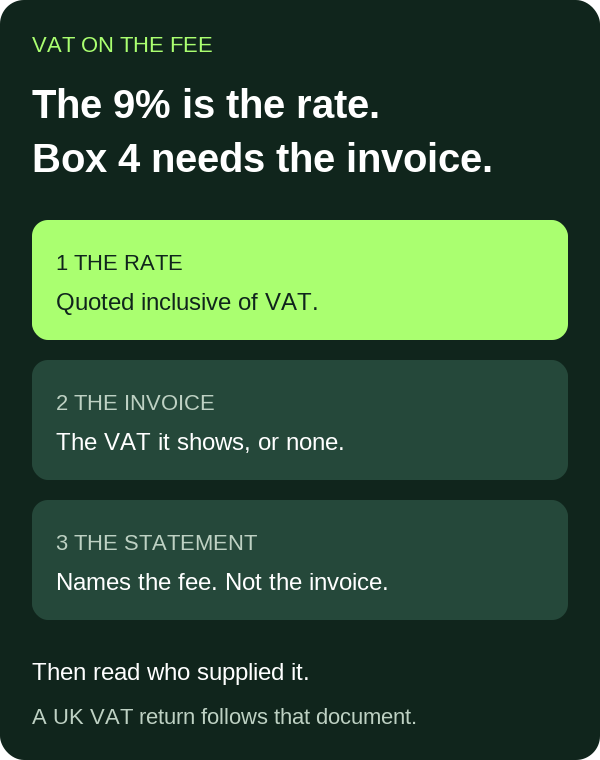
A VAT-registered UK seller puts a TikTok Shop platform fee on the VAT return in one of two ways: box 4 takes the UK VAT shown on a valid VAT invoice, where the input-tax conditions are met, or you account for the VAT yourself where the supplier belongs outside the UK and the reverse charge applies. TikTok states the commission rate as inclusive of applicable taxes, including VAT, which is how the rate is quoted. The statement line is not the VAT invoice.
This page is that fee and that return. The TikTok Shop VAT guide is the wider VAT page. The fee reconciliation guide is how the lines land in the books. Creator commission is a separate deduction, with its own month-end in the creator commission reconciliation.
What does “inclusive of VAT” refer to?
The current UK Seller Terms of Service were last updated on 30 September 2026. The academy page that carries them was updated on 4 November 2026. Clause 12.2 says that, unless the terms or the TikTok Shop policies specify otherwise, the Fees are inclusive of VAT, GST, service tax, consumption tax and any other applicable taxes that arise in the country or region where TikTok Shop provides the relevant services. The terms call those taxes on fees. The same clause says the Fees are exclusive of any taxes you are required to withhold or pay where you operate, and that you agree to receive invoices and receipts electronically for the Fees.
Clause 11.1 defines the Fees as the fees for use of TikTok Shop. For orders sold to customers in the United Kingdom, the commission rate is the rate in the TikTok Shop UK Commission Rate Policy. That policy is dated 18 September 2025. It says the commission fee rate is currently 9% before incentive reductions. Specified Electronics and Beauty and Personal Care categories are subject to a reduced effective rate of 5%. Only one reduction applies to a product at a time. A full return refunds the full commission fee. A partial refund refunds the commission on the refunded items.
The Platform Commission Fee page, updated 15 September 2025, states that the commission fee rate, inclusive of applicable taxes, including but not limited to VAT, is 9%. Its FAQ says the rates stated on that page include applicable taxes, including VAT. The shoe example on that page is a 9% charge on a £95 base, which is a commission of £8.55. The page does not split £8.55 into a net amount and VAT. It also says its screenshots are mock-ups and that the actual interface and rates are different. The rate on the invoice and the statement is the rate you use.
The Introduction to Seller Fees, updated 22 August 2025, uses the same inclusive wording for the 9% platform commission. Clause 2.3 of the current terms says those terms prevail over the TikTok Shop policies if the documents conflict.
Clause 12.3 is the tax on the sale. You calculate, collect and pay the taxes on the sale, and you issue a valid tax invoice to the customer, unless TikTok is obliged to do that. The tax inside the platform fee and the tax on the customer’s order are different charges.
| Wording | What the document covers |
|---|---|
| Taxes on fees, clause 12.2 | VAT and the other taxes listed, arising where TikTok Shop provides the services, included in the Fees unless a term or policy says otherwise |
| Taxes you withhold or pay where you operate, clause 12.2 | Excluded from the Fees |
| Taxes on the sale, clause 12.3 | The customer’s order, which you account for unless TikTok is obliged to |
| The statement line “TikTok Shop commission fee” | The fee amount, in the Fees group. The page that names it says the screenshots are mock-ups |
Is affiliate commission inside that 9%?
Affiliate commission is a separate deduction. The 22 August 2025 fee introduction lists it beside TikTok Shop commission, with its own formula: the commission rate times (product price, minus seller discount, minus platform discount). That row does not repeat the inclusive-of-VAT sentence.
Clause 13.13 of the current terms says a portion of the customer payment is deducted and paid to creators, as fees you owe the creators under your agreement with them, and to partners on the same pattern. Clause 12.5 says you, the creator or partner, or both, rather than TikTok, are responsible for reporting and paying the withholding and other taxes on your procurement of those services, unless TikTok is obliged to deduct or withhold them.
A reclaim on a creator’s charge uses the evidence for that creator’s supply. The platform-fee invoice is the document for the platform fee.
Which document can support a reclaim?
GOV.UK says you cannot reclaim VAT using an invalid invoice, a pro-forma invoice, a statement or a delivery note. You cannot claim more VAT than is shown on a valid VAT invoice. If the amount to pay is wrong, you ask the supplier to correct it and issue a new invoice. If you pay less than the amount due, you reclaim the VAT on the amount you paid.
The platform commission page says sellers receive an invoice the following month for the previous month’s billing period, downloaded from Finance, then Invoice Centre, Platform Service Fee. It says those screenshots are mock-ups and the actual interface differs. The terms say you agree to receive invoices and receipts electronically for the Fees. The statement names the fee. The invoice is what you test against the VAT invoice rules.
Notice 700 says a VAT invoice shows a unique number, the tax point, the issue date where it differs, the supplier’s name, address and VAT number, the customer’s name and address, a description, the amounts excluding VAT, the VAT rate, and the total VAT in sterling. A simplified invoice is available where the supply is £250 or less and the customer agrees. Where the supplier is based in Northern Ireland, the customer must not be in an EU member state. The simplified invoice shows the supplier’s name, address and VAT number, the tax point, a description, and, for each VAT rate, the total payable including VAT and the rate. Where that simplified invoice does not show the VAT separately, the input tax is the VAT fraction of the total for a standard-rated supply, using the fraction for the rate in force at the tax point. A statement is not that invoice.
What does HMRC let you reclaim?
You can reclaim VAT on items you buy for the business if you are VAT-registered. You do it on the VAT return. Where a purchase is also for personal use, you claim the business proportion and you keep the record of how you worked it out. You hold valid VAT invoices.
Notice 700 describes input tax as the VAT you are charged on business purchases, including goods and services supplied to you in the UK and services supplied in the UK which you receive from abroad. You can normally reclaim input tax that relates to taxable supplies, and zero-rated supplies are taxable. You cannot normally reclaim VAT that relates to exempt supplies, VAT charged incorrectly, or VAT on goods and services not used for the business.
Where the input tax is reclaimable in full, Notice 700 says the amount is the VAT shown on the supplier’s VAT invoice. You deduct input tax from output tax on the return. Notice 700/12 says box 4 is the VAT reclaimed in the period on purchases and other inputs, and that the claim needs a proper VAT invoice, subject to the rules in Notice 700. Box 7 is the value of purchases and expenses, leaving out VAT.
You normally claim on the return for the period of the supplier’s tax point. If you do not yet hold the evidence, you claim on the return for the period in which you receive it. Missing the first return on which you were entitled is an error. Notice 700 says you correct that error using the methods in Notice 700/45, and the time limit is four years from the due date of the return on which you were first entitled to the deduction.
On the Cash Accounting Scheme, Notice 700 says you must also have paid for the supply. For supplies received on or after 1 January 2003, if you have not paid within six months of the date of supply, or of a later due date for payment, you repay the input tax you reclaimed.
GOV.UK calls a business partly exempt when it sells a mixture of taxable and exempt supplies, and says you cannot reclaim VAT on goods and services the business uses to make VAT-exempt supplies.
On the VAT Flat Rate Scheme, GOV.UK says you cannot reclaim the VAT on your purchases, except for certain capital assets over £2,000. Notice 733, last updated 18 December 2025, allows that reclaim on a single purchase of capital expenditure goods of £2,000 or more including VAT, and says no VAT is claimable under that rule where the supply is of services. It says the normal VAT rules decide whether a supply is goods or services. Notice 700/12 says a Flat Rate Scheme business does not normally make a separate input-VAT claim, because the flat-rate percentage includes an allowance for it. The same section says box 4 is still where you account for a reverse charge. TikTok describes the commission as a fee charged for sellers’ use of the platform.
When does the reverse charge apply instead?
The current terms name the entity providing TikTok Shop as TikTok Information Technologies UK Limited, company 10165711, registered office Kaleidoscope, 4 Lindsey Street, London, EC1A 9HP. Companies House records that company as active, at that registered office. Clause 11.2 authorises TikTok to instruct Stripe Payments UK Ltd and Stripe Payments Europe Limited to withhold the Fees from the amount the customer paid and remit those amounts to TikTok.
Notice 741A says a registered office alone is not sufficient to create a business establishment. You belong in the UK for a supply of services when you have a business establishment in the UK and no fixed establishment elsewhere that is more closely connected with the supply, or a business establishment outside the UK with a fixed establishment in the UK that is most directly connected with the supply, or no establishment anywhere and your usual place of residence in the UK. The company number identifies the contracting company. The supplier named on the invoice is the supplier you test.
Notice 741A applies the reverse charge where the place of supply is the UK, the supplier belongs outside the UK, you belong in the UK, and the supply is not exempt. For a supply outside the general rule, you also have to be VAT-registered in the UK. It applies even where that overseas supplier has a UK VAT number. It does not apply where you and the supplier both belong in the UK. It applies where the services are supplied in the UK by a supplier who belongs overseas.
Where it applies, you credit the VAT account with output tax on the full value and debit the input tax the normal rules allow. Notice 741A puts the output tax in box 1, the input tax in box 4, and the full value in box 6 and box 7. If that input tax relates to taxable supplies and is reclaimable in full, the reverse charge has no net cost. If it does not, including where you make exempt supplies, you pay VAT on the supply at the UK rate.
The amount you pay an overseas supplier excludes UK VAT. The value on which you add VAT is the total paid, including any taxes levied abroad. GOV.UK’s short page on services from abroad says you convert that value into sterling, calculate the VAT, and credit and debit the VAT account, with nothing to pay unless the business is partly exempt. The same page lists services that follow different rules, including electronically supplied services. The invoice shows the supplier. Notice 741A is the test for which rule applies.
If the reverse charge applies and the supplier still issues a VAT invoice on a UK VAT registration, Notice 741A says you still apply the reverse charge, and you ask the supplier to correct the invoice.
What do the boxes show on one illustrative month?
TikTok’s published shoe example first. Original price £100, seller discount £10, platform discount £10, so net sales are £80. Customer-paid shipping is £5. The platform discount is added back. Refunds are zero. The base is £95 and the commission at 9% is £8.55. Arithmetic: £80 + £5 + £10 = £95, and £95 × 0.09 = £8.55. The page does not show the VAT inside £8.55.
Synthetic month, labelled as such. One platform-fee invoice totals £1,200. The same month’s statement also shows £480 of affiliate commission. The £480 sits outside the £1,200, and this example calculates no VAT on it. £1,200, £200, £240 and £480 are made up. They are not the shoe example and not a fee schedule.
| A. UK VAT shown on the invoice | B. Reverse charge | |
|---|---|---|
| Assumption | A valid VAT invoice shows £200 of UK VAT. The supplier belongs in the UK. The input tax is reclaimable in full. The Flat Rate Scheme is not in use. | The supplier belongs outside the UK. The reverse-charge conditions are met. £1,200 is the amount paid and it excludes UK VAT. The input tax is deductible in full. |
| VAT on the fee | £200, which is £1,200 ÷ 6 | £240, which is £1,200 × 20% |
| Box 1 | No entry from this fee | £240 |
| Box 4 | £200 | £240 |
| Box 6 | Sales. This purchase does not go here. | £1,200 |
| Box 7 | £1,000 from this fee, the value excluding VAT | £1,200 |
| Net VAT on this fee | A £200 reclaim. Net cost £1,000. | £0 |
GOV.UK states the standard rate is 20%, and that it has been 20% since 4 January 2011. Notice 700 works the fraction at 20% as one sixth, because 20 ÷ 120 = 1/6. Its own illustration is a £2.40 price that contains 40p of VAT. Column A uses one sixth because the illustration assumes the invoice shows £200 of UK VAT on a standard-rated supply. An invoice that shows a different figure uses the figure it shows. Column B adds 20% to an amount that already excludes UK VAT, which is the value rule in Notice 741A. £240 is not one sixth of £1,200.
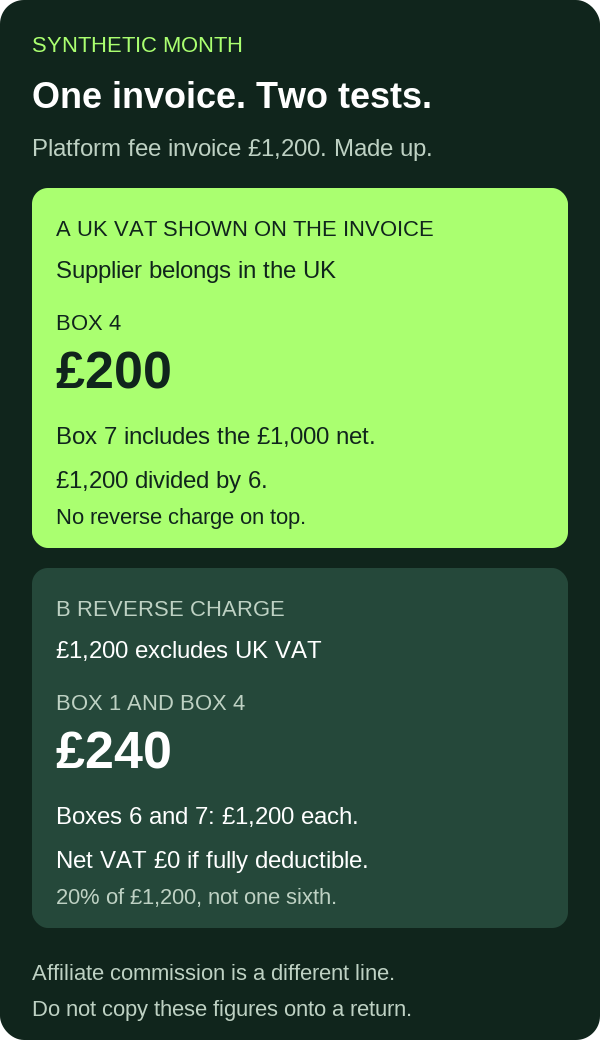
Leave £1,200, £200, £240 and £480 off the return. They are not TikTok’s rate card and not a client result. £8.55 is the commission in TikTok’s shoe example, and that page does not split it into VAT. A live month uses the invoice for that month, including a 5% category rate where the policy gives one.
What do you check before the figure goes on the return?
- Download the invoice for the Fees. The platform commission page points to Finance, then Invoice Centre, Platform Service Fee, for the invoice issued the following month, and it says the live screen can differ. The statement line “TikTok Shop commission fee” is the name of the fee.
- Read the supplier, the VAT number, the tax point, the VAT rate and the VAT in sterling. Those are items Notice 700 requires on a VAT invoice. A simplified invoice has its own, shorter list, and the £250 limit.
- Reclaim the VAT shown, where the input tax is deductible in full. You cannot claim more than the invoice shows, and you cannot use a statement, a pro-forma or a delivery note.
- Use the return for the tax point, or the return for the period you receive the evidence. Notice 700 sets that timing, the four-year correction limit, the cash-accounting payment rule, and the six-month repayment rule.
- If you are on the Flat Rate Scheme, do not make a separate input-VAT claim for an ordinary purchase. Notice 733’s separate reclaim is a single purchase of capital expenditure goods of £2,000 or more, and no VAT is claimable under that rule where the supply is of services. A reverse charge is still accounted for in box 4.
- If the supplier belongs outside the UK and the reverse charge applies, add VAT to the amount paid. That amount excludes UK VAT and includes taxes levied abroad. Boxes 1, 4, 6 and 7 all move. A UK VAT number on the invoice does not remove the charge.
- Keep affiliate commission off the platform-fee invoice. It has its own formula, and the terms treat it as a payment to the creator.
- Read the live rate. The policy states 9% before reductions and an effective 5% for the named categories. The commission page says the mock-up rates differ from the live rates.
Frequently asked questions
Does “inclusive of VAT” mean one sixth of the 9% goes in box 4?
The 9% sentence quotes the rate. Box 4 takes the deductible VAT shown on a valid VAT invoice. Notice 700 uses the one-sixth fraction where VAT at 20% is already included and the invoice does not show it separately, which is the simplified-invoice case, not a settlement line. In the synthetic month, one sixth of £1,200 is £200, and that is column A only.
Is the statement line a VAT invoice?
The platform commission page tells you to find the amount under “TikTok Shop commission fee”, in Fees, on the statement, and to download an invoice the following month. GOV.UK says a statement cannot be used to reclaim VAT.
Does the London registered office decide the reverse charge?
The terms name TikTok Information Technologies UK Limited and a London registered office, and Companies House shows that company as active at that office. Notice 741A says a registered office alone is not a business establishment. The supplier on the invoice is the one you test. Where that supplier belongs outside the UK and the conditions are met, the reverse charge applies even if the invoice carries a UK VAT number.
Is creator commission inside the platform fee?
Creator commission is deducted separately and paid to the creator. The fee introduction gives it a different formula, and clause 12.5 puts the tax reporting for those services on you, the creator, or both, unless TikTok is obliged to withhold. The platform-fee invoice does not do that job. The month-end for the creator line is the creator commission reconciliation.
Where do you take the invoice?
Put the invoice next to the statement and complete the checklist before the fee reaches box 4. TikTok Shop accounting is the ongoing work for the channel, including the settlement and the VAT on a spike. Where the invoice and the statement will not tie, Unfck Your Books is the clean-up. The two neighbouring pages are the wider TikTok Shop VAT guide and the fee reconciliation.
Prepared by Social Commerce Accountants editorial with AI assistance. The £1,200 month is synthetic and the arithmetic is checked. TikTok’s shoe example is quoted from its academy page. This is not a claim of human professional review or personalised tax advice.