
In 2026, the gap between "selling stuff online" and running a profitable brand has never been wider. The algorithms are smarter, the competition is fiercer, and the tax man is sharper.
If you are scaling a brand on TikTok Shop, Amazon, or Shopify, your financial data cannot be a rearview mirror exercise. You need real-time clarity.
Yet, most founders are still drowning in spreadsheets or relying on generalist accountants who think a "settlement report" is something legal. This guide breaks down exactly how a specialist ecommerce accountant operates differently and why your financial infrastructure is the only thing standing between you and sustainable growth.
Traditional vs. Specialist Ecommerce Accountant: What’s the Difference?
Let’s be honest. Most high street accountants are brilliant at what they do—for local cafes, tradespeople, and consultants. But when you hand them a CSV export from Amazon Seller Central or ask about VAT thresholds in Germany, you can see the panic set in.
The best ecommerce accountants don’t just file returns; they understand the architecture of online retail.
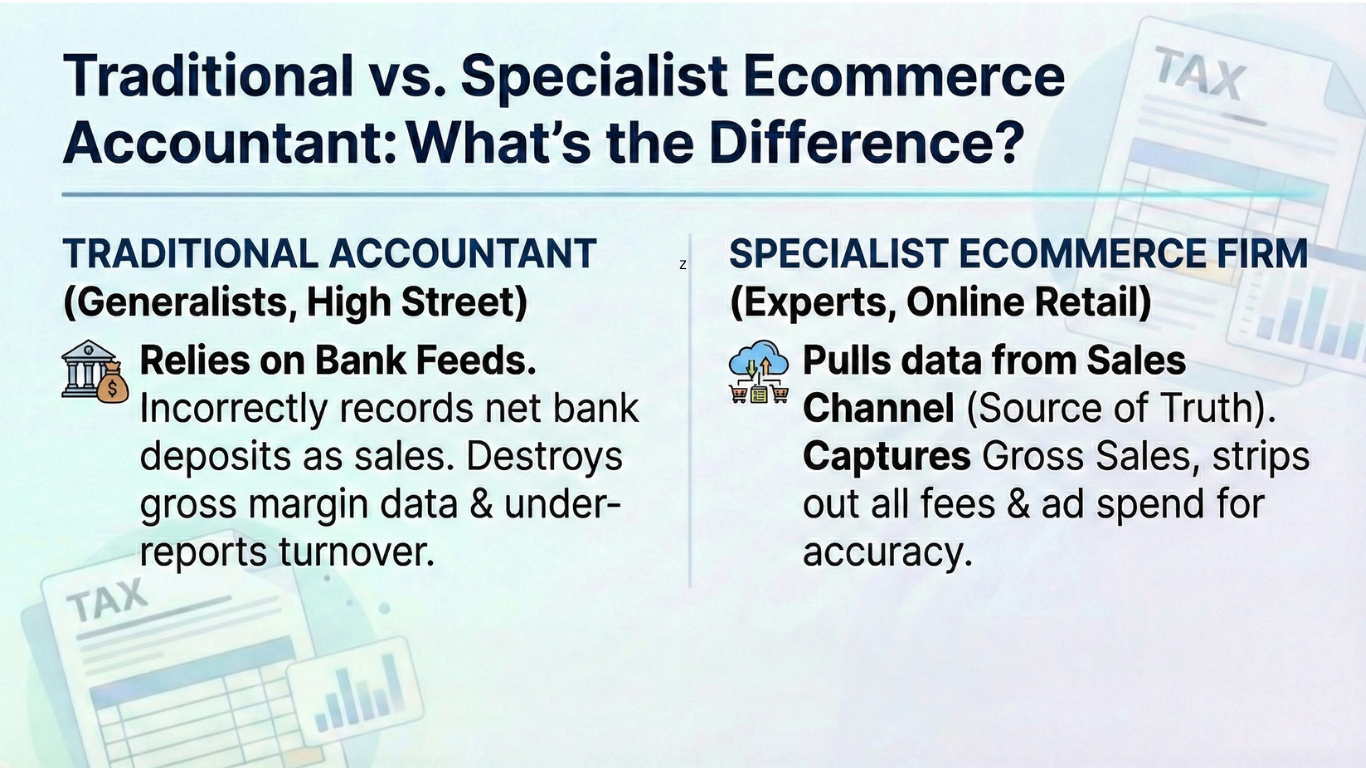
The core Difference:
- Traditional Accountant: Relies on bank feeds. If £5,000 hits your bank from Amazon, they record £5,000 as sales. This is incorrect. That £5,000 is net of fees, advertising, and refunds. Your actual revenue might have been £8,500. This mistake destroys your gross margin data and under-reports your turnover to HMRC.
- Specialist ecommerce Firm: We ignore the bank feed for revenue. We pull data directly from the sales channel (the source of truth) to capture the gross sales, then strip out the platform fees, FBA fees, and ad spend.
What is an ecommerce specialist accountant? An accountant who uses cloud-based technology to integrate sales platforms (like Shopify or TikTok Shop) directly with accounting software (like Xero), ensuring gross revenue, platform fees, and VAT are reconciled automatically rather than manually.
If your accountant asks you to print out invoices for every £2 Facebook ad charge, it is time to move on.
The 2026 Ecommerce Tech Stack: Automation & AI
In 2026, automation isn't a luxury; it is the baseline. An ecommerce accounting firm worth its salt will not be manually typing data. We build stacks that talk to each other.
The Standard Stack:
- The Hub: Xero (still the gold standard for UK integration).
- The connector: A2X or Link My Books. These tools sit between your shop and Xero. They turn messy payout files into neat summary journals.
- The Inventory: Cin7 or similar for serious multi-channel stock management.
The Seller Economy Gap However, here is the reality check for 2026 that most software companies won't tell you. If you are an online seller, channel, or seller purely on TikTok Shop or similar platforms, the integration software doesn't really exist yet.
While standard sellers have A2X, online sellers dealing with channel fees often face a data black hole. The platforms provide terrible PDF summaries that don't sync with Xero.
What this means for you: If you are a ecommerce-led business, do not assume there is an "app for that." You need an accountant who can handle high-volume data cleaning manually or via custom scripts until the software market catches up. We have to get our hands dirty here because the API connections just aren't there for the channel side of the equation.
Mastering Multi-Channel Revenue (Shopify, Amazon, & TikTok Shop)
Accounting for ecommerce business operations becomes a headache when you sell on multiple channels.
The biggest pitfall is the "Cash Trap."
- Shopify pays out daily or weekly (depending on your gateway).
- Amazon pays out every two weeks (usually).
- TikTok Shop holds cash for significantly longer periods, especially for new sellers or during high-volume spikes.
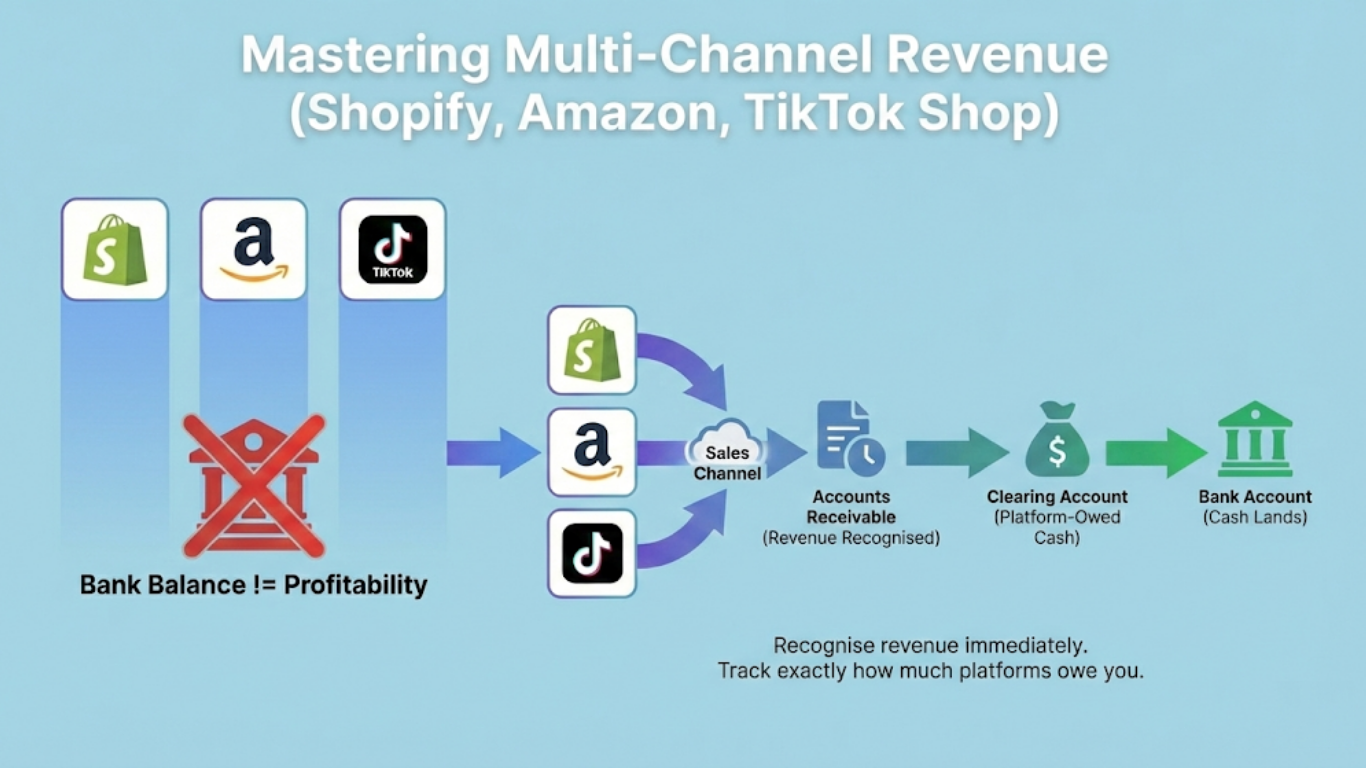
If you look at your bank balance to judge profitability, you will fail. You might have sold £20k of stock on TikTok, but the cash won't land for 30 days. Meanwhile, your supplier needs paying today.
The Specialist Approach: We use "Clearing Accounts" in the balance sheet. When a sale happens, we recognise the revenue immediately (accrual accounting), increasing your "Accounts Receivable." When the cash lands, we clear that balance. This shows you exactly how much money the platforms owe you at any given moment.
Navigating International Tax & VAT in 2026
If you are purely UK-based, keeping an eye on the £90,000 VAT threshold is day one stuff. But ecommerce scales globally fast.
Key VAT Challenges:
- EU Sales (IOSS): Since Brexit, selling to Europe requires the Import One-Stop Shop (IOSS) scheme if you want to avoid customers getting hit with customs charges at the door.
- US Nexus: If you start hitting decent numbers in the US (via Amazon FBA US), you may trigger "Economic Nexus" in specific states. You might need to collect sales tax in California or Florida even if you have no physical presence there.
Bookkeeping for ecommerce must track the destination of goods, not just the total value. A generic bookkeeper will code everything as "Sales." We code it based on jurisdiction so we know when you are approaching a tax threshold in a foreign country.
Beyond Bookkeeping: The "Fractional CFO" Approach
Bookkeeping is history; strategy is the future. Once your revenue hits the six or seven-figure mark, basic compliance isn't enough. You need a Fractional CFO.
This is where we transition from "counting beans" to "growing the crop."
We look at:
- Contribution Margin: Revenue minus Cost of Goods Sold (COGS) minus Pick & Pack minus Ad Spend. This number tells you if a product is actually viable.
- Inventory Forecasting: We analyse your sales velocity to predict exactly when you need to reorder stock for Q4, factoring in the 3-month lead time from China.
- Cash Flow Management: Can you afford that new online seller campaign? We model the scenarios.
The Bottom Line In 2026, your finance function should be a profit centre, not a cost centre. Whether you are a solo seller navigating the lack of software integrations or a multi-channel brand expanding to the US, you need an ecommerce accounting firm that speaks your language.
At Social Commerce Accountants, we don’t just file taxes; we help you keep the profit you work so hard to generate.
What Can We Do For You Next?
If you are worried that your current setup is leaking profit or you are struggling to reconcile your seller income, let’s have a chat. We can run a free financial health check on your current Xero setup to spot immediate red flags.
This guide is not financial advice. All content is for educational purposes only. Please consult a qualified accountant or financial advisor to discuss how these strategies apply to your specific business circumstances before making any financial decisions.