
Founder Decisions / Growth & Marketing
Your advertising is working. Sales are growing, ROAS looks healthy, and your agency wants to increase the budget by another £50,000 a month. Should you approve it?
Only if that additional spend is expected to generate more contribution than it costs.
The mistake is assuming that because your existing £100,000 advertising budget produces a 3.5x ROAS, the next £50,000 will perform the same way.
It might. It might perform better.
But it could also generate plenty of additional revenue while contributing almost nothing to profit.
For a founder running a £1m-£20m ecommerce brand, the decision isn't simply whether to spend more. It's whether the next investment should go towards buying more traffic, producing better advertising creative, improving conversion or building a marketing operation that no longer depends entirely on the founder.
Those decisions need different financial calculations.
Let's work through them.
Your Existing ROAS Doesn't Tell You What the Next £50k Will Earn
Imagine you're running a £5m ecommerce brand selling through Shopify, Amazon and TikTok Shop.
Your current monthly advertising performance looks like this:
| Metric | Monthly performance |
|---|---|
| Advertising spend | £100,000 |
| Platform-attributed sales | £350,000 |
| Reported ROAS | 3.5x |
| Proposed additional advertising spend | £50,000 |
Your agency recommends increasing the budget because the account is performing profitably.
There's an important distinction here.
Average ROAS measures the relationship between existing advertising spend and attributed sales. Marginal ROAS measures the additional revenue associated with the next increment of spending.
Even then, attributed revenue isn't necessarily incremental revenue.
A customer might click an advert before purchasing a product they were already intending to buy. That sale can appear in an advertising report without the advert having created the entire purchase.
Google distinguishes attributed results from the causal lift measured through Conversion Lift studies, comparing exposed and control groups to estimate what happened because of advertising.
For a financial investment decision, you want to estimate the additional sales that wouldn't otherwise have occurred.
Then you need to calculate what those sales contribute after their associated costs.
Start With Contribution Before Advertising
Before increasing your advertising budget, calculate how much contribution you retain from each additional pound of sales.
For this calculation:
Pre-advertising contribution = Net sales - Variable product and selling costs
Variable costs should include the relevant landed cost of products sold, fulfilment, payment processing, marketplace fees, returns and affiliate commissions.
Use sales net of VAT and after expected refunds. The costs in the calculation should exclude recoverable input VAT. Don't subtract VAT a second time from revenue that's already stated excluding VAT, or deduct a refund again if it has already reduced net sales.
Agency fees, creative production and other additional costs associated with a particular spending decision must also be captured, but separately from the media budget unless they're already included in the contribution calculation.
Suppose our illustrative £5m brand retains 40p of contribution from each additional £1 of net sales before advertising.
The other 60p covers its variable product and selling costs.
That gives us:
Break-even incremental ROAS = 1 / Pre-advertising contribution margin
At a 40% contribution margin:
1 / 0.40 = 2.5x
Every additional £1 of media spending must generate £2.50 of genuinely incremental net sales simply to cover that media cost.
That's the break-even point before any additional creative production, agency charges or fixed operating costs caused by expansion.
The reported 3.5x ROAS might look comfortably above that threshold.
But we're interested in what happens to the next £50,000.
Worked Example: The £50k Advertising Increase That Adds No Profit
Let's model the proposed increase in four spending increments.
The figures below are illustrative assumptions, not actual SCA client data or published industry benchmarks. All figures are monthly and in GBP, excluding VAT. Incremental sales are assumed to be net of refunds and genuinely additional. Contribution uses the variable cost definition above; extra overheads are not assumed.
We assume the extra sales become harder to win as spending increases.
| Additional media spend | Incremental net sales | Marginal ROAS | Contribution at 40% | Profit change after media |
|---|---|---|---|---|
| First £10,000 | £35,000 | 3.5x | £14,000 | +£4,000 |
| Next £15,000 | £45,000 | 3.0x | £18,000 | +£3,000 |
| Next £15,000 | £30,000 | 2.0x | £12,000 | -£3,000 |
| Final £10,000 | £15,000 | 1.5x | £6,000 | -£4,000 |
| Total £50,000 | £125,000 | 2.5x | £50,000 | £0 |
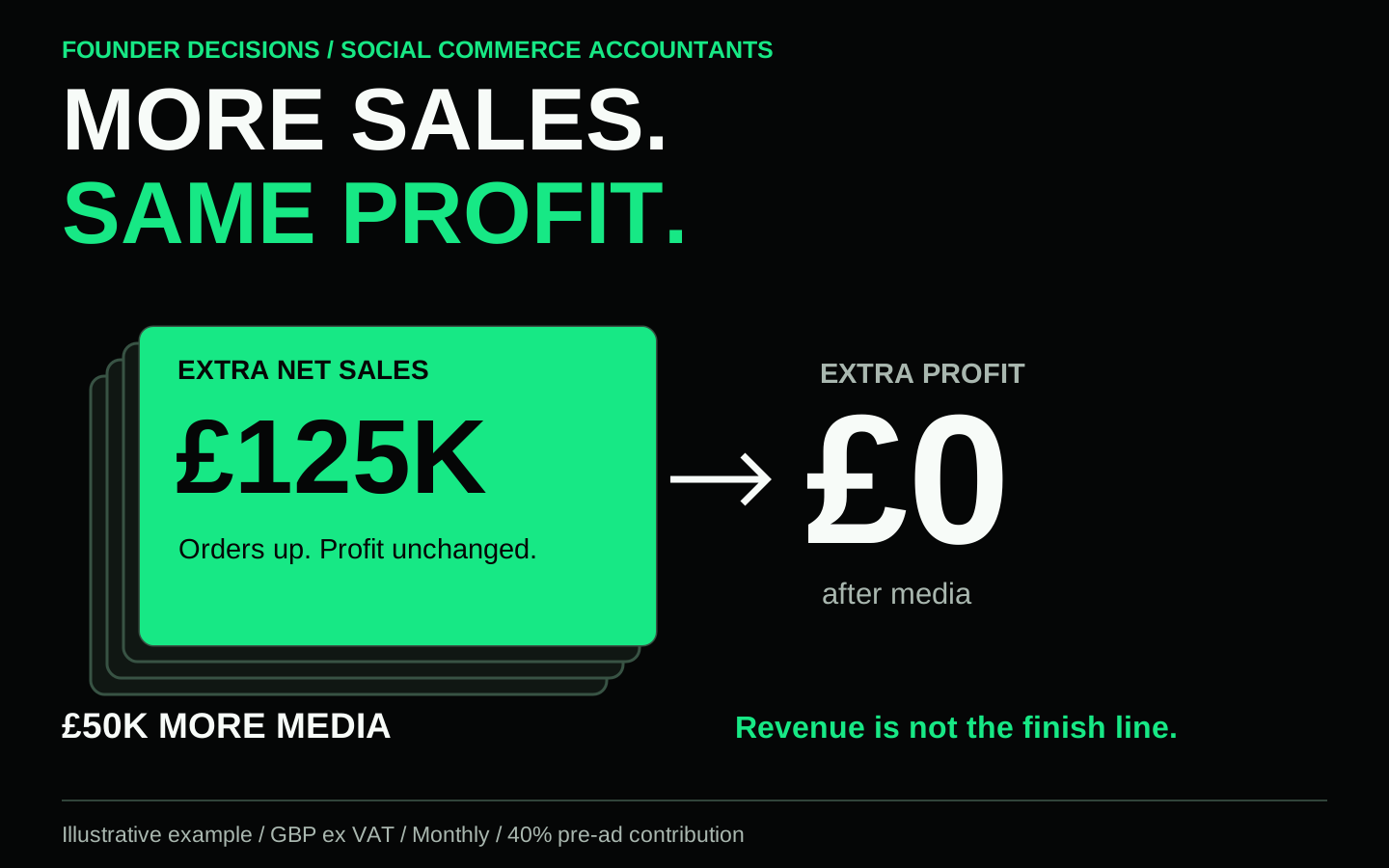
The business spends another £50,000. Revenue increases by £125,000. But incremental profit before any additional creative or overhead costs increases by precisely £0.
If you looked only at revenue, you might celebrate another £125,000 of growth. If you looked only at reported advertising performance, a 2.5x return could still appear acceptable.
But financially, the last £25,000 of additional spending has wiped out the £7,000 contribution generated by the first £25,000.
In this example, spending an extra £25,000 produces £7,000 more profit. Spending the full £50,000 produces none.
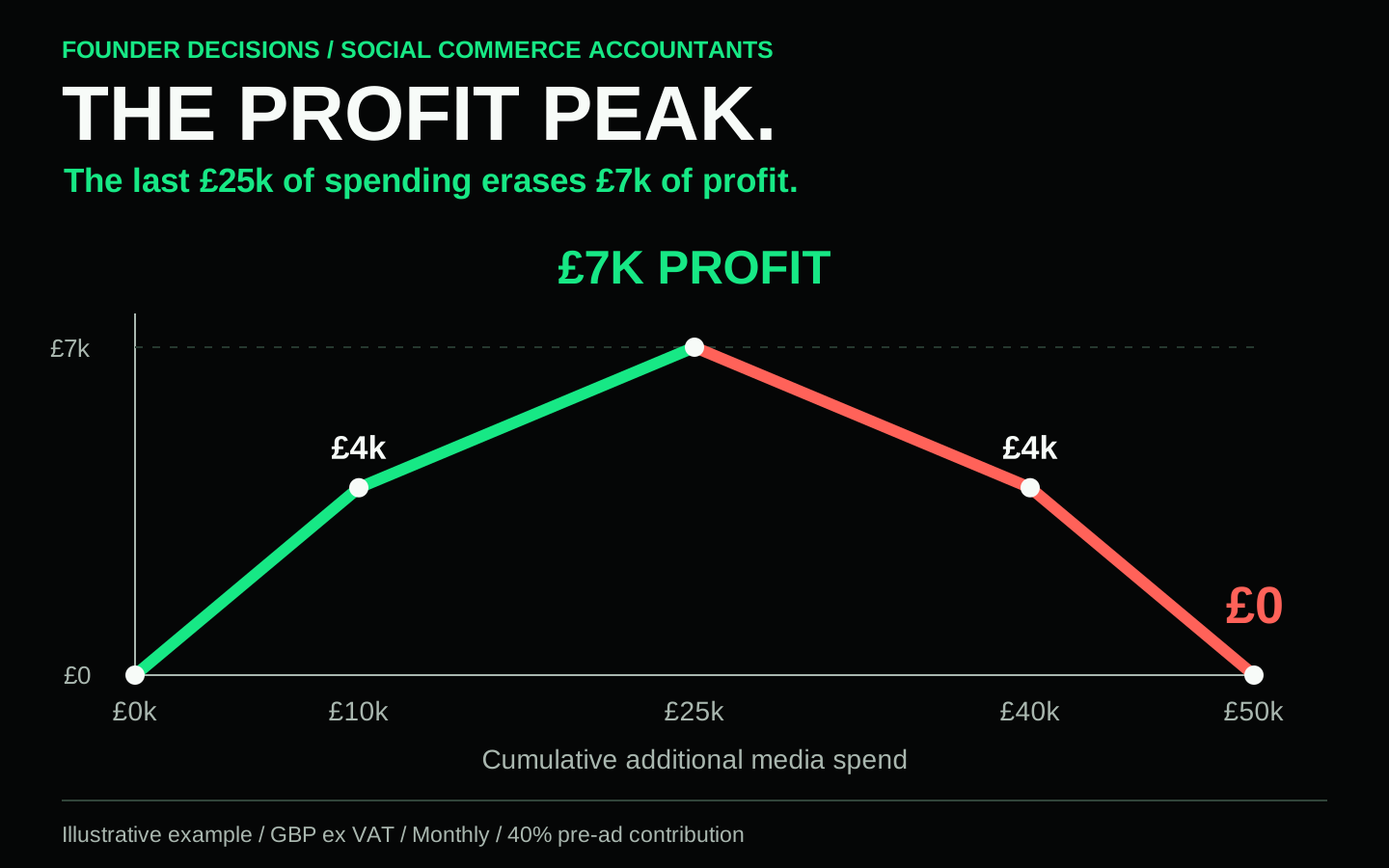
That doesn't automatically mean £25,000 is the perfect budget. Our table assumes a particular response curve, and actual performance could be better or worse.
It does show why approving spending in smaller increments can produce a different answer from approving the entire amount.
What if your contribution margin changes?
Now keep the £125,000 incremental sales assumption but change the margin.
| Pre-advertising contribution margin | Contribution from £125k sales | Profit after £50k media |
|---|---|---|
| 35% | £43,750 | -£6,250 |
| 40% | £50,000 | £0 |
| 45% | £56,250 | +£6,250 |
A five-percentage-point movement in contribution margin changes the result by £6,250.
That's why the product mix matters. A campaign promoting high-margin Shopify products might justify more spend than one generating similar revenue through lower-margin marketplace orders.
Equally, a TikTok Shop promotion involving substantial affiliate commissions may have a different break-even point from an own-store campaign without those commissions. One blended ROAS cannot answer all three decisions.
For a wider explanation of how profitability deteriorates as brands grow, see SCA's guide to profitability at scale.
How Do You Know What the Next £50k Will Actually Deliver?
The figures in the previous example are a forecast. The challenge is obtaining enough evidence to make that forecast credible.
Start with the existing relationship between budget changes and business performance. Look at periods when spending increased or decreased. Identify what happened to net sales, contribution, customer acquisition and returns.
But don't simply compare two months and assume advertising caused the difference. Promotions, seasonality, stock availability, price changes and competitor activity can all affect sales.
For example, increasing advertising spend immediately before Black Friday and observing higher revenue doesn't establish that the advertising caused the whole increase.
Use forecasting tools, then test the assumptions
Google Ads Performance Planner can forecast how changing budgets and campaign settings may affect performance for eligible campaigns. Those forecasts are useful inputs, but they're not substitutes for a contribution model or proof of incrementality.
For larger spending decisions, consider controlled experiments. These might involve comparing eligible campaign variations, running a structured audience holdout or using carefully designed geographic tests.
Google's documentation describes geographic Conversion Lift studies comparing exposed and control regions. Access is not available to every account. Measured effects are estimates, not guaranteed results; retain the uncertainty in your investment case.
Where platform experiments aren't accessible or practical, you may need a combination of historical evidence, broader business results and conservative assumptions.
That uncertainty belongs in the financial model. An estimate producing £8,000 of additional profit in the best case but a £12,000 loss in the downside case is different from one producing £8,000 across a credible range of outcomes.
Build a spending approval around the next increment
Instead of approving £50,000 immediately, the founder and marketing team could agree to test an additional £10,000 first.
Set the question before launching: what additional contribution must that £10,000 produce, over what measurement period, for us to release the next increment?
Use the same treatment of refunds, VAT and channel costs throughout. Allow for the purchase cycle and delayed returns before declaring success.
If the evidence supports further investment, increase the budget again. If it doesn't, stop.
That is a more useful control than waiting until the end of the quarter to discover whether spending increased profit.
Should Your Next £30k Go Into Creative or More Advertising?
This is a different decision.
Suppose you have an additional £30,000 available for marketing. You could give the entire amount to your agency to spend on existing campaigns. Or you could invest some of it in developing better adverts.
The second option might improve not only the performance of new advertising spend but also the return from the media budget you're already committed to spending.
That's where creative investment can become particularly valuable.
Comparing two options
Using the same illustrative monthly 40% pre-advertising contribution margin, consider these scenarios.
Option A: Spend the entire £30,000 on media.
Using our earlier marginal response assumptions, and assuming the 2.0x return applies proportionately within the third spending increment, the next £30,000 generates £90,000 of additional net sales.
Contribution: £90,000 x 40% = £36,000.
Less additional media: £36,000 - £30,000 = £6,000 additional profit.
Option B: Spend £10,000 developing creative and £20,000 on additional media.
Assume the £10,000 covers production, editing, creative development and rights. The £20,000 media budget includes testing and subsequent distribution, so test media isn't counted twice.
Suppose the new media generates £70,000 in incremental sales. The new creative also improves performance across the brand's existing, unchanged media budget, generating another £25,000 in genuinely additional net sales. These are separate effects in this example: no sale is counted twice.
Total incremental sales: £70,000 + £25,000 = £95,000.
Contribution: £95,000 x 40% = £38,000.
Less additional media and creative: £38,000 - £30,000 = £8,000 additional profit.
| Decision | Additional spending | Incremental net sales | Additional profit |
|---|---|---|---|
| More media only | £30,000 | £90,000 | £6,000 |
| Creative plus media | £30,000 | £95,000 | £8,000 |
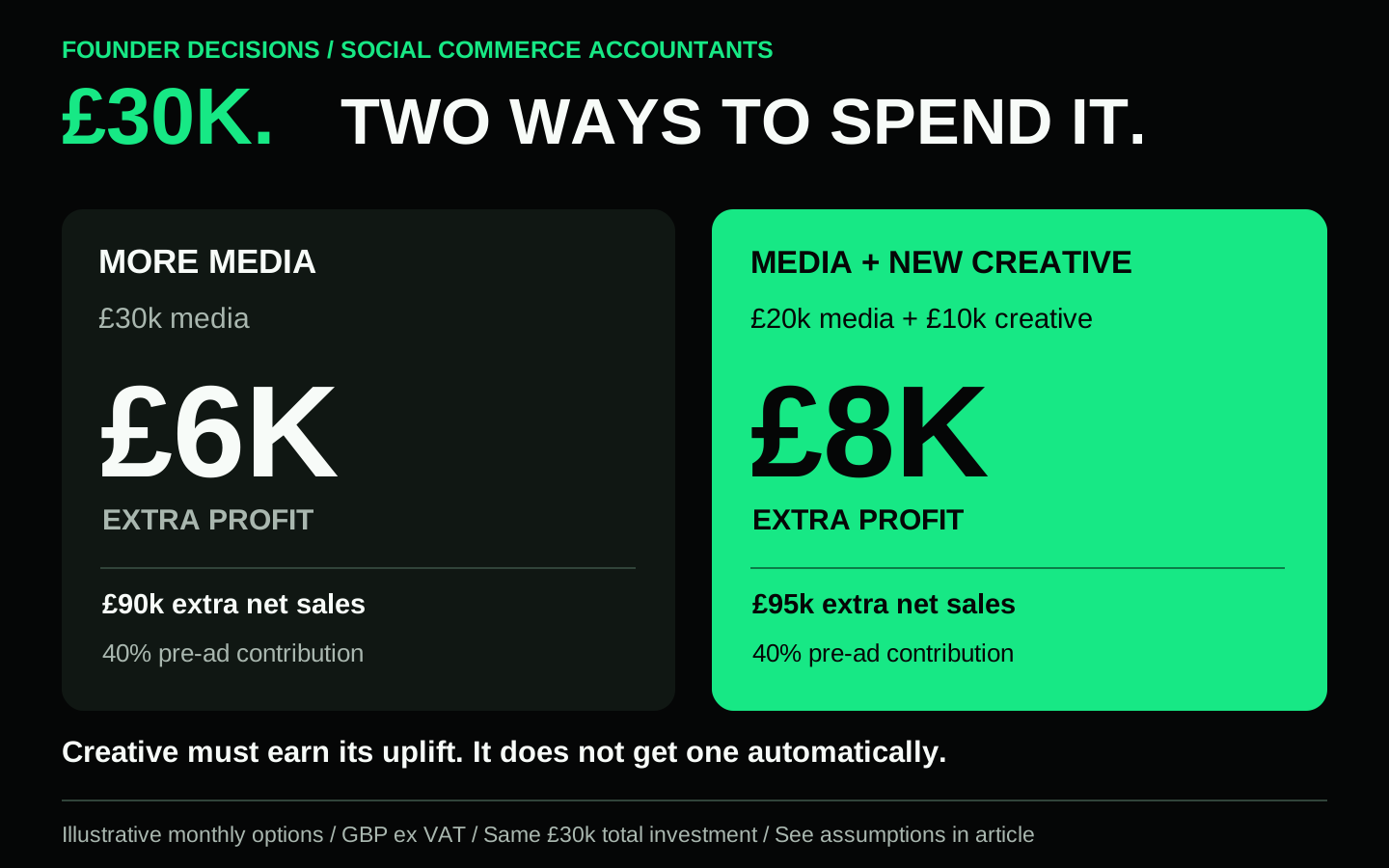
In this example, creative investment wins by £2,000. But notice how dependent that conclusion is on the claimed £25,000 uplift across the existing budget. Without that uplift, Option B would lose £2,000.
For Option B merely to match Option A, the creative would need to generate at least £20,000 of extra net sales from the existing media budget under these assumptions.
The question isn't whether better creative could increase ROAS. It's how much additional contribution the creative must generate to justify its cost.
That gives the marketing team a meaningful target before production begins. It also creates a clear test: can they demonstrate that the new creative produced additional sales, rather than merely receiving credit for existing demand?
What Does It Actually Cost to Find One Winning Ad Concept?
A growing ecommerce brand might produce dozens of creative variations each month. The agency reports that three performed particularly well. But what did it cost to find those three?
The production invoice alone doesn't answer that. Include unsuccessful concepts, internal editing time, creator payments, paid testing and additional charges needed to use the content commercially.
The cost-per-winning-concept calculation
Suppose a brand tests 24 genuinely different concepts over a month. Its illustrative programme costs are:
| Cost | Amount |
|---|---|
| Creator and production costs | £6,000 |
| Editing, scripting and internal production time | £3,000 |
| Paid media used to test concepts | £9,000 |
| Total programme cost | £18,000 |
Three concepts pass predefined performance tests and remain commercially useful after initial testing.
The gross fully loaded cost per validated winner is:
£18,000 / 3 = £6,000.
Not £250 per video. Not £750 per concept. £6,000 per validated winner.
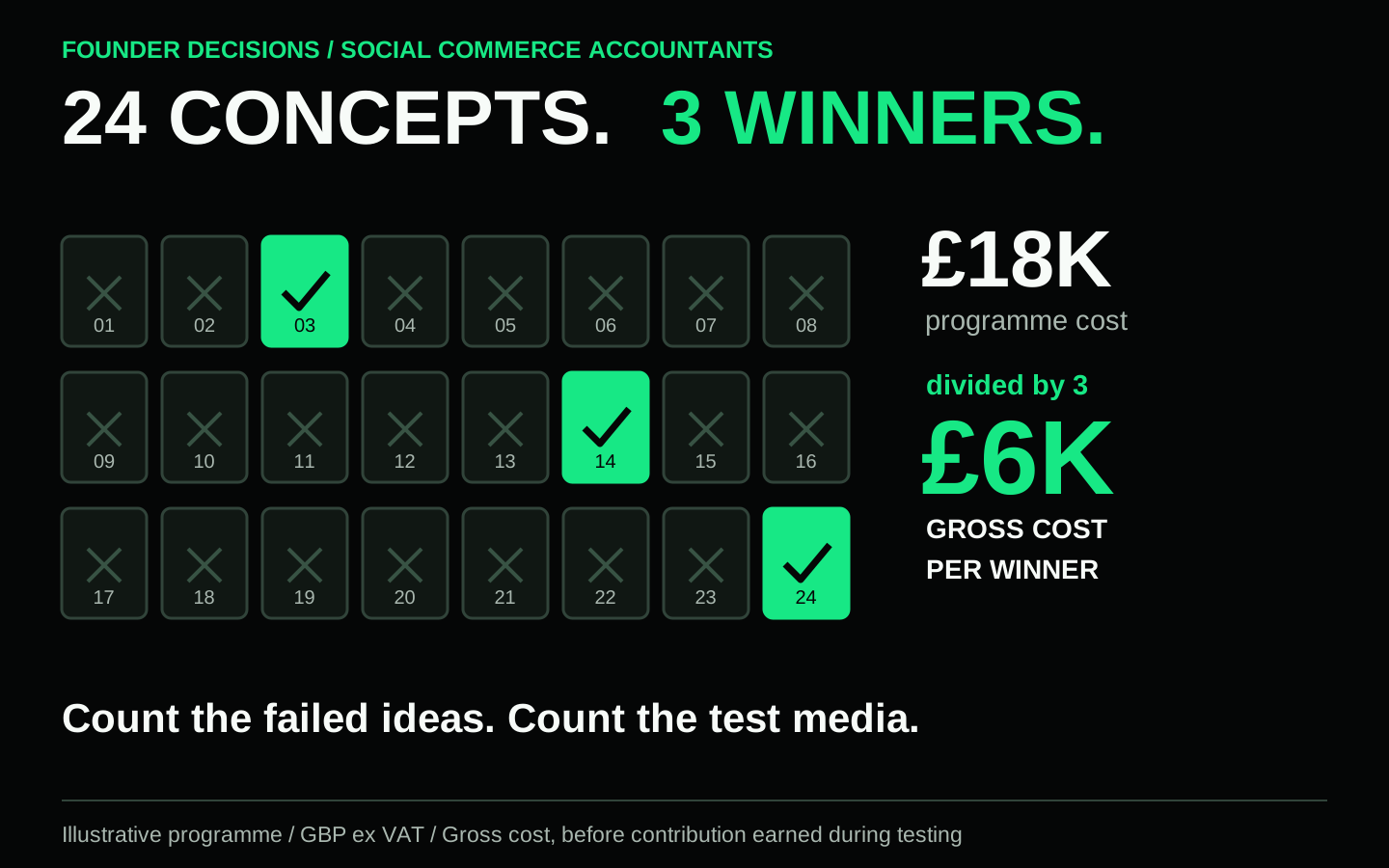
That doesn't necessarily mean the programme lost £18,000. Testing can generate genuine sales.
Suppose the test campaigns produce £15,000 of incremental net sales, representing £6,000 of contribution before media at our illustrative 40% margin.
The net programme cost after that contribution is £18,000 - £6,000 = £12,000. Divided by three successful concepts: £4,000 net cost per validated winner.
Both figures are useful. The gross £6,000 shows the full investment required to find each winner. The net £4,000 shows the remaining investment after contribution generated during testing, assuming those sales are genuinely incremental.
Don't mistake either for a universal benchmark. This is a fully loaded investment measure; allocated existing staff time is not automatically an additional cash outflow.
What should qualify as a winning creative?
An advert shouldn't graduate simply because it achieved the highest reported ROAS in a small test.
A worthwhile definition considers acceptable incremental contribution, performance beyond the launch period, the intended customers and whether it scales without unacceptable deterioration. Validate the initial winner again rather than extrapolating a lucky small sample.
Also consider its usable lifetime. A video performing exceptionally for five days might be less valuable than one producing slightly lower returns for three months.
Rights matter too. Paying for production doesn't necessarily grant unrestricted paid advertising use forever. Check where and how long you can use the content. GOV.UK explains that a copyright licence may be limited by purpose, time or place.
TikTok supports structured split testing of advertising variables in eligible campaigns rather than comparing uncontrolled results alone. Its custom split-test eligibility documentation, updated January 2026, lists TikTok Shop as ineligible for that specific custom campaign-level feature. Do not assume a test available for standard web advertising works identically for Shop campaigns.
The output you want from testing isn't simply more videos. It's a repeatable process for finding commercially useful ideas at an affordable cost.
What if Your Best-Performing Advert Is You?
There's another problem that appears as founder-led brands grow.
The founder is the face of the business. They explain products, appear in videos, conduct demonstrations and build trust with the audience. It works. Then the business gets bigger.
Suddenly the founder is also managing suppliers, recruiting, reviewing finances and making strategic decisions. Every new advert still depends on them finding time to get in front of a camera.
That's not just a marketing issue. It's a dependency that has a financial cost.
But replacing the founder immediately could damage an acquisition system that is already working.
Build a funded transition
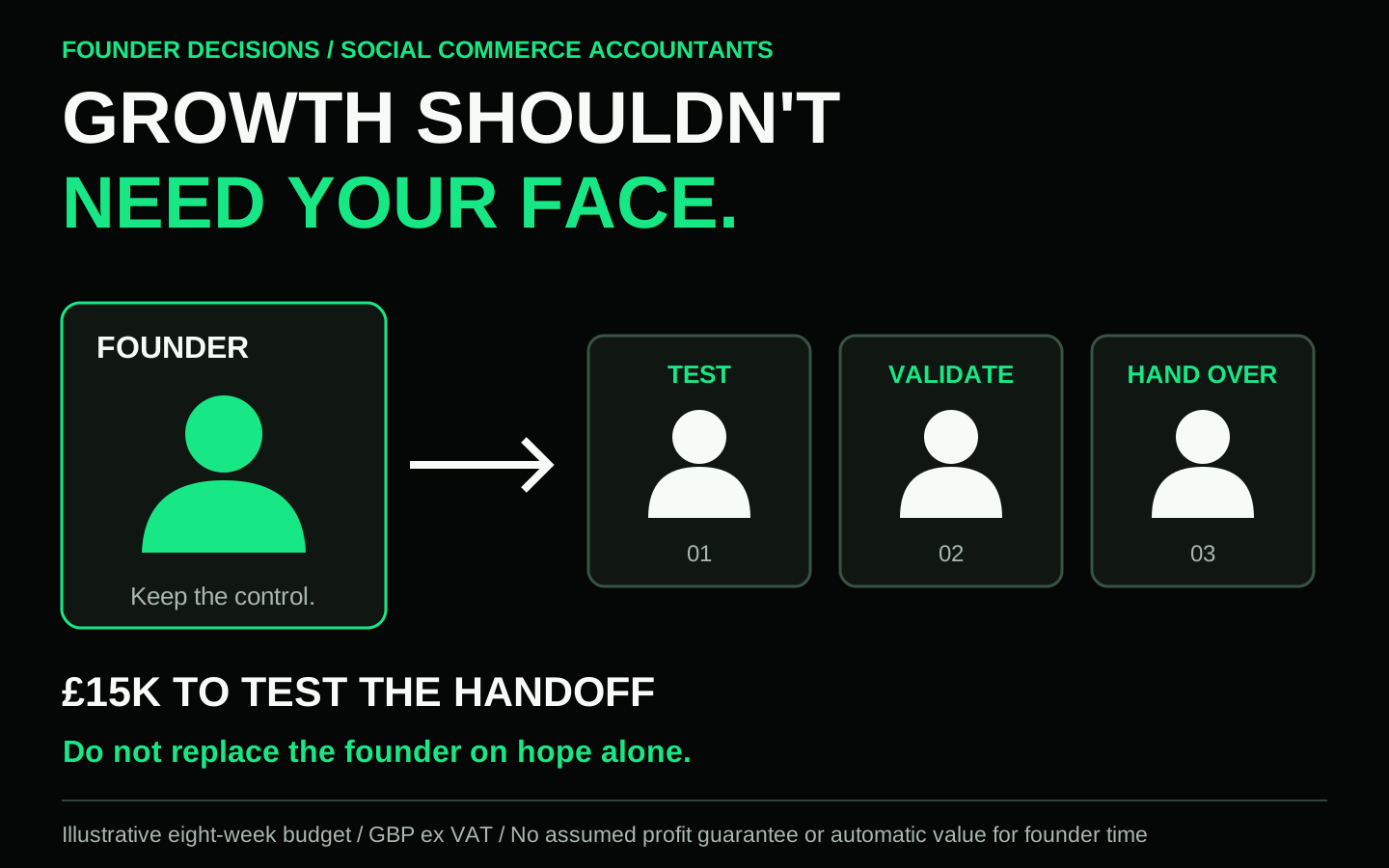
Test alternative presenters while the founder's existing content continues to perform. Here's an illustrative eight-week testing budget:
| Investment | Cost |
|---|---|
| Three alternative presenters | £6,000 |
| Scripts, editing and production support | £3,000 |
| Additional controlled test media | £5,000 |
| Rights and contingency allowance | £1,000 |
| Total | £15,000 |
This is a separate example from the earlier creative programme; its £5,000 of media testing is already included in the £15,000 total.
The aim isn't to spend £15,000 and immediately produce more revenue. It's to establish whether the business can maintain acceptable marketing performance without depending on the founder for every new asset.
Test the presenter, not everything at once
Start with a founder advert that already performs consistently. Document what makes it work. Is it the founder's knowledge, personality, a convincing demonstration or the fact customers recognise them?
Develop comparable versions with alternative presenters. Keep the offer, landing page, product and other material variables as consistent as practical. Use the founder's established creative as the control in an appropriately designed test.
Measure contribution after media, not simply which video attracts most views.
If the replacement performs worse, establish why. It might be the presenter. But it might be a weaker demonstration, different delivery, poor editing or an audience mismatch.
Once an alternative proves commercially viable, increase their role gradually. Ideally, establish more than one person capable of producing useful content. Replacing one indispensable presenter with another isn't much of a reduction in dependency.
How do you justify the £15,000 financially?
There are two potential sources of value.
The first is additional profit generated by the replacement creative. At a 40% pre-advertising contribution margin, £15,000 of total programme cost requires £37,500 of incremental net sales to cover it, assuming all additional media and production costs are included and no other costs arise.
The second is profit protected when the founder becomes unavailable.
Suppose, purely illustratively, founder-dependent campaigns could lose £10,000 of contribution after their normal media costs each month if the founder stopped producing content.
If alternative presenters prevent two months of that loss, they protect £20,000 of contribution. Less the £15,000 programme, that is £5,000 of net value in that disruption scenario, before ongoing presenter costs.
Assess how likely that disruption is. A possible loss is not an expected loss, and do not count the same sales as both growth and avoided loss.
There may be a third benefit: founder time freed for other work. But that time isn't an automatic cash saving. It only creates measurable financial value when it reduces real costs or enables profitable activity.
The broader decision is whether a relatively modest transition investment reduces a material dependency without damaging existing acquisition.
Don't Ignore the Cash Needed to Support Additional Sales
A profitable advertising decision can still create a cash-flow problem.
Suppose an extra £25,000 of media is expected to produce £80,000 of incremental net sales. At a 40% pre-advertising contribution margin, that could add £7,000 of profit after media.
But the business might need to purchase inventory weeks before those sales occur. Advertising costs could leave the bank before marketplace settlements arrive. Supplier deposits, import charges and tax payments might fall in different periods from customer receipts.
For a multi-channel brand, that timing difference matters.
The decision needs two separate calculations:
Profit: Will additional sales generate more contribution than the additional costs?
Cash: Can the business fund advertising, inventory and associated commitments until the money comes back?
These aren't interchangeable. A £7,000 projected profit increase doesn't mean the business needs only £7,000 of available cash.
For more on advertising metrics and the actual bottom line, see SCA's guide to net profit versus ROAS.
How to Make the Next Marketing Budget Decision
Before approving another substantial advertising commitment, bring the marketing and finance numbers together.
The advertising team should explain what additional customers and sales it expects at different spending levels, including the evidence behind the forecast.
Finance should translate those scenarios into incremental contribution using the actual product, channel, fee and returns profile. Then compare additional profit with the cash required and the risk of the forecast being wrong.
You should be able to answer four questions:
- Where does the next spending increment stop generating enough contribution to justify itself?
- Would better creative improve returns from the budget we're already spending?
- How much does it cost to find genuinely useful new creative, including failures and testing?
- Are we building a marketing operation that can continue performing when the founder steps back?
A marketing dashboard alone won't answer all four. Neither will a conventional P&L combining every platform, product and marketing expense into a handful of lines.
You need the marketing evidence and financial reporting to agree on what is being measured.
At Social Commerce Accountants, our focus is turning Shopify, Amazon and TikTok Shop activity into reliable channel-level financial reporting, so founders can make commercial decisions using numbers they understand.
Considering a substantial marketing investment but unable to establish what additional profit it should generate? Speak to Social Commerce Accountants about the reporting needed to evaluate it.
The Bottom Line
The next £50,000 of advertising shouldn't be approved because the last £100,000 performed well.
It should be approved because expected additional contribution justifies the investment, the downside is manageable and the business can fund the cash requirement.
Sometimes the answer will be to spend the whole £50,000. Sometimes it will be £25,000. Sometimes the better investment will be in the people, creative and systems that make existing advertising work harder.
The objective isn't to spend more efficiently according to the advertising dashboard. It's to make more money from the next decision.
Sources and example basis
Source links checked on 21 October 2026. All financial scenarios are illustrative, not client results or industry benchmarks. The £50k and £30k comparisons are monthly; the founder-presenter transition is an eight-week programme.