

Founder Decisions / Growth & Marketing
Bring growth in-house when the complete team can deliver a better commercial result, you can fund the transition, and the business will control the accounts and assets it depends on. Not simply when an agency invoice becomes larger than one person's salary.
For an established ecommerce brand, the strongest option may be a hybrid: an internal growth leader who owns priorities and commercial decisions, supported by external specialists. The answer depends on the work being replaced, not a universal revenue threshold.
A £90,000 head of growth does not automatically replace a £20,000-a-month agency. Someone still needs to produce creative, operate campaigns, manage retention, maintain tracking and cover absences.
Here's how to compare the options without buying an apparently cheaper team that produces less profit.
Agency, internal team or hybrid: compare capability, control and the cost of changing. The £20k monthly agency fee is an illustrative assumption, not a market benchmark.
Compare the work before comparing the price
Start with the next twelve months of required output: channels managed, creative volume, email programmes, reporting, testing, response times and peak-period cover.
Then identify who supplies each part under three arrangements: retain the full-service agency, hire a growth leader with specialist support, or build an internally led execution team.
For example, does the current retainer include Amazon advertising and TikTok Shop affiliate management, or just Meta and Google? Is production included, or merely creative direction? Does your proposed employee have the capability and time to cover the same workload?
An empty cell in that comparison is not a saving. It is work you have not funded.
Track the founder's management hours separately, too. Freed time has strategic value, but it is not automatically a cash saving. Nor should an internal hire be assumed to remove the need for direction and supervision.
Would a head of growth cost less than a £20k-a-month agency?
Consider an illustrative £5m brand. All three options below are assumed to deliver the same agreed workload. These are modelling inputs, not salary or agency-price benchmarks.
Figures are annualised in GBP, excluding recoverable VAT. Paid media is excluded because its budget is unchanged across options. Existing company overheads are also unchanged.
| Annual operating cost | Agency-led | Hybrid | In-house-led |
|---|---|---|---|
| Full-service agency | £240,000 | - | - |
| Employee basic salaries | - | £90,000 | £135,000 |
| Budgeted cash bonuses | - | £10,000 | £15,000 |
| Employer National Insurance | - | £14,250 | £21,000 |
| Employer pension contributions | - | £4,500 | £6,750 |
| Retained specialist delivery | Included | £72,000 | £30,000 |
| Creative production | Included | £24,000 | £24,000 |
| Brand-paid software | £12,000 | £12,000 | £12,000 |
| Training and absence cover | Included | £6,000 | £8,000 |
| Total recurring cost | £252,000 | £232,750 | £251,750 |
| Annual saving against agency-led | - | £19,250 | £250 |
The hybrid employs one growth leader. Its specialist retainer covers paid media, retention and Amazon execution; creative production is separate. The in-house-led option adds a £45,000 paid-media manager with a £5,000 bonus, but retains £30,000 of email and Amazon support.
For ordinary category-A employees, HMRC's 2026/27 employer NI rate is 15% above the £5,000 annual secondary threshold. The leader's annual budgeting calculation is therefore (£90,000 + £10,000 - £5,000) x 15% = £14,250. Payroll-period calculations can differ slightly. Source 1
We assume any available Employment Allowance is already used elsewhere, no relevant NI relief, and no Apprenticeship Levy charge. Check the actual payroll position. This annualised comparison holds 2026/27 rates constant; a forecast crossing into another tax year needs updating. Source 1
Employer pensions are assumed at 5% of basic salary. That is an example employment package, not the legal minimum: minimum automatic-enrolment contributions commonly use qualifying earnings, and the scheme's rules matter. Source 2
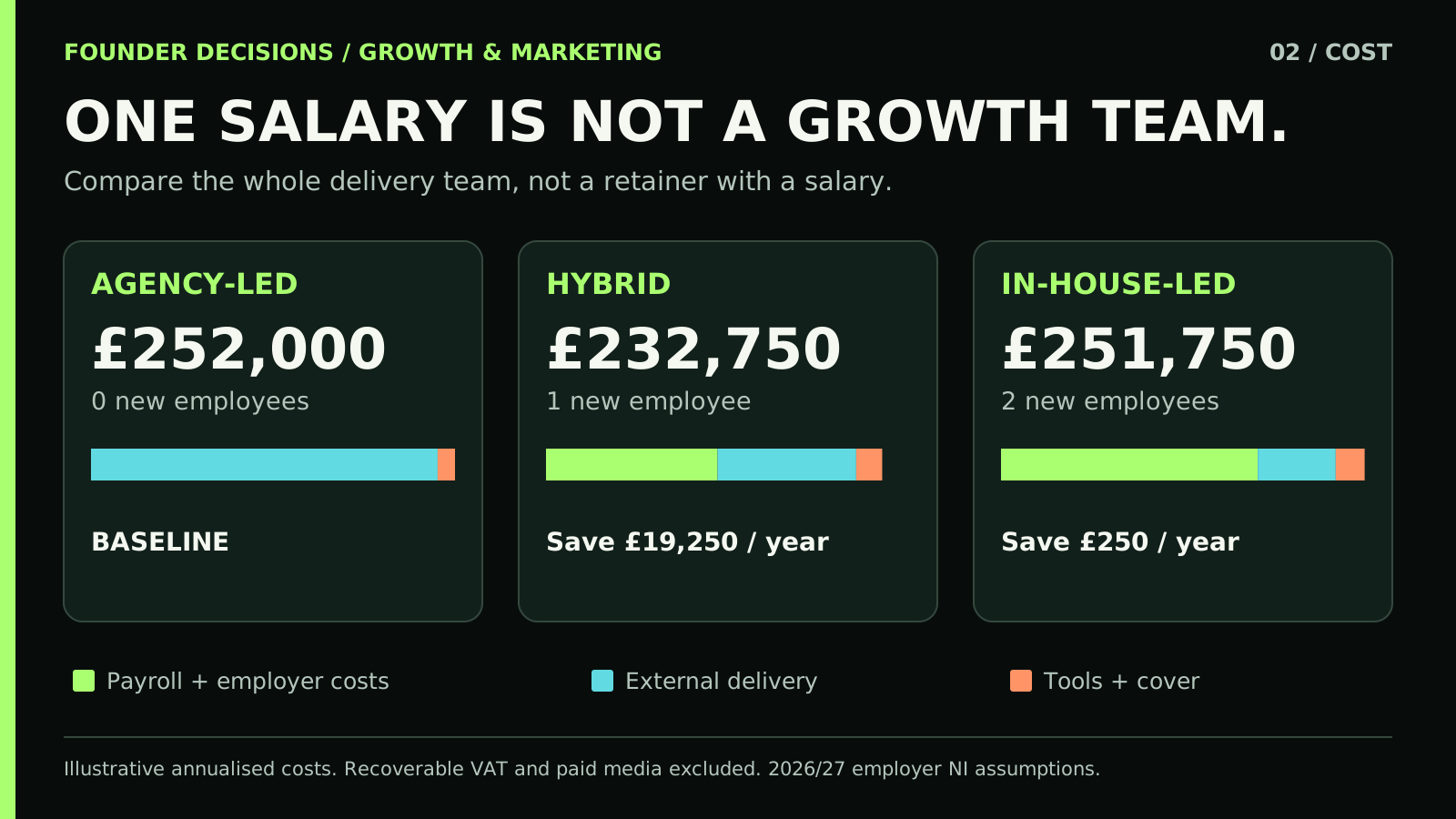
The comparison is not £240,000 versus £90,000. It is £252,000 versus £232,750 versus £251,750, before transition costs or performance changes.
Which capabilities should come in-house first?
Use this as a decision framework, rather than a rule that every growing brand must employ a complete department.
| Capability | Starting position to test |
|---|---|
| Commercial priorities and budget ownership | Give one person inside the brand accountability for products, offers, stock constraints and the commercial brief. |
| Daily campaign execution | Internalise when there is enough recurring work for a capable operator, plus supervision and backup. Otherwise retain specialist delivery. |
| Creative direction and customer knowledge | Keep brand voice, customer insight and testing priorities close to the business; buy production capacity separately where appropriate. |
| Technical or intermittent work | Retain specialists for tracking repairs, technical SEO, complex marketplace issues or occasional conversion projects unless sustained workload justifies a hire. |
Map capacity as well as expertise. A growth leader spending four days each week editing videos cannot simultaneously deliver the strategy and coordination you budgeted for.
For a proposed hybrid, obtain a written reduced-scope agency quote before hiring. The old fee will not necessarily fall in proportion to the tasks you remove. Agree outputs, response times and responsibility for anything that crosses between teams.
How much cash does the transition need?
The hybrid saves £19,250 annually once established. It may still require substantial cash before those savings accumulate.
Assume the following separate transition scenario, beginning when the new leader starts:
| Transition assumption | Additional amount |
|---|---|
| Two months of old agency fees overlapping the new model | £40,000 |
| Recruitment | £18,000 |
| One-off onboarding and setup | £6,000 |
| Three months of lost contribution at £8,000 a month | £24,000 |
| Total transition burden before recurring savings | £88,000 |
The lost contribution is not an invoice. It represents lower net sales of £20,000 a month at a 40% contribution margin before media, with media spending unchanged.
First-year operating and setup cash payments are £232,750 + £64,000 = £296,750, versus £252,000 for staying agency-led. Adding the £24,000 contribution shortfall leaves the business £68,750 worse off over that year under these assumptions.
Timing makes the peak requirement larger. Assume recurring costs, including bonuses, are paid evenly each month; recruitment and setup are paid in month one; and lost contribution reduces cash immediately.
| Point in transition | Cumulative extra cash required versus staying agency-led |
|---|---|
| End of month 1 | £50,396 |
| End of month 2 | £76,792 |
| End of month 3: peak | £83,188 |
| End of month 12 | £68,750 |
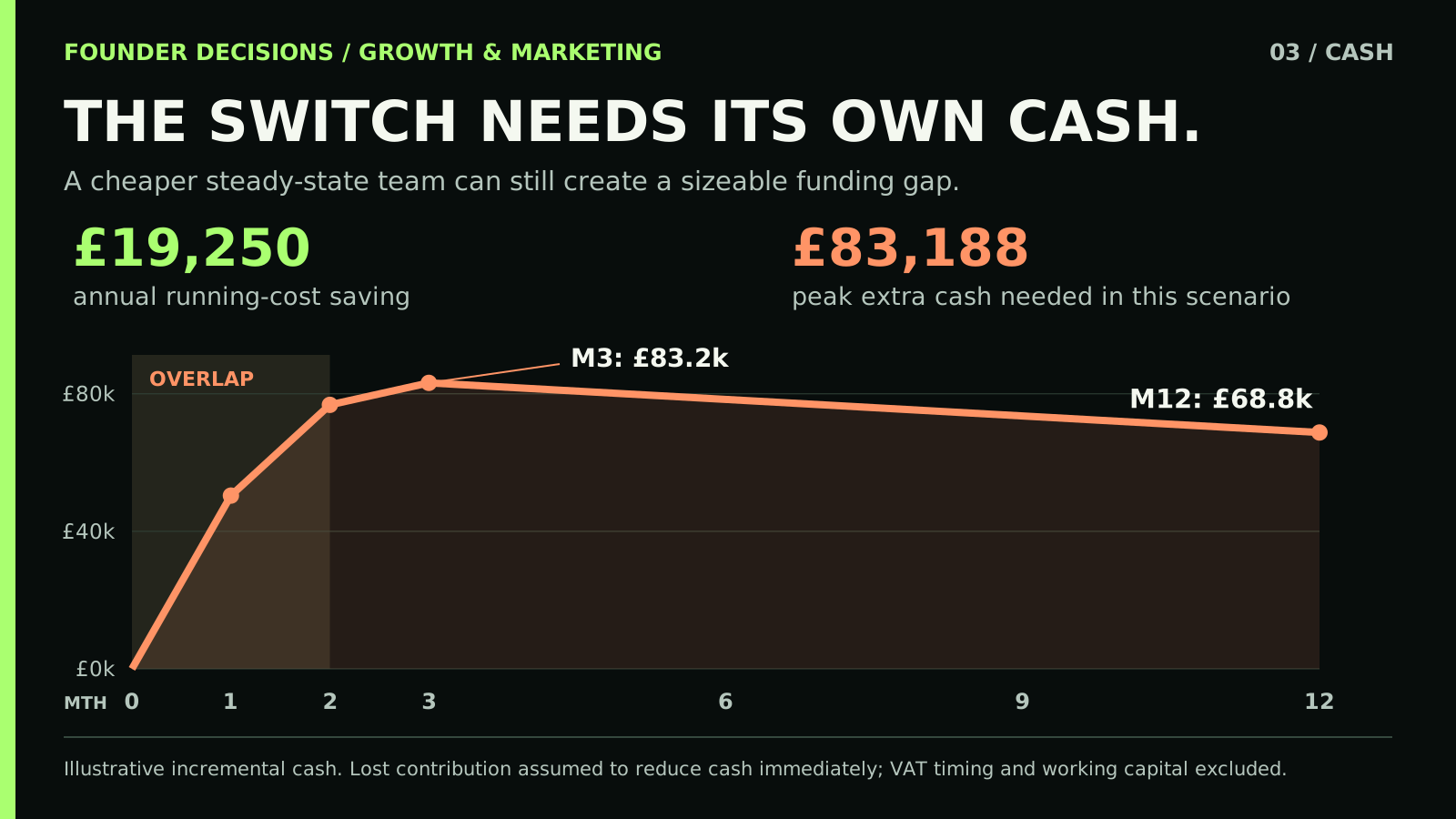
This is not the total bank balance required. Add the brand's normal stock, tax and operating commitments, plus the actual payment timetable. Treat recruitment delays explicitly: they postpone savings, but ordinary agency months before the switch are not automatically extra transition costs.
Before giving notice, obtain employment advice where an organised group of agency employees is assigned to the service. TUPE can apply to insourcing; hiring your preferred replacement does not itself settle whether transfer obligations exist. Source 3
What if the cheaper team performs worse?
For this £5m brand, a 1% annual reduction in net sales is £50,000. At 40% contribution before media and unchanged media spend, that removes £20,000 of contribution.
The hybrid saves £19,250 in recurring costs, so:
Annual operating-profit change = £19,250 - (£50,000 x 40%) = -£750.
Its recurring saving is erased by a revenue loss of £19,250 / 40% = £48,125, or approximately 0.96% of annual net sales, under this particular cost structure.
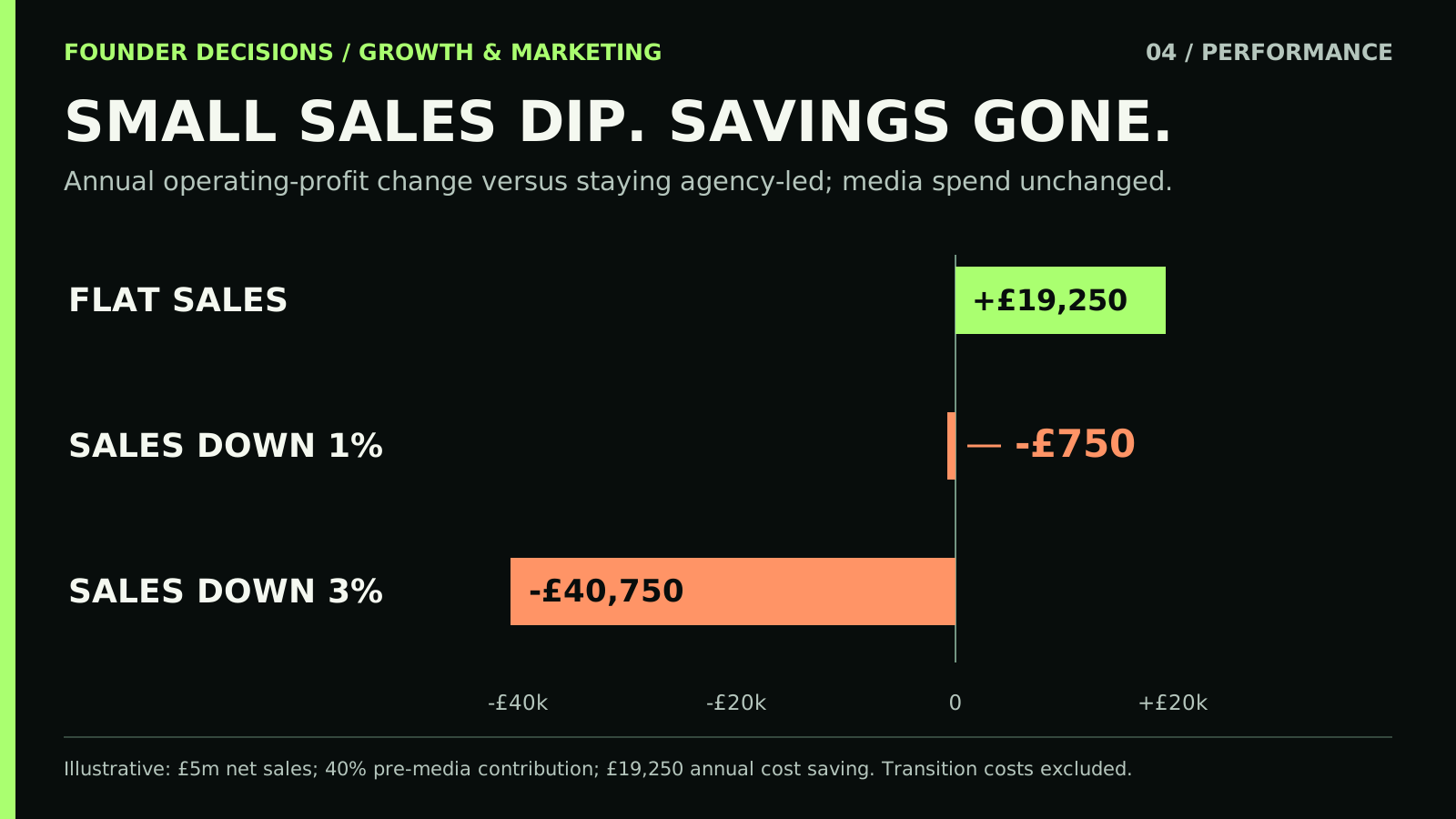
This is not a forecast that internal teams perform worse. It quantifies how little deterioration this particular saving can absorb.
Agree handover gates: accurate tracking, agreed creative throughput, covered launches and channel-level contribution within an acceptable range. Measure comparable periods and account for stockouts, promotions and returns rather than treating every sales movement as a staffing effect.
SCA's guide to ROAS and contribution provides the reporting background. Here, the decision is whether a different team improves the financial outcome, not whether it produces an attractive advertising screenshot.
What must you control before leaving the agency?
An exit inventory should separate access, ownership and permission to reuse. They are not interchangeable.
Accounts and administration. Record the brand's ad accounts, business portfolios, storefront, Seller Central, TikTok Shop, analytics, tag management, catalogue feeds and domains. Test brand-controlled administrator and recovery access, with individual permissions rather than shared passwords.
Data and dependencies. Record which account owns conversion actions, pixels, datasets, audiences, integrations and reporting connections. Establish what can remain, transfer or be exported lawfully and under platform rules; identify anything that must be rebuilt.
Creative and usage rights. Obtain the agreed source files, footage, copy, landing pages and creator agreements. Check paid-use duration, territories, editing rights and whether rights survive termination.
Handover acceptance. Require a campaign register, test history, budget settings, known problems and a working-access check before removing the agency's permissions. Agree the handover obligation and charges in the contract rather than assuming unlimited assistance.
Google distinguishes manager-account ownership from the client's data ownership and administrative rights; it also requires appropriate administrative access to unlink accounts. Do not treat a new login as proof that the transition is complete. Source 4Source 5
Paying for creative does not automatically transfer copyright. The Intellectual Property Office says commissioned work normally belongs initially to its creator unless agreed otherwise in writing. Have the contract and third-party licences checked before reusing assets through a new team. Source 6
Could a better agency agreement solve the problem instead?
An invoice rising with ad spend is a reason to examine incentives, not proof that the agency should be replaced.
A commercial structure worth testing combines a fixed fee for defined delivery with a capped variable payment for verified improvement. Avoid making the agency dependent on company-wide profit affected by costs it cannot control.
For example, an illustrative bonus could be 10% of quarterly contribution above an agreed baseline, capped at £6,000. If qualifying contribution improves by £50,000, the bonus is £5,000.
Define that contribution using net sales excluding VAT and refunds, less landed product costs, fulfilment, marketplace/payment fees, media and the base agency fee - but before the performance bonus. Specify the baseline, affected channels, seasonality adjustments, return true-ups and treatment of stockouts or price changes.
Make sure profitable existing demand is not counted repeatedly by different agencies. Agree who validates the calculation and when the performance payment becomes payable. A fixed reporting convention is useful, but it does not prove the agency caused every improvement.
This may preserve a strong delivery team while correcting the incentive you disliked. Compare that renegotiated option with recruitment before choosing either.
Are you really more productive, or just outsourcing more people?
Revenue per employee can flatter a brand that outsources fulfilment, customer service and marketing.
Consider two illustrative businesses with the same £5m net revenue:
| Brand A | Brand B | |
|---|---|---|
| Average employed full-time equivalents | 10 | 20 |
| Estimated external labour equivalents | 10 | 0 |
| Revenue per employed FTE | £500,000 | £250,000 |
| Revenue per total labour FTE | £250,000 | £250,000 |
On payroll headcount alone, A appears twice as productive. After counting the labour used to deliver the work, the difference disappears in this example.
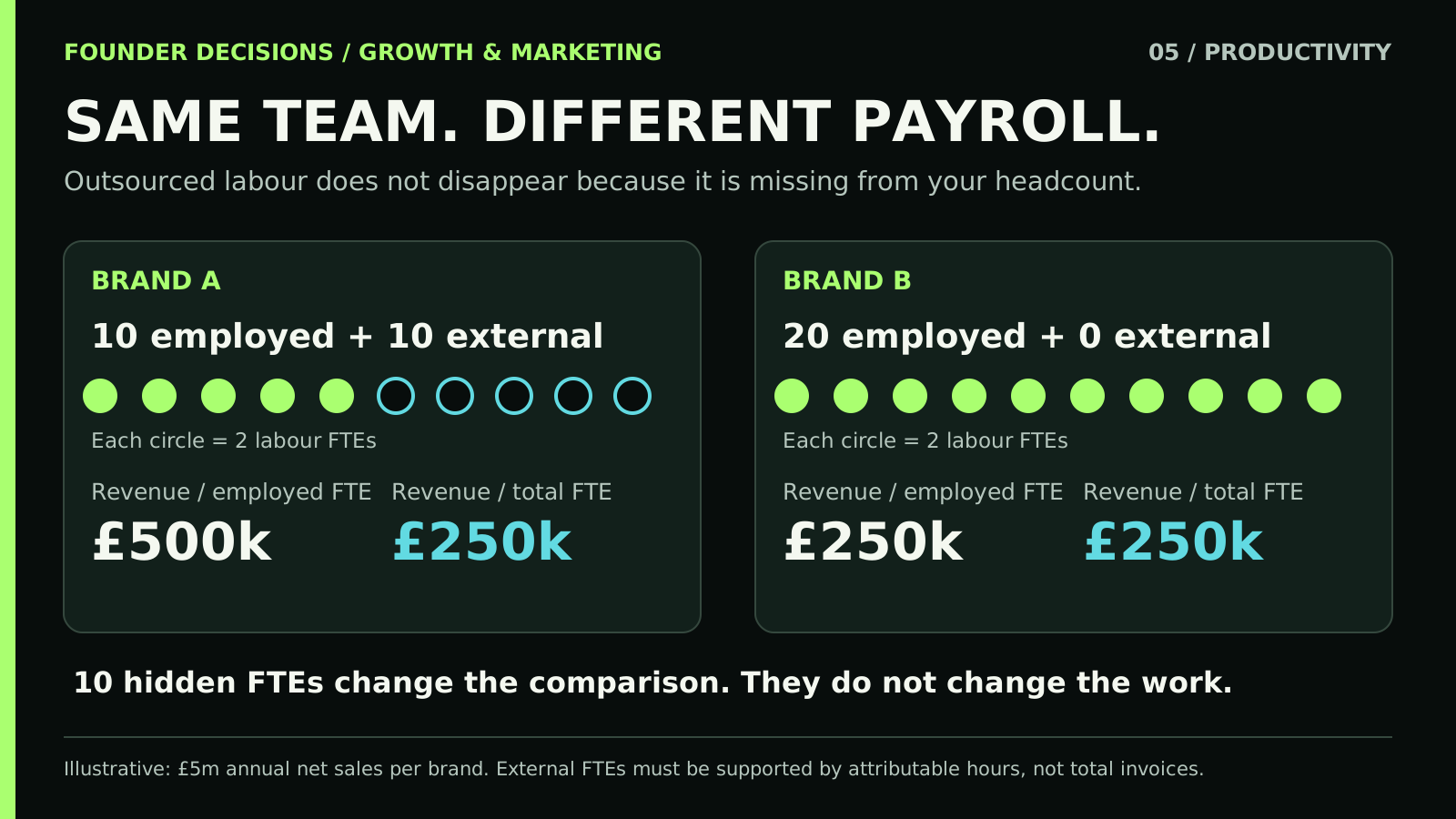
Estimate external FTEs from attributable hours divided by the same annual capacity used for employees. Don't convert a whole 3PL invoice into people: it can include premises, delivery, equipment and the supplier's margin.
Where hours cannot be obtained, compare a consistently defined combined internal/external labour-cost ratio, with a disclosed range for uncertain labour components. Also compare contribution generated, not just sales. Product margins, channel mix and service levels can otherwise distort the result.
The decision to make before posting the job advert
Commission three things: a like-for-like delivery plan, a twelve-month cost-and-cash model, and a tested account-and-asset handover plan.
Bring leadership in-house when ownership of decisions is the missing capability. Bring execution in-house when the workload, skills and cover justify it. Retain specialists where their contribution warrants their cost.
Social Commerce Accountants provides ecommerce accounting and channel-level reporting for established brands. Reliable contribution figures are the foundation for this decision; they show what the new team must protect, not just what it might save. Source 7
The objective is not to replace an expensive invoice with a cheaper salary. It is to build a growth function whose total cost, performance and cash demands make sense together.