
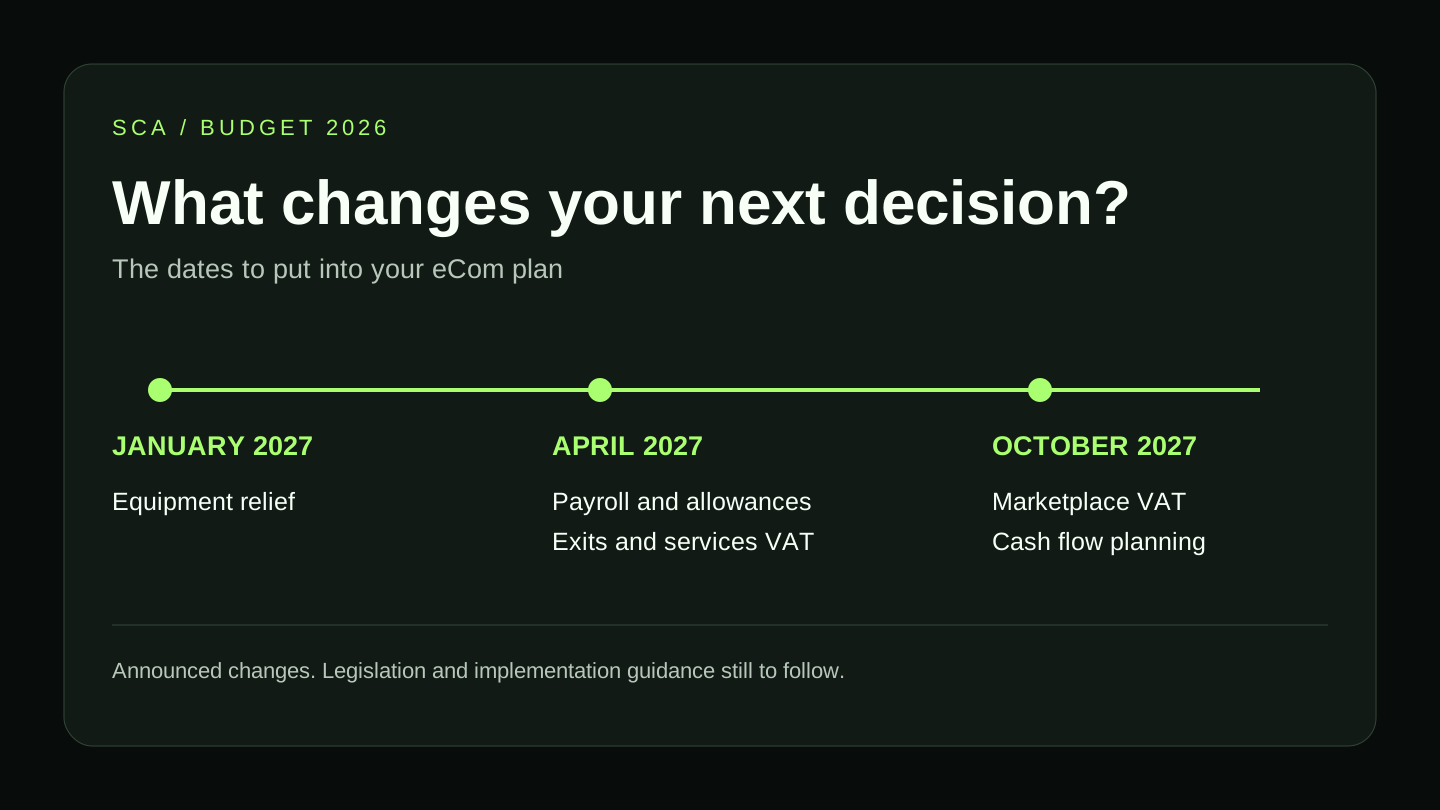
The Budget on 28 October 2026 gives eCom founders a few things to plan for. The biggest one is what happens to your cash when marketplaces start collecting VAT on more UK sellers’ sales.
I’ve pulled out the changes that could affect your next hire, stock order, equipment purchase or business sale. Here’s what they mean for you, and what I’d look at first.
Published 29 October 2026. These are announced changes. Legislation and some implementation details still need to follow. The dates below are the announced start dates, rather than changes to apply to today’s transactions.
1. Marketplace VAT: less cash between payouts and returns
From October 2027, the government intends marketplaces to collect VAT on qualifying consumer sales of goods located in the UK by UK VAT-registered sellers. Other UK businesses meeting the announced £90,000 annual sales threshold on that platform will also be covered. Personal sales, second-hand goods and business-to-business transactions are excluded from the announced measure.
The practical impact? Your payout could arrive with the VAT already taken out. If you’ve been using the cash between settlements and your VAT payment to fund stock or advertising, that funding gap needs attention.
This changes who collects the VAT. It doesn’t mean you pay the same VAT twice. Your books will need to distinguish what the marketplace collected from what your business still owes.
The normal business-wide VAT registration rules remain separate. The platform test isn’t a fresh VAT-free allowance for every channel. Detailed secondary legislation will explain how the threshold and exclusions operate.
What I’d do: identify the sales likely to be covered, then model the payout cash available for your next stock cycle. Read HMRC’s marketplace VAT announcement.
2. Staff costs: build April’s rates into hiring decisions
From 1 April 2027, the announced hourly minimums are £13.21 for workers aged 21 and over, £11.27 for ages 18–20, and £8.31 for ages 16–17 and eligible apprentices.
If your team is on or close to those rates, update the payroll budget before you commit to another hire or a bigger fulfilment operation. Include any associated employer National Insurance and pension costs, rather than just multiplying the headline wage by hours.
Also look at the gap between roles. A higher starting wage may prompt a conversation about experienced staff pay, even where their current rate already exceeds the minimum. That’s a budgeting consideration, not an automatic legal requirement to increase every salary. See the Budget’s wage announcement.
3. Equipment: check the relief before choosing when to buy
The qualifying main-rate first-year allowance rises from 40% to 50% for expenditure from 1 January 2027. The main writing-down allowance falls from 14% to 12%, from 1 April 2027 for Corporation Tax and 6 April 2027 for Income Tax. Accounting periods spanning the change use a hybrid rate.
That does not mean all equipment only receives 50% upfront relief. Full expensing and the £1 million Annual Investment Allowance remain available for qualifying expenditure.
For a warehouse fit-out or equipment purchase, the useful question is which allowance your business and the asset actually qualify for. A tax deduction is not a cash reimbursement of the purchase price. Get the timing and tax benefit checked before moving a purchase just because of the headline. Read HMRC’s capital allowances detail.
4. Selling the business: review the gain you’ll keep
The lifetime limit on gains qualifying for Business Asset Disposal Relief is due to fall from £1 million to £500,000 for disposals from 6 April 2027.
That limit applies to qualifying gains, not your sale price. If your gain exceeds the available relief, more could be taxed at the normal Capital Gains Tax rate. Previous use of the relief matters too.
If an exit is on the cards, tell us early. We can look at eligibility, relief already used and the after-tax outcome alongside the commercial deal. Don’t rush a sale because of a headline; a worse sale price can outweigh a tax saving. Read HMRC’s BADR announcement.
5. Not VAT-registered? Check overseas software and advertising
From 1 April 2027, the overseas-services reverse charge will be restricted to UK purchasers registered for VAT. Overseas suppliers will need to charge applicable UK VAT to non-registered UK businesses.
Some software, advertising or platform costs could increase for non-registered businesses. The effect depends on the service and supplier; don’t assume every subscription rises by the same amount.
List the overseas services you use and check their VAT treatment when budgeting renewals. For VAT-registered businesses, this announcement does not mean simply removing the reverse charge from your bookkeeping. Read HMRC’s overseas-services proposal.
One for you personally: savings and property income
From April 2027, the announced rates on taxable savings income are 24%, 44% and 49% across the UK. The same property income rates apply to individuals in England, Wales and Northern Ireland; Scotland is separate.
These are not new tax rates on your company’s trading profits. Savings allowances and ISAs still matter, so the headline rate alone doesn’t tell you your personal bill. Read HMRC’s property and savings income detail.
What I’d prioritise
- Payroll: update April’s costs before your next hiring commitment.
- Marketplace cash flow: find out how much your stock and ad plans depend on holding VAT cash.
- Big decisions: review any planned equipment purchase or business sale against the relevant dates.
You don’t need to overhaul everything today. You do need to know which of these changes affects a decision you’re making. Existing clients: just reply to your Budget email and let me know. If we haven’t worked together yet, tell us about your business.