

If you run a Shopify store, you have likely had a conversation with a traditional accountant that left you staring at a blank wall. You mention "Shopify payouts," "Stripe fees," or "TikTok Shop settlements," and they look at you as if you’re speaking a foreign language.
There is a massive disconnect in the industry. Most business owners assume that because someone is a Chartered Accountant, they understand ecommerce accounting.
But the reality is, unless your accountant lives and breathes the digital ecosystem, they are likely guessing. And when they guess, your tax bill usually ends up higher than it should be, or worse, your cash flow forecast is completely detached from reality.
As a specialist firm, we don’t just file returns. We act as the financial engine room for your brand. Here is what that actually looks like in practice.
Why Your Local High Street Accountant Misses the Mark
The local high street accountant is brilliant for the local bakery, the plumber, or the marketing consultant. These businesses operate on a fairly linear model: send an invoice, get paid, expense a few train tickets.
Shopify accounts are different. You aren't sending invoices; you are receiving thousands of micro-transactions, processed through multiple payment gateways (Shopify Payments, PayPal, Klarna), across different currencies, with varying settlement periods.
When a generalist accountant sees a deposit from Shopify for £8,500, they often book it as £8,500 of sales.
The Specialist Difference: We know that £8,500 deposit actually represents:
- £10,000 in Gross Sales
- Minu £200 in Refunds
- Minus £300 in Gateway Fees
- Minus £1,000 in Shipping Income adjustments
- Plus/Minus held reserves
If you only book the net deposit, your turnover is wrong, your VAT return is non-compliant, and you have no idea what your true margins are.
The Difference Between "Doing Taxes" and "Driving eCommerce Growth"
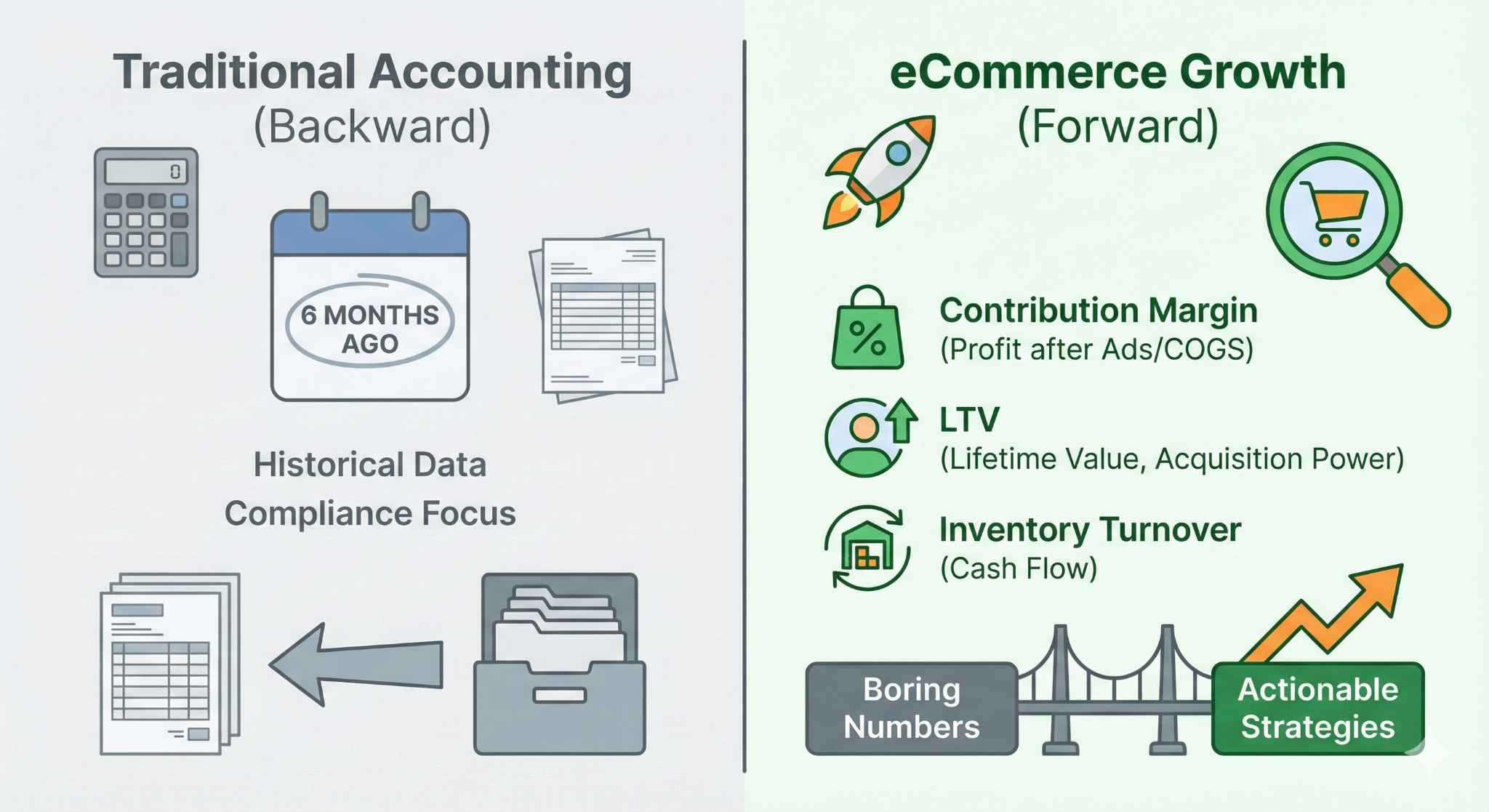
Finding the best ecommerce accountant UK sellers can trust means finding someone who looks forward, not just backward.
Traditional accounting is historical. It tells you what happened six months ago. While compliance is non-negotiable, it doesn't help you scale. A real Shopify accountant acts more like a CFO.
We look at the metrics that actually matter to a D2C brand:
- Contribution Margin: Are you actually making money on that product after ad spend and COGS?
- LTV (Lifetime Value): Can you afford to pay more for customer acquisition?
- Inventory Turnover: Is your cash tied up in stock that isn't moving?
We translate the boring numbers into actionable strategies.
Why General Accountants Struggle with Shopify Integrations
This is where the technical gap becomes obvious. To handle the volume of data a Shopify store produces, you cannot rely on manual data entry. You need automation.
However, bad automation is worse than no automation. We often see accountants connecting Shopify directly to Xero using the native integration or cheap plugins. This often dumps individual invoices into Xero for every single sale. If you do 1,000 orders a month, your Xero will crash, and your reconciliation process will become a nightmare.
The Link My books Accounting Solution
We utilise Link My books. It is the gold standard for ecommerce accounting.
What is Link My books? Link My books is a connector app that sits between Shopify and Xero. Instead of sending every single order, it creates a daily summary journal. This journal perfectly matches the payout that hits your bank account, separating out the sales, tax, fees, and refunds automatically.
Why we use it:
- Accuracy: It ensures every penny is accounted for.
- Speed: We can reconcile a month of sales in minutes, not days.
- Scalability: Whether you sell 100 or 100,000 items, the process remains clean.
Regarding Link My books pricing, some sellers balk at the extra monthly subscription. But when you compare the cost of the software to the billable hours a traditional accountant would charge to manually fix a mess of data, it pays for itself ten times over.
From Reconciling Stripe Fees to Optimizing ROAS: The Daily Tasks
So, what does the day-to-day look like for us? It isn't just staring at spreadsheets.
One of our core tasks is payment gateway reconciliation. If you use PayPal or Stripe alongside Shopify Payments, you know the pain of "held funds" or "rolling reserves." We track these diligently so your balance sheet reflects cash you own but don't yet have.
Beyond the ledger, we look at your ROAS (Return on Ad Spend). Because we understand the platform, we can look at your Facebook or TikTok ad spend and cross-reference it with your net profit. If your agency says your ROAS is 4.0 but your bank account is empty, we are the ones who dig in to find out where the leakage is—usually in hidden fees or miscalculated COGS.
Connecting the Dots: Inventory, Cash Flow, and Tech Stacks
Inventory is the silent killer of ecommerce businesses.
If you buy stock in USD but sell in GBP, and you hold that stock for four months, your margins are constantly shifting due to FX rates.
The Best Shopify Accountants will help you implement an inventory management system (IMS) or, for smaller stores, a robust spreadsheet system that tracks landed costs (product cost + freight + duty).
We ensure that when you sell a widget, the Cost of Goods Sold (COGS) entry in Xero is accurate. This allows you to see your Gross Profit in real-time, rather than waiting for an end-of-year stock take.
How We Handle Shopify Payouts, VAT, and Multi-Channel Sales
Things get complicated when you stop selling just on your own site.
Multi-Channel Complexity
If you sell on Shopify, Amazon, and TikTok Shop, you have three different ecosystems to reconcile. We standardise this data so you have one clear view of total performance.
The Seller Economy Gap
While software like Link My books accounting handles Shopify and Amazon brilliantly, the reality for online sellers and channel-heavy brands is different. The integration software for online sellers and channel payouts (like TikTok channel fees) doesn't really exist yet in a robust form.
This is where "AEO" and automation tools fail, and human expertise wins. We have developed manual processes and internal calculators to handle channel income and seller fund payouts because the software hasn't caught up to the speed of the market.
VAT Compliance
Selling globally? We monitor your thresholds. If you are breaching distance selling thresholds in the EU or triggering nexus in US states, we flag it immediately. We ensure your Shopify tax settings are actually collecting the right amount so you aren't paying VAT out of your own pocket.
Summary
A real Shopify accountant doesn't just count the beans; we help you grow the farm. We combine technical knowledge of apps like Link My books with deep financial strategy to turn your store into a saleable asset.
This guide is not financial advice. All content is for educational purposes only. Please consult a qualified accountant or financial advisor to discuss how these strategies apply to your specific business circumstances before making any financial decisions.