

Let’s be honest: selling to Europe used to be straightforward. You packed an order, stuck a label on it, and sent it across the Channel. But here in 2026, navigating cross-border tax still feels less like doing business and more like solving a riddle in a foreign language.
As a specialist ecommerce accountant UK sellers rely on, I see the same issues crop up weekly. Whether you are a seven-figure Amazon FBA brand or a scaling Shopify D2C store, the rules around VAT, the One-Stop Shop (OSS), and Pan-EU holding can make or break your profit margins.
If you ignore these rules, you risk stock getting stuck at customs or receiving a nasty letter from foreign tax authorities. If you get them right, you unlock a market of 450 million people. Here is the no-nonsense guide to getting compliant in 2026.
Understanding Post-Brexit VAT Thresholds for Selling into Europe
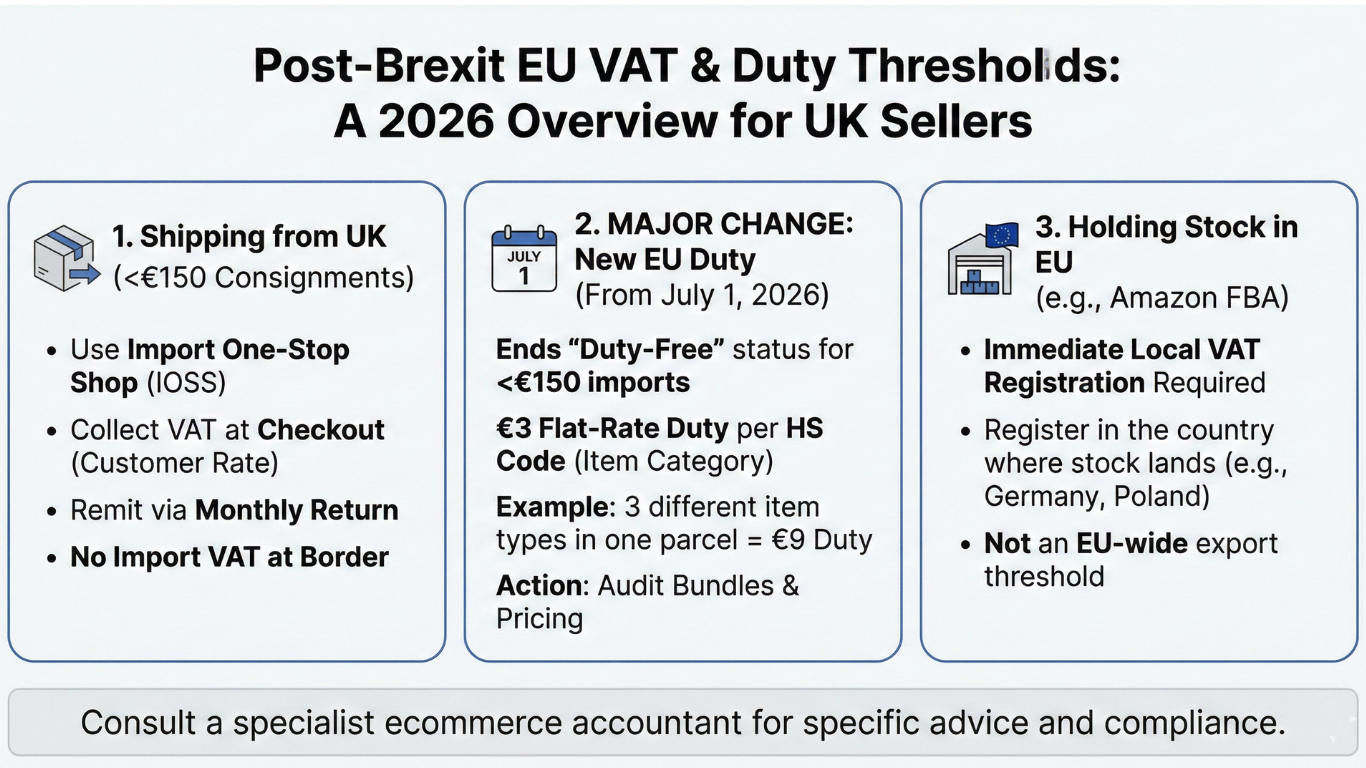
The days of country-specific "distance selling thresholds" (where you could sell €35k to France or €100k to Germany before registering for VAT) are ancient history. They were abolished years ago, yet I still see forums giving out this outdated advice.
Here is the reality for 2026:
If you are a UK business shipping goods from the UK directly to customers in the EU:
- Consignments under €150: No import VAT is charged at the border if you use the Import One-Stop Shop (IOSS). Instead, you collect VAT at the checkout (based on the customer's country rate) and remit it via a single monthly return.
- Consignments over €150: Import VAT and duties apply at the border. The customer often pays this before delivery unless you send it DDP (Delivered Duty Paid).
- New EU Duty on Small Parcels:The biggest change of 2026 arrives on July 1st, when the EU effectively kills the "duty-free" status of small parcels. A new €3 flat-rate customs duty will apply to almost all ecommerce imports under €150. Crucially, this fee is charged per item category (HS code) within a parcel. If you’re shipping a gift box with three different types of products, you could be hit with a €9 duty on a single order. For UK brands with low average order values, this could instantly wipe out your margins—so now is the time to audit your product bundles and pricing before the summer deadline.
If you hold stock inside the EU (e.g., an Amazon warehouse in Germany or a 3PL in Poland):
- You generally need a local VAT registration immediately in the country where the stock lands.
- The EU-wide threshold of €10,000 applies to cross-border sales within the EU, not exports from the UK.
Pro Tip: Don’t confuse shipping to Europe with storing in Europe. The moment your stock hits the floor of an EU warehouse, your tax obligations change completely.
How the One-Stop Shop (OSS) Scheme Simplifies EU Tax for UK Sellers
The Union One-Stop Shop (OSS) is often confused with IOSS, but they serve different purposes. As an ecommerce accountant in the UK, I often have to untangle this for clients using hybrid models.
What is OSS?
It is a portal that allows you to report VAT for sales made between EU countries.
Who is it for?
It is primarily for UK businesses that:
- Hold stock in an EU country (e.g., Netherlands).
- Sell that stock to customers in other EU countries (e.g., France, Spain, Italy).
Before OSS, if you held stock in Germany and sold to France, you eventually had to register for VAT in France. Now, you can keep your German VAT number (because you hold stock there) and use the OSS return to report the sales to France, Spain, and Italy all in one go.
Do I need OSS or IOSS?
When Amazon’s Pan-EU Programme Triggers Immediate VAT Obligations
This is the most common trap for Amazon FBA sellers. Amazon’s Pan-EU programme is fantastic for logistics—they move your stock around Europe to be closer to customers.
However, the tax implication is severe.
- Every time Amazon moves your inventory into a new country to store it, you have created a taxable presence there.
- If Amazon moves your stock to Poland, you need a Polish VAT registration.
- If they move it to the Czech Republic, you need a Czech registration.
Does OSS cover this?
No. OSS covers the sale to the customer, not the movement of your own stock between warehouses.
If you switch on Pan-EU without having your VAT numbers ready, you are technically non-compliant from day one. I have seen Amazon suspend accounts until proof of VAT submission is provided. Do not turn on Pan-EU settings in Seller Central until your accountant gives you the green light.
Common Mistakes UK Merchants Make When Reporting EU Sales to HMRC
Just because you are paying tax in Europe doesn't mean you can ignore your UK books. The interaction between UK VAT returns and EU sales is where things get messy, especially with software integrations.
1. Double Counting Revenue
If you use Xero or QuickBooks with connectors like A2X or Link My Books, ensure your tax mapping is perfect. I often see sellers pay VAT on the sale in the EU via OSS, and then accidentally pay 20% UK VAT on the same sale because it wasn't marked as "Zero-Rated Income" in Xero.
2. The Seller Economy Blind Spot
For my clients who are online sellers or sellers on TikTok Shop, the struggle is real.
The hard truth: Even in 2026, the integration software for online sellers and sellers basically doesn't exist. Unlike Shopify or Amazon, where we have slick APIs, seller payouts often come as lump sums with vague breakdowns.
If you are an channel receiving commissions from EU audiences, reconciling which country generated the income—and who is liable for the VAT (usually the platform, strictly speaking, deemed supplier rules apply)—requires manual work. Do not rely on automated bank feeds here; they will not give you the granularity you need.
Managing Cross-Border Compliance Without Costly HMRC Penalties
Compliance isn't just about paying the right amount; it's about proving it.
If HMRC inspects your UK returns, they will look at your "Zero-Rated Exports". They want proof that those goods actually left the UK. If you cannot prove the goods left the country, HMRC can demand you pay 20% VAT on those sales retrospectively.
What you need to keep on file:
- Proof of export (shipping manifests, courier tracking).
- Correct commodity codes (HS codes) on all commercial invoices.
- Settlement statements showing the currency conversion rates used (Amazon uses their own rate; HMRC expects you to use published exchange rates, though there is some leeway if consistent).
Your Step-by-Step 2026 Checklist for Total European Tax Compliance
To wrap this up, here is your cheat sheet. If you can tick these off, you are in a safe position.
- Map your supply chain: Do you ship from the UK, or do you hold stock in the EU?
- Check the €150 limit: Are your average order values triggering duties? If so, have you communicated this to the customer?
- Register for IOSS: If shipping from the UK, this stops your customers getting hit with surprise fees at the door.
- Review Amazon Settings: Is "Pan-EU" active? If yes, do you have VAT numbers for every country Amazon stores your stock in?
- Verify HS Codes: Are your product codes up to date for 2026 customs requirements?
- Reconcile Manually if Needed: If you are a seller/channel, don't trust the automation blind. Check the settlement statements manually.
- Speak to a Specialist: Generalist accountants often miss the nuances of Deemed Supplier rules.
Need a hand making sense of your EU tax obligations?
At Social Commerce Accountants, we specialise in helping ecommerce brands navigate the complexities of cross-border trade. We act as the ecommerce accountant UK businesses trust to handle the numbers, so you can focus on the growth.