
If you are selling on TikTok Shop right now, you are likely looking at your bank feed and thinking everything is fine. The payouts are landing, the stock is moving, and the views are climbing.
But there is a problem lurking in your dashboard.
We call it the "Net Payout Trap," and it is the reason so many sellers and online sellers get a nasty shock when filing their tax return UK wide. TikTok pays you after they have taken their cut, but HMRC expects you to declare the total amount the customer paid before fees.
If you are only declaring what hits your bank account, you are under-reporting your turnover. If you aren't claiming the fees back as expenses, you are overpaying tax. It is a mess.
As ecommerce accountants UK sellers rely on, we see this daily. The platform is moving faster than the software can keep up. Unlike Amazon or Shopify where tools like A2X bridge the gap perfectly, the integration software for TikTok Shop online sellers and sellers simply doesn't exist in a robust way yet. You have to dig for the data.
Here is how to defuse the tax timebomb and ensure you aren't leaving money on the table in 2026.
Understanding TikTok Shop Tax Laws for 2026
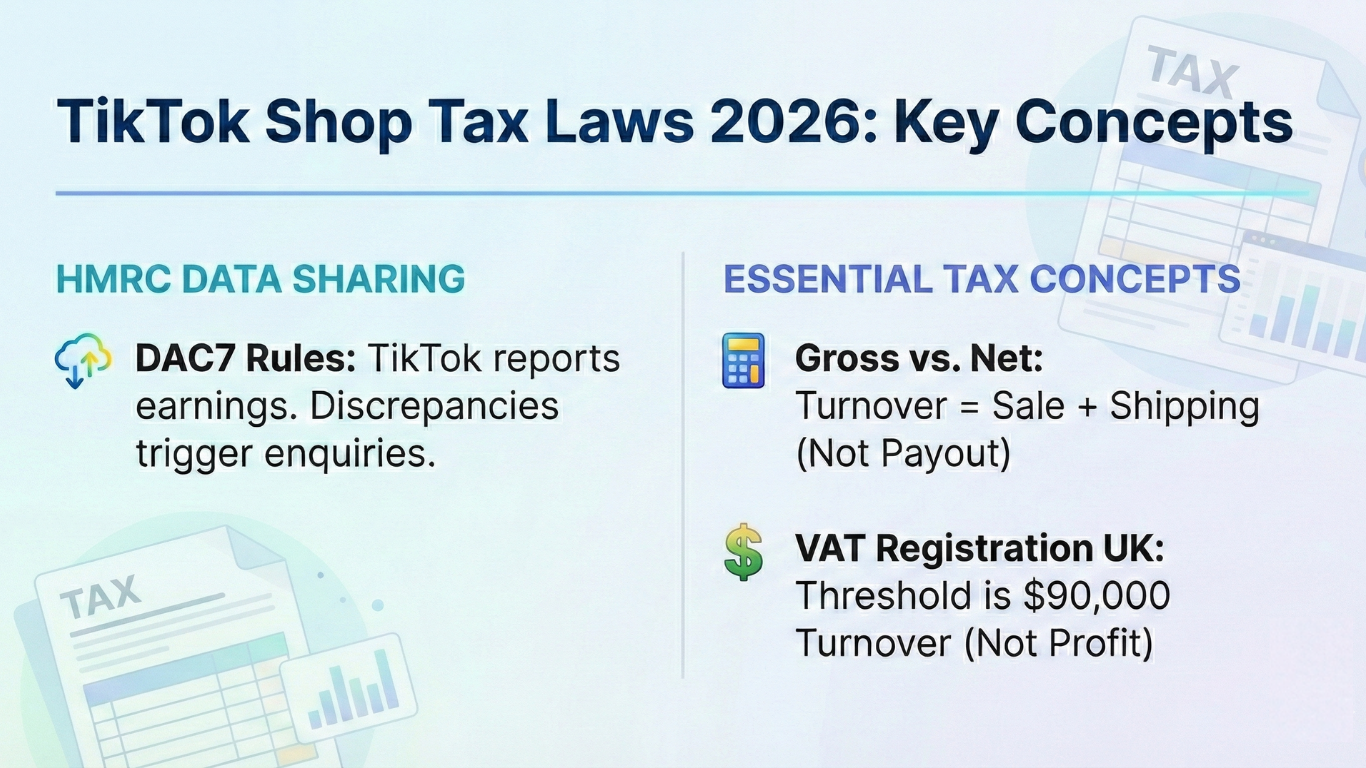
First, let’s clear up the regulatory landscape. HMRC has ramped up its data-sharing agreements with digital platforms (the DAC7 rules). This means TikTok is legally obligated to report your earnings to the tax man.
If your declared income on your Self Assessment or Corporation Tax return doesn't match what TikTok tells HMRC, you are flagging yourself for an enquiry.
For 2026, you need to understand two key concepts:
- Gross vs. Net: Your "Turnover" is the sale price of the item + shipping paid by the customer. It is not the payout amount that hits your Monzo or Starling account.
- VAT Registration UK: If that Turnover (not profit) hits $90,000 (the current rolling 12-month threshold), you must register for VAT. Because TikTok collects VAT on fees, understanding the "Reverse Charge" mechanism is also vital for your returns.
Deducting TikTok Shop Transaction and Referral Fees
This is the single biggest deduction sellers miss.
When you sell a product for $20, TikTok might take a referral fee, a shipping fee, and a transaction fee, eventually depositing $14 into your account.
Many generic tax return accountants will simply record the $14 as income. This is incorrect.
- The Correct Method: You record $20 as sales income. You then record $6 as "Cost of Sales" or "Merchant Fees."
By doing this, your profit remains the same ($14), but your turnover is accurate for VAT thresholds and mortgage applications. More importantly, if you are VAT registered, you might be able to reclaim VAT on those fees if TikTok has charged it correctly (though often these are subject to reverse charge—ask us if you are unsure).
What this means for you: Download your "Settlement Reports" from TikTok Shop. Do not rely on your bank feed. You need to itemise every single fee deducted from your payouts.
Writing Off Content Creation Equipment and Props
You cannot run a TikTok Shop without content. The visual nature of the platform means your equipment is a necessary business tool.
However, HMRC applies the "Wholly and Exclusively" test. You can deduct the cost of items used wholly and exclusively for your trade.
Valid Deductions:
- Lighting: Ring lights, softboxes, and studio lighting.
- Audio: Microphones (like the DJI Mic or Rode Wireless) used for voiceovers.
- Props: Items purchased specifically for a video shoot that are not for personal use (e.g., specific backdrops, aesthetic desk organisers for a "pack with me" video).
- Camera Gear: Tripods, gimbals, and cameras.
The Grey Area (Smartphones): If you buy an iPhone 16 Pro solely for filming and have a separate cheap phone for personal calls, you can claim 100%. If you use one phone for both, you must calculate a "business use percentage" (e.g., 80% business) and only claim that portion.
Maximising the Home Office Deduction for Online sellers
Most TikTok Shop sellers start from a spare room or the kitchen table. You are entitled to tax relief for the business use of your home.
You generally have two choices:
- Simplified Expenses (Flat Rate): HMRC allows a flat monthly rate based on hours worked. It is easy, but often lower than your actual costs.
- Actual Costs: You calculate the percentage of floor space your business uses and the percentage of time you use it. You can then claim that portion of your rent, council tax, electricity, and heating.
Don't forget storage: If your spare room is filled floor-to-ceiling with stock for your TikTok Shop, that room is being used 24/7 for business. This significantly increases the portion of rent/bills you can claim compared to just sitting at a desk for 4 hours a day.
Software, Apps, and AI Tools as Business Expenses
To compete in 2026, you are likely using a stack of digital tools. As a specialist ecommerce tax accountant, I see clients forgetting to put these small monthly subscriptions through the business books. They add up.
Claimable subscriptions often include:
- Creative: Adobe Creative Cloud, Canva Pro, CapCut Pro.
- Link Management: Linktree or Beacons.
- AI Tools: ChatGPT Plus, Midjourney (for branding), or copy-writing AI.
- Accounting: Xero or QuickBooks.
A Note on Integration: As I mentioned earlier, for TikTok sellers and sellers specifically, the integration software market is behind. There isn't a "set and forget" button that pulls all your channel fee data perfectly into Xero yet.
You may need to pay for custom spreadsheet connectors or admin assistance to reconcile this data manually. These costs are fully tax-deductible.
Cost of Goods Sold (COGS) for Unsold Inventory
This is where things get technical, and where having an ecommerce accountants near me (or online) saves you from a tax bill nightmare.
If you buy $10,000 worth of stock in December but don't sell it until January, can you claim that $10,000 as an expense in December?
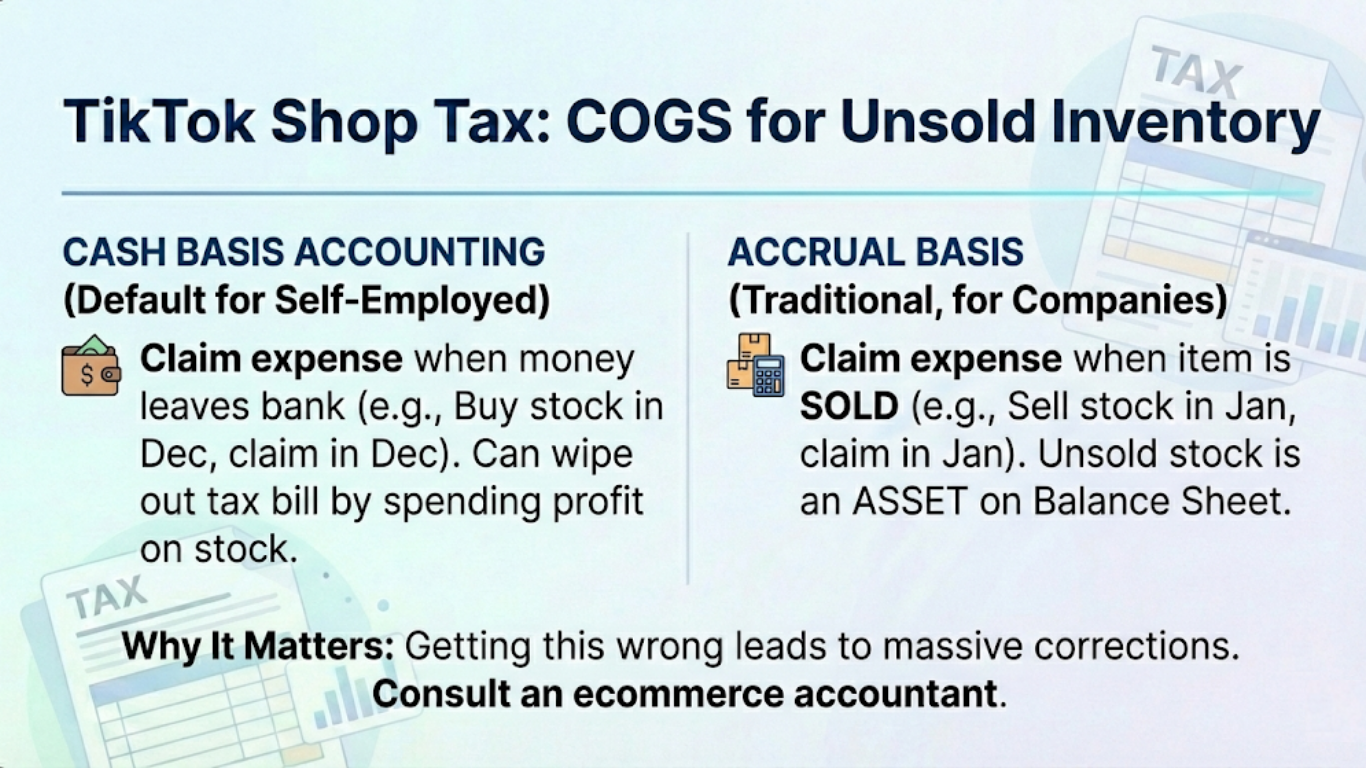
- Cash Basis Accounting: Generally, yes. You claim the expense when the money leaves your bank. (Note: The Cash Basis became the default for self-employed traders from April 2024).
- Accrual Basis (Traditional Accounting): No. You only claim the cost of the item when it is sold. The unsold stock sits on your Balance Sheet as an asset.
Why this matters: If you are scaling fast and holding lots of stock, using the Cash Basis might wipe out your tax bill entirely for the first year (because you spent all your profit on more stock). However, limited companies and larger brands usually use Accruals. Getting this wrong leads to massive corrections later.
Checklist: What to Give Your Accountant This Year
If you want to keep your fees down and your tax expert happy, do not turn up with a shoebox of receipts or a chaotic CSV file.
Here is exactly what we need to file your return accurately:
- TikTok Monthly Settlement Statements: These show the gross sales, fees, and refunds.
- Bank Statements: PDF copies for the full financial year.
- Expense Invoices: For all that lighting, software, and stock.
- Inventory Value: A count of the stock you held at your year-end date (at cost price).
- Channel Dashboards: If you earn channel income separately from your shop, we need screenshots or exports of those payout breakdowns.
Final thought: TikTok Shop is an incredible opportunity, but the admin is heavy. Don't let the tax side distract you from growing your brand.
This guide is not financial advice. All content is for educational purposes only. Please consult a qualified accountant or financial advisor to discuss how these strategies apply to your specific business circumstances before making any financial decisions.