
If 2024 was the year of the TikTok Shop explosion, and 2025 was the year of consolidation, then 2026 is undoubtedly the year of compliance and automation.
Welcome to the new reality.
For years, I’ve sat with clients who viewed their e-commerce ventures as "side hustles"—a bit of extra cash from Depop, Vinted, or Amazon FBA that existed in a grey area of the economy. But as we settle into January 2026, the "wild west" era of social commerce is officially over.
The regulatory nets have tightened, the taxman has upgraded his tech, and the way your customers buy products has fundamentally shifted.
If you are selling online in the UK today, here is the state of play.
The Death of the 'Hobby' Seller (and the DAC7 Hangover)
Do you remember the panic back in early 2024 about the "side hustle tax"? At the time, many dismissed it as scaremongering.
Fast forward to today. The OECD’s Model Reporting Rules (implemented in the UK as the Platform Operators Regulations) are now fully mature. We are currently seeing the fallout from the first full cycle of data sharing.
The Reality Check:
By 31st January 2025, platforms like TikTok, Etsy, eBay, and Vinted submitted their first complete reports to HMRC covering your sales data from the 2024 calendar year.
- What this means now: HMRC currently holds a digital dossier of your exact gross income. They know how many units you shipped and exactly how much revenue you generated.
- The "Nudge" Letters: If your self-assessment tax return filed a few weeks ago (for the 24/25 tax year) didn't match the data Amazon or TikTok sent to HMRC, you are likely already flagged for an enquiry.
The concept of a "hobby" seller who flies under the radar is extinct. If you turn over more than £1,000 (the Trading Allowance), you are on the grid. The difference in 2026 is that HMRC no longer relies on you to tell them; they already know.
The New Tax Traps: Fiscal Drag & The MTD Deadline
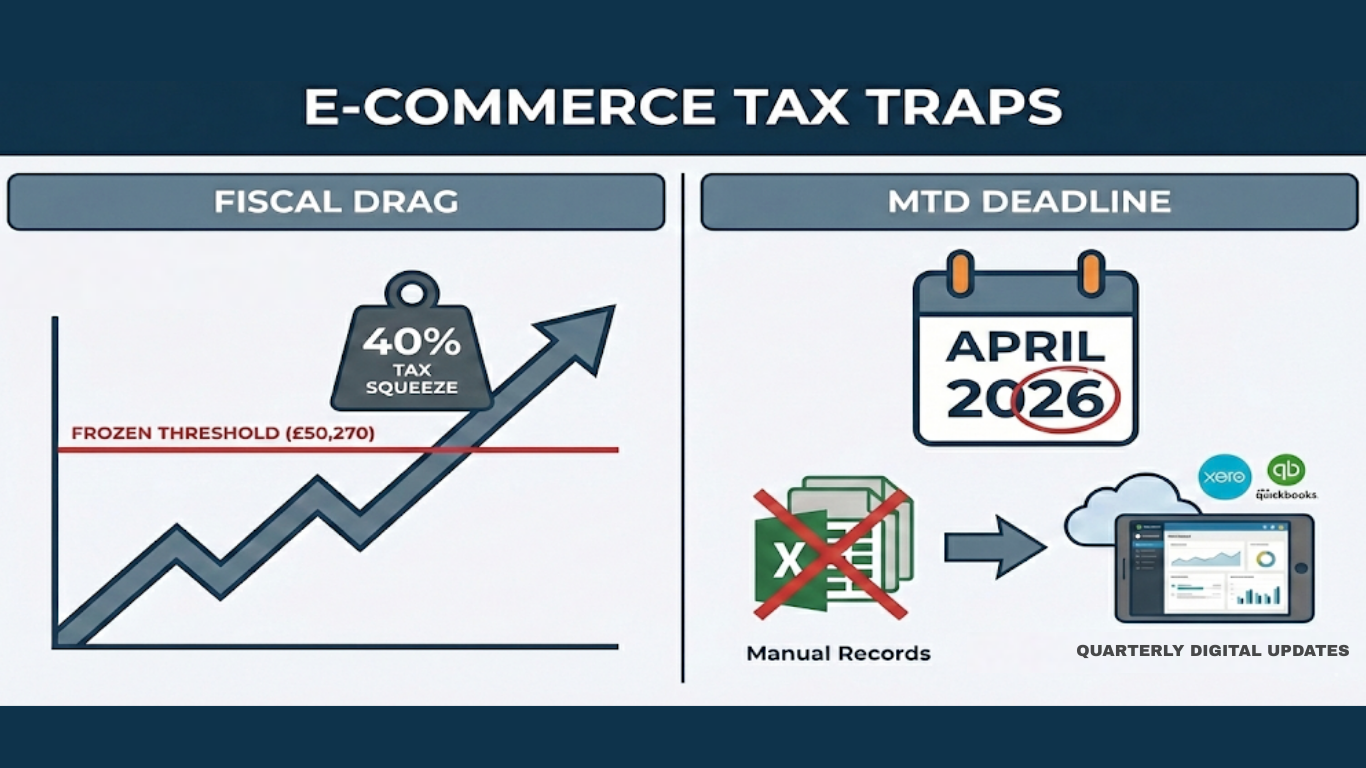
The political landscape has created a silent squeeze on e-commerce profits. With the Chancellor confirming late last year that income tax thresholds will remain frozen until 2030/31, we are facing a brutal period of "fiscal drag."
For a successful social commerce brand, hitting £50,270 in profit is easier than ever—but in real terms, that money buys significantly less than it did five years ago, yet you are being pulled into the 40% Higher Rate tax band immediately.
The Looming April 2026 Deadline:
We are mere months away from the mandatory rollout of Making Tax Digital (MTD) for Income Tax.
- From April 2026, if your qualifying income is over £50,000, you can no longer file a simple once-a-year return.
- You must keep digital records and send quarterly updates to HMRC.
- The Trap: Many sellers are still running their seven-figure TikTok empires on Excel spreadsheets. Come April, this will be non-compliant. If you haven't migrated to Xero or QuickBooks yet, you are essentially driving a car with no MOT.
Rise of the AI Shopper: Who is Really Buying Your Products?
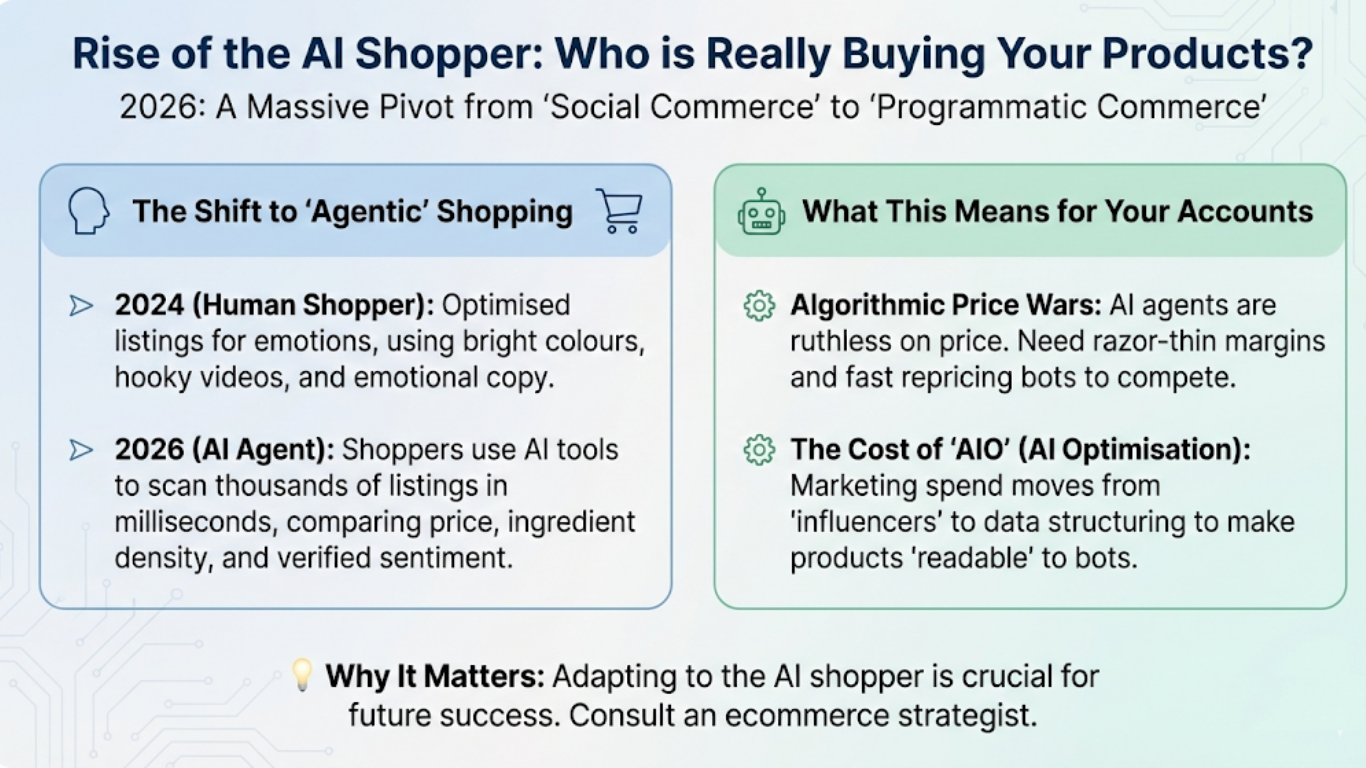
While the tax landscape is tightening, the commercial landscape is getting stranger. In 2026, we are seeing a massive pivot from "Social Commerce" to "Programmatic Commerce."
The shift to 'Agentic' Shopping:
In 2024, we optimised listings for humans. We used bright colours, hooky videos, and emotional copy.
In 2026, your customer is increasingly an AI Agent.
Shoppers are using tools integrated into their operating systems (like the advanced iterations of Amazon’s Rufus or OpenAI’s agents) to "find me the best organic face cream under £30." The AI scans thousands of listings in milliseconds, comparing price per ml, ingredient density, and verified sentiment analysis of reviews.
What this means for your accounts:
- Algorithmic Price Wars: AI agents are ruthless on price. If your margins aren't razor-thin and perfectly calculated, you will lose out to a competitor whose repricing bot is faster than yours.
- The Cost of "AIO" (AI Optimisation): Marketing spend is moving away from traditional "online sellers" and toward data structuring that makes your product "readable" to shopping bots. This is a new line item in your P&L that didn't exist two years ago.
The VAT Threshold Trap
The VAT registration threshold remains a stubborn ceiling for many of my clients. By freezing the threshold (still lingering around £90k), the government has created a "growth cliff."
In 2026, due to inflation, £90k turnover is not a large business. It is a small side hustle. Yet, crossing it immediately swipes 20% of your gross margin (if you can't pass it on to customers).
The Trap:
I am seeing many sellers trying to "manage" their sales to stay under the threshold.
- Do not do this. Artificially suppressing your sales to avoid VAT is a surefire way to kill your business valuation.
- The Solution: You must model your pricing structure as if you are already VAT registered. If your unit economics don't work with VAT included, you don't have a viable business in 2026.
Action Plan for 2026
If you are reading this feeling slightly nauseous, don't worry. Clarity is the first step to solvency. Here is your immediate checklist:
- Audit Your 2024/25 Data: Ensure the revenue you declared on your recent tax return matches exactly what your platforms (TikTok Shop, Amazon, Shopify) show on their seller dashboards. If there is a discrepancy, correct it before HMRC writes to you.
- Ditch the Spreadsheets: With the April 2026 MTD deadline looming for higher earners, you need a cloud accounting stack now. We recommend Xero as a starting point.
- Review Your Margins for AI: Can your product survive a price comparison by a ruthless AI agent? If not, you need to build brand equity that an algorithm can't quantify—community, story, and exclusivity.
- Professionalise Your Structure: If you are hitting that £50k profit mark, the sole trader route is becoming tax-inefficient and risky. It might be time to look at Limited Company incorporation, not just for tax, but for the liability protection it offers in an increasingly litigious market.
Summary
The era of "fake it 'til you make it" is over. In 2026, the data is too transparent, and the technology is too advanced.
But this is good news. It means the market is maturing. It means the "cowboys" are being flushed out, leaving more room for genuine, well-run brands to dominate.
Stay compliant, stay profitable, and keep building.
This guide is not financial advice. All content is for educational purposes only. Please consult a qualified accountant or financial advisor to discuss how these strategies apply to your specific business circumstances before making any financial decisions.