
.png&w=3840&q=75)
We all chase the notification spike. That moment when your phone buzzes so much it feels like it’s vibrating off the table. For a TikTok Shop seller, going viral is the holy grail.
But as an accountant who works exclusively with social commerce brands, I need to be the one to burst the bubble: Revenue is vanity, profit is sanity, and cash is reality.
I have seen businesses do £50,000 in sales over a weekend and end up with less money in the bank than when they started. When you factor in TikTok Shop fees, aggressive ad spend, and the hidden logistics of fulfilling thousands of orders, the margins can disappear faster than a trending sound.
Here is the financial reality of viral success on TikTok Shop—and how to ensure you actually keep the money.
The "Viral Tax": Why High Views Don’t Always Mean High Profits
There is a concept I explain to clients called the "Viral Tax." It’s the margin erosion that happens when volume scales faster than your operations.
When you sell ten units a day, you pack them yourself. When you sell 1,000 units in an hour, the economics change. You are suddenly paying for rush shipping from suppliers, emergency 3PL fees, and overtime.
What this means for you
If your standard profit margin is 20%, a viral spike can compress that to 5% or even negative figures if you aren’t tracking social commerce margins in real-time. The cash flow gap is the killer: TikTok holds your payout (often 15+ days), but your suppliers want paying now.
Breaking Down TikTok Shop Fees
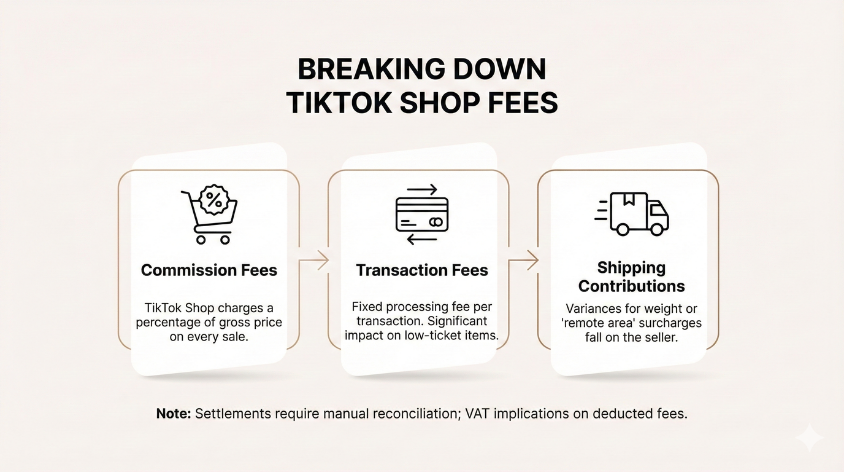
To understand TikTok Shop profitability, you must strip away the platform’s cut first. Don't mentally spend your gross revenue.
Here is the hierarchy of deductions:
- Commission Fees: TikTok Shop charges a commission on every sale. Budget for this percentage coming off the gross price.
- Transaction Fees: Similar to Stripe, there is a processing fee per transaction. On low-ticket items (under £15), this fixed fee eats a massive chunk of your margin.
- Shipping Contributions: Even if TikTok subsidises some shipping, variances in weight or "remote area" surcharges usually fall on you.
Accountant’s Note: The integration software for online sellers and sellers doesn't really exist yet. Unlike Amazon/Xero integrations which are seamless, TikTok Shop settlements often require manual reconciliation to ensure you aren't paying VAT on fees that were already deducted.
The Ad Spend Trap: ROAS vs. ROI
This is where I see the most money wasted. You see a ROAS (Return on Ad Spend) of 3.0 and think, "Brilliant, keep spending!"
But ROAS is a marketing metric. It ignores your Cost of Goods Sold (COGS), VAT, and overheads.
- ROAS: Measures gross revenue from ads.
- ROI: Measures actual net profit after all costs.
If your product has a 30% margin and you are spending 35% of the sale price on TikTok ad costs, you are losing money on every "successful" conversion.
Inventory Logistics: The Hidden Costs
When a video goes viral, you sell out. That triggers a chain reaction of costs that hurt TikTok Shop profitability:
- Emergency Air Freight: Restocking via air from China costs significantly more than sea freight.
- 3PL Surge Pricing: Warehouses often charge extra for "rush" processing or exceeding volume caps.
- Returns: High volume often leads to lower quality control. If 5% of your viral orders are returned, the processing costs can wipe out your viral marketing ROI.
How to Calculate Your "Viral Break-Even" Point
Do not wait for the end of the month to check your bank balance. Use this logic to find your true break-even point:
Gross Profit = (Selling Price - VAT) - COGS - Shipping Cost - Net TikTok Fees
The Real-World Example:
- Selling Price: £20.00
- VAT: £3.33
- COGS: £5.00
- Shipping: £3.50
- TikTok Fees: £1.00
- Result: You have £7.17 left.
If your CPA (Cost Per Acquisition) on TikTok Ads is £8.00, you are losing 83p per sale. You are going viral, and you are going broke.
Strategies to Pad Your Margins
To combat TikTok Shop seller fees, you need to increase the Average Order Value (AOV).
- The Bundle Strategy: Don't sell one item for £8. Sell a kit of three for £20. You pay shipping and transaction fees once, effectively lowering your customer acquisition cost on TikTok.
- Digital Upsells: Attach a PDF guide or video course to the physical product. These have 100% margin and can turn a break-even order into a profitable one.
Moving Beyond the Spike
The tragedy of social commerce is the "one-hit wonder." To secure long-term success, you must move customers off TikTok.
- Inserts: Include a card offering a discount for your Shopify store.
- Email: Build a list so you can market to them again for free.
- Subscriptions: If you sell consumables, push them toward a subscription model.
The goal is to pay for the customer once via TikTok fees, and monetize them repeatedly for free.
Q&A: Common TikTok Shop Accounting Questions
Q: Can I claim TikTok Shop fees as a business expense?
A: Yes. These are a cost of sale. Ensure you download the monthly VAT invoices from the TikTok seller center to reclaim VAT correctly.
Q: Why doesn't my bank deposit match my sales report?
A: TikTok deducts fees, refunds, and adjustments before sending the cash. You receive the net amount. We have to reconcile this manually against the Settlement Report.
Q: How do I handle VAT on TikTok Shop sales?
A: TikTok is often a Marketplace Facilitator, meaning they collect and remit VAT. However, this depends on where your stock is held. Never assume—check your liability settings.
Bonus Tip: Your 12-Month Exit Roadmap
If you are crushing it on TikTok Shop, you are building an asset. But investors don't buy "viral moments"; they buy consistent cash flow.
If you plan to sell your brand, segregate your "viral" ad spend from your "maintenance" ad spend in your accounts. This allows us to prove to buyers that the business is profitable even without the aggressive marketing budget.
This guide is not financial advice. All content is for educational purposes only. Please consult a qualified accountant or financial advisor to discuss how these strategies apply to your specific business circumstances before making any financial decisions.