
For years, UK e-commerce brands selling into Europe have leaned on a specific "buffer": the €150 de minimis threshold. If your parcel was valued under that amount, it slipped through without customs duties. It made the post-Brexit transition slightly less painful for D2C brands and TikTok sellers shipping to EU customers.
However, the European Commission is moving to scrap this exemption entirely. This isn't just a minor paperwork update; it’s a fundamental shift in how UK-to-EU trade functions. Whether you are scaling an Amazon FBA brand or managing a viral TikTok Shop, the "cheap" entry to the European market is closing.
What is the EU De Minimis rule?
The EU de minimis rule currently allows goods valued at €150 or less to be imported into the EU from non-EU countries (like the UK) without being subject to customs duties. While Import VAT is still due (usually via IOSS), the absence of duty has kept costs down for small-batch sellers.
The big change: As of 1 July 2026, a temporary €3 flat customs duty per item is expected to apply to these low-value parcels. By 2028, the threshold will be abolished entirely, and full customs duties based on product categories will apply to every single package, regardless of value.
EU De Minimis Changes for Amazon Sellers
If you’re running an Amazon FBA or FBM business from the UK, the removal of the €150 threshold hits your bottom line and your "Buy Box" eligibility. Currently, many UK sellers use the Merchant Fulfilled Network (MFN) to test EU markets, relying on the de minimis rule to keep pricing competitive.
When the new rules kick in—starting with the interim €3 fee in July 2026—your landed cost increases. If you aren't using Amazon’s Pan-EU FBA program (which involves holding stock inside the EU), you’ll face a choice: absorb the duty costs or pass them to the customer. Passing them on often leads to "Customs Refused" returns, which tank your account health. You need to audit your pricing architecture now to ensure your margins can survive an extra €3 per item, or eventually, 4% to 12% in duty on every unit.
What this means for you: Your Amazon settlements are about to get more complex. You’ll need to ensure your shipping settings are strictly DDP (Delivered Duty Paid) to avoid customer friction, but the cost of that "convenience" is going up.
Expert Tip: Check if your product categories carry high duty rates. If they do, shipping individual units from the UK may no longer be viable compared to bulk-shipping to an EU-based 3PL before 2028.
Looking to protect your Amazon margins? Book a discovery call with our e-commerce specialists.
EU De Minimis Changes for TikTok Shop Sellers
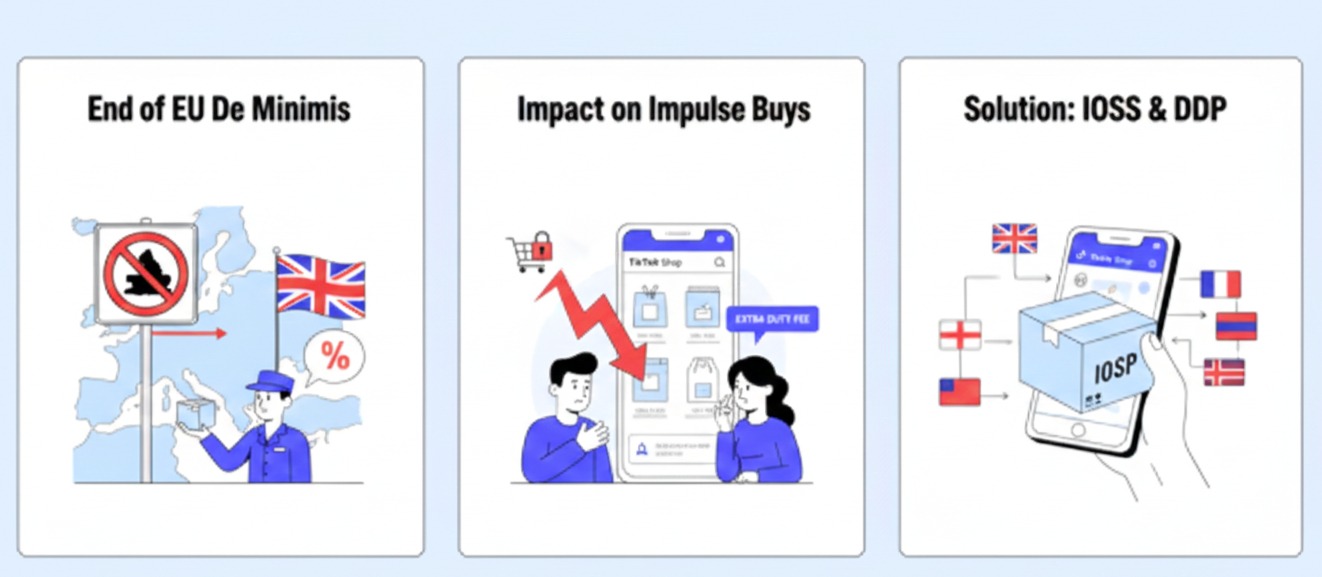
TikTok Shop is the wild west of e-commerce right now, and for UK brands shipping to EU shoppers via the platform, the end of de minimis is a major roadblock. TikTok Shop thrives on impulse buys—usually lower-order values that fall neatly under the €150 mark.
When duty applies to every order, the seamless "scroll and buy" experience is at risk. If a customer in France gets a notification from La Poste asking for €3+ in duty before they can receive their £20 leggings, your brand sentiment will nosedive. TikTok’s backend isn't always the most sophisticated at handling varied duty rates across 27 different member states, so the onus is on you to bake these costs into your TikTok Shop shipping templates.
What this means for you: You need a clear strategy for IOSS (Import One Stop Shop) and a courier partner that can handle DDP at scale for small parcels. Be prepared for the €3 "per item" rule—if a customer buys three items, that’s an extra €9 in costs.
Struggling with TikTok Shop payouts and VAT? Let’s get your Xero set up correctly.
EU De Minimis Changes for Shopify Sellers
For Shopify store owners, the end of the €150 rule is an administrative headache. Unlike Amazon, you own the entire customer experience, which means you own the blame when things go wrong at the border.
Most Shopify brands use apps like Zonos or Shopify Markets to calculate duties at checkout. If you haven’t updated your settings to account for the upcoming 2026 flat fee or the 2028 full removal, your checkout will be providing inaccurate quotes. We see many brands failing to reconcile the duty paid at checkout with the actual bill from DHL or UPS. Without the €150 buffer, these discrepancies will happen on every single EU order, leading to a nightmare in your Xero reconciliation.
What this means for you: You must ensure your Shopify tax settings are configured to collect duty at the point of sale for all orders, not just those over €150.
Need to sync Shopify and Xero without the mess? Speak to our Shopify accounting team today.
EU De Minimis Changes for Etsy Sellers
Etsy sellers often deal in handmade or unique items with high margins but low volumes. The de minimis rule was a lifesaver for the "side-hustle" turned "scale-up" Etsy brand.
With the threshold gone, Etsy will likely have to update its internal IOSS system to handle duty collection for all transactions. For the seller, this means more of your sale price is eaten up before it hits your bank account. If you sell vintage items or supplies where the HS codes (customs codes) are ambiguous, you risk your items being held at the border or overcharged. Accuracy in your listing data has never been more critical.
What this means for you: Every listing needs a precise HS code. If you guess, you’ll pay for it in customs penalties and unhappy EU customers.
Want to know how your Etsy fees impact your actual profit? Reach out for a brand audit.
EU De Minimis Changes for TikTok Sellers
Here is the hard truth that most "gurus" won't tell you: the tech stack for UK TikTok sellers is broken when it comes to international complexity. If you are an channel receiving samples from EU-based brands, or if you are promoting products that ship from the UK to EU followers, the removal of the €150 rule complicates your "earning potential."
While brands handle the shipping, the increased friction at the border means lower conversion rates for your links. Furthermore, as a seller, if you are receiving high-value "PR packages" or samples from the EU, the removal of the threshold could theoretically make these samples subject to duty upon arrival in the UK (if the UK reciprocates, which is currently planned for March 2029).
The Software Gap:
We often get asked about automation for online sellers. While brands use A2X or Link My Books to manage Amazon and TikTok Shop settlements, these tools do not work for TikTok Sellers. There is currently no "plug-and-play" integration that handles the nuanced commission-only income and the associated VAT liabilities for international promotion. You are likely doing this manually or incorrectly.
What this means for you: You need a specialist accountant who understands the "Seller Economy" and can manually reconcile your TikTok income while accounting for the impact of international trade barriers on your commission.
Are you a high-earning channel? Get an accounting partner who actually gets TikTok.
EU De Minimis Changes for Subscription Boxes
Subscription box models rely on predictable, recurring costs. If you ship a monthly box from the UK to EU subscribers for £30, you’ve likely never worried about customs duty.
The end of de minimis turns your predictable model into a variable cost nightmare. The interim July 2026 rule—€3 per item based on commodity codes—is particularly lethal for sub-boxes. If your box contains 5 different items (a snack, a drink, a sticker, etc.), you could be looking at €15 in duties on a £30 box. The administrative burden of declaring these monthly at the border without the €150 exemption could make the EU market unprofitable for many UK sub-boxes.
What this means for you: You may need to simplify your box contents to fall under a single HS code (where legal) or consider "kitting" your boxes inside the EU to bypass parcel-level duties.
Running a subscription model? Let’s look at your international shipping margins.
Why "Wait and See" is a Dangerous Strategy
The EU is making these changes to combat the flood of undervalued parcels coming from giant marketplaces and to reclaim lost tax revenue. UK brands are simply caught in the crossfire.
If you wait until 2026 to update your Xero, your shipping software, and your pricing, you will face a week of "failed deliveries" and a month of accounting errors. We recommend a full "Duty Impact Assessment" for every brand we work with that does more than 10% of their turnover in the EU.
Summary Table: Current vs. Future State
Q&A
When does the EU €150 duty exemption end?
The EU will begin removing the exemption with an interim flat fee (likely €3) starting 1 July 2026. The full abolition of the €150 threshold and transition to the EU Customs Data Hub is set for 2028.
Does this affect UK sellers shipping to the EU?
Yes. Every parcel sent from the UK to an EU consumer will be subject to customs duties, regardless of value, once the exemption is fully removed.
What is the "€3 per item" rule?
Starting mid-2026, the EU plans to charge a flat customs fee of approximately €3 for every distinct product category (HS code) within a parcel valued under €150, provided the seller uses IOSS.
Can I still use Xero for my EU sales?
Yes. However, you must ensure your accounting workflow separates the new duty fees from the product price and VAT. Simply recording the "net" bank receipt will hide the fact that your margins are being eroded by these new costs.
This guide is not financial advice. All content is for educational purposes only. Please consult a qualified accountant or financial advisor to discuss how these strategies apply to your specific business circumstances before making any financial decisions.