
It is the most common trap in e commerce: staring at the Shopify dashboard, watching the sales figures climb, and assuming everything is fine.
You see the revenue number. It looks healthy. But when you check your actual bank balance at the end of the month, the cash isn’t there.
As a specialist ecommerce accounting firm, we see this scenario constantly. Founders often confuse turnover with profit. They scale their ad spend based on top-line revenue, only to realise they have been operating at a loss for months.
Real profitability isn’t found on your Shopify dashboard. It is found in the reconciliation work—the boring, gritty details of accounts shopify sellers often overlook.
Here is how to calculate if your Shopify store is actually making money, and where the hidden leaks usually are.
Revenue vs. Profit: The Core Difference
Before we dive into maths, we need to define the terms clearly.
What is the difference between Revenue and Net Profit?
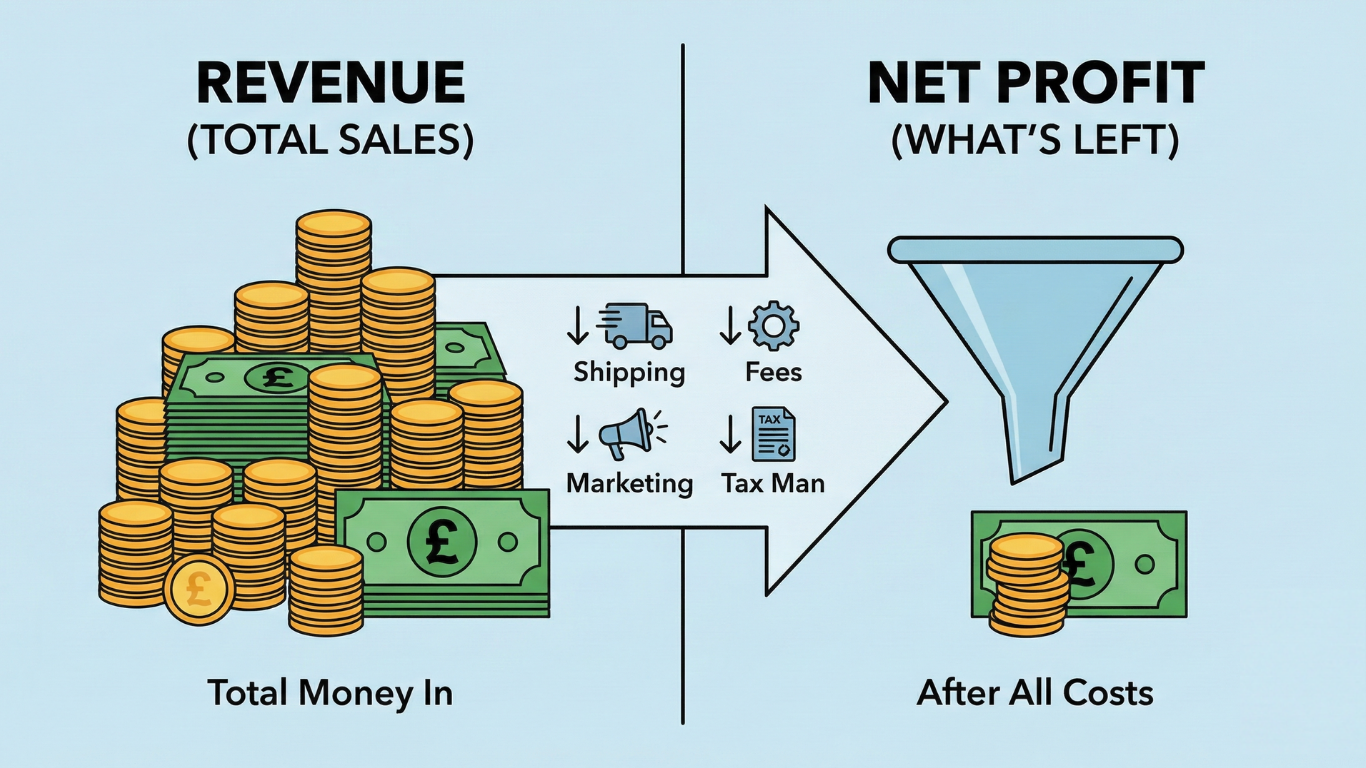
Revenue (Gross Sales) is the total amount of money your customers have paid you. Net Profit is what is left after you have paid for the product, the shipping, the platform fees, the marketing, and the tax man.
The VAT Trap
If you are VAT registered in the UK, 1/6th of your gross sales figure doesn't belong to you—it belongs to HMRC.
Many new sellers look at a £120 sale and think they have £120 to play with. In reality, you have £100. The £20 VAT must be stripped out immediately before you calculate any margins. If you are basing your profitability on gross figures including VAT, your data is wrong from day one.
Calculating Your True Cost of Goods Sold (COGS)
Most business owners calculate COGS simply as the unit price they pay their supplier. This is a mistake that leads to inflated profit estimates.
To get an accurate picture, your COGS must be the Landed Cost.
What to include in Landed Cost:
- Unit Cost: The price per item paid to the manufacturer.
- Freight: The cost to ship the goods from the factory to your warehouse or 3PL.
- Duty: Import taxes paid at the border.
- Packaging: The boxes, tissue paper, and inserts used to ship to the customer.
If you don't factor in freight and duty, your margin analysis is effectively useless.
The Role of Automation: Link My books and The Seller Gap
If you are doing more than 50 orders a month, you cannot rely on manual spreadsheets. This is where accounting middleware comes in.
Why we use Link My books
For standard Shopify stores and Amazon FBA sellers, Link My books is the gold standard. Link My books accounting software sits between your sales channel (Shopify) and your accounting software (Xero).
It doesn't just dump individual orders into Xero (which clogs up the system). Instead, it pulls a settlement summary that matches the payout from Shopify Payments perfectly. This separates your gross sales, shipping income, refunds, and fees automatically.
Is Link My books worth the cost?
When clients ask about Link My books pricing, I ask them how much their time is worth. Reconciling Shopify payouts manually can take hours every month and is prone to human error. Link My books automates the "grunt work" so you can see your true numbers daily.
The "Seller Economy" Gap
However, a word of warning for the online sellers and social commerce brands we work with. While Link My books is brilliant for standard ecommerce, the integration software for seller and channel income (e.g., TikTok Shop channel payouts) largely doesn't exist yet or is very immature.
This is where having a human expert matters. We have to manually build the bridges that software hasn't caught up with yet to ensure your channel revenue is tracked just as accurately as your direct sales.
Auditing Your Monthly Operating Expenses (OpEx)
Gross profit is what you make on the product. Net profit is what you make on the business. The difference between the two is your Operating Expenses (OpEx).
In the Shopify ecosystem, "death by a thousand apps" is a real risk.
Common OpEx Leaks:
- App Subscriptions: Are you still paying for that upsell app you stopped using six months ago?
- Transaction Fees: Shopify Payments, PayPal, and Klarna all take a cut. If you aren't accounting for the 2% to 3% transaction fees, your profit is overstated.
- Returns Processing: The cost of labour and restocking for returned items.
- Storage Fees: If you use Amazon FBA or a 3PL, long-term storage fees can destroy margins on slow-moving stock.
You need to audit these lines monthly. If an expense doesn't directly contribute to sales or compliance, cut it.
The Impact of Ad Spend on Your Net Margin
This is where most Shopify stores live or die.
You might see a ROAS (Return on Ad Spend) of 4.0 in your Facebook or TikTok ads manager and think you are winning. But does a 4.0 ROAS actually yield a profit?
Let’s look at the maths:
- You sell a product for £50.
- VAT (1/6) is £8.33. Net Sales = £41.67.
- COGS (Landed) is £15.
- Shipping/Fulfillment is £5.
- Gross Margin available for ads: £21.67.
If your CPA (Cost Per Acquisition) on Facebook is £25, you are losing money on every single sale, despite what the "ROAS" says.
We encourage our clients to look at MER (Marketing Efficiency Ratio) rather than just platform-specific ROAS. MER looks at total revenue divided by total ad spend across all channels. It gives you the "macro" view of your profitability.
Conclusion: When to Hire a Social Commerce Accountant
You can run a Shopify store using spreadsheets when you are starting out. But once you hit consistent daily sales, the complexity of VAT, international tax, and multi-channel inventory makes manual accounting dangerous.
If you are looking for the best Shopify accountants who understand the nuances of modern social commerce—from TikTok Shop to D2C—you need a partner who looks beyond the tax return.
We don't just file numbers; we help you understand them. We ensure your tech stack (like Link My books and Xero) is set up correctly, and we handle the complex seller income streams that software can't handle yet.
Ready to see if you are actually profitable? If you are looking for the Best ecommerce accountant uk sellers trust, get in touch with Social Commerce Accountants today. Let’s turn your vanity metrics into sanity metrics.
This guide is not financial advice. All content is for educational purposes only. Please consult a qualified accountant or financial advisor to discuss how these strategies apply to your specific business circumstances before making any financial decisions.