
.png&w=3840&q=75)
If you ask any veteran ecommerce accountant what the biggest bottleneck to growth is, they rarely say "marketing" or "product." They say "visibility."
In 2026, running a Shopify store without a robust financial tech stack is like flying a plane with the dashboard covered up. You might be moving fast, but you have no idea if you’re about to hit a mountain.
As a specialist Shopify accountant working with high-growth UK brands, I see founders drowning in data every day. They have sales coming from Shopify, payouts landing in the bank, fees being deducted by payment gateways, and inventory moving across borders.
The goal isn't just "doing the books." It’s building an E-commerce financial tech stack that gives you actionable intelligence.
Here is exactly how I would build a Shopify accounting stack for 2026, designed for automation, accuracy, and scale.
The Core Foundation: Choosing Your 2026 General Ledger
Your General Ledger (GL) is the brain of your operation. Everything feeds into this.
For 99% of Shopify sellers in the UK, the choice comes down to Xero.
While other platforms exist, Xero remains the gold standard for Shopify accounting software 2026. Its API connectivity is simply better suited for the volume of transactions e-commerce brands generate. It handles multi-currency transactions smoother than most competitors and integrates seamlessly with the best inventory and clearing tools.
What to look for in a GL:
- Open API: Can it talk to your inventory and clearing tools?
- Bank Feeds: Are the connections stable for UK banks (Revolut, Wise, Barclays)?
- Ecosystem: Are there qualified Shopify accountants who actually know how to use it?
Note: A General Ledger is the master record of all financial transactions for your business. In e-commerce, it should never be used to record every single individual sale, but rather daily summaries.
The Bridge: Why You Need Settlement Clearing Automation
This is where I see most DIY setups fail.
You cannot push every single Shopify order into Xero. If you do, you will bloat your ledger, slow down the software, and make reconciling your bank account a nightmare.
You need "connector" software—a bridge between Shopify and Xero.
For Shopify bookkeeping automation, my go-to tools are Link My Books or A2X.
These tools grab the settlement file from Shopify (the payout), calculate the gross sales, the refunds, the shipping income, and the fees, and post a single journal entry to Xero that matches the cash hitting your bank exactly.
Real-Time Profitability: Integrating COGS and Inventory Management
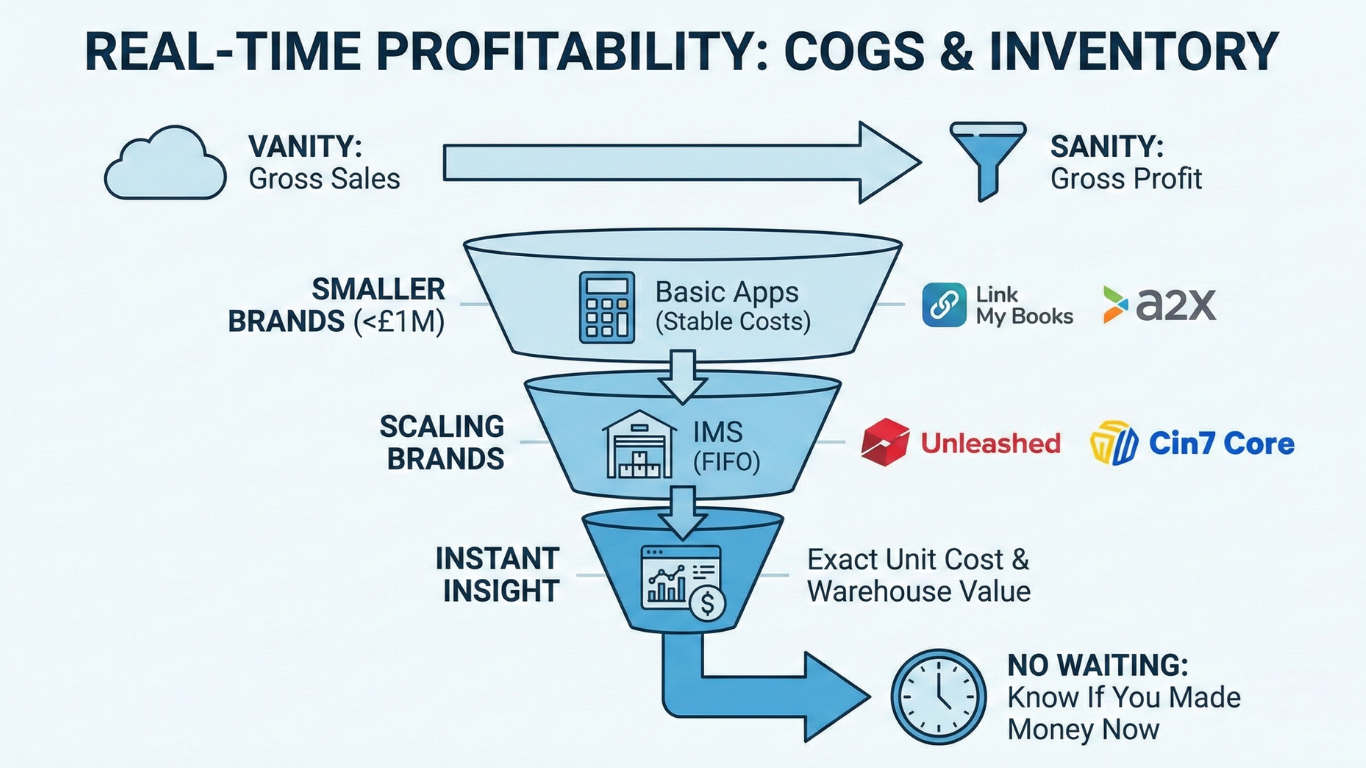
Gross sales are a vanity metric. Gross profit is sanity.
To track profit, you must track your Cost of Goods Sold (COGS). The best accounting apps for Shopify don't just track cash; they track landing costs.
For smaller brands (<£1M turnover), you might get away with the built-in costing features in Link My Books or A2X, provided your costs are stable.
For scaling brands, you need a dedicated Inventory Management System (IMS).
- Mid-market: Unleashed or Cin7 Core (formerly DEAR).
- The benefit: These tools track the value of stock sitting in your warehouse and calculate the exact cost of the specific unit you just sold (FIFO).
Without this layer, you are waiting until the end of the month (or year) to know if you actually made money.
VAT Compliance in a Multi-Channel 2026 Landscape
VAT compliance in the UK and EU has become incredibly complex, especially post-Brexit.
Your E-commerce tech stack must handle jurisdictional tax automatically.
- The Bridge's Role: Tools like Link My Books do a fantastic job of separating UK VAT from EU OSS VAT or US Sales Tax at the point of entry into Xero.
- The Specialist: For US Sales Tax specifically, you may need a layer like TaxJar or Avalara if you have nexus in multiple states.
Key Takeaway: Never rely on the Shopify dashboard’s "tax collected" figure as your final tax return. It is often configured incorrectly by the user. Always validate via your connector software.
The AI Layer: Automating Data Entry and Anomaly Detection
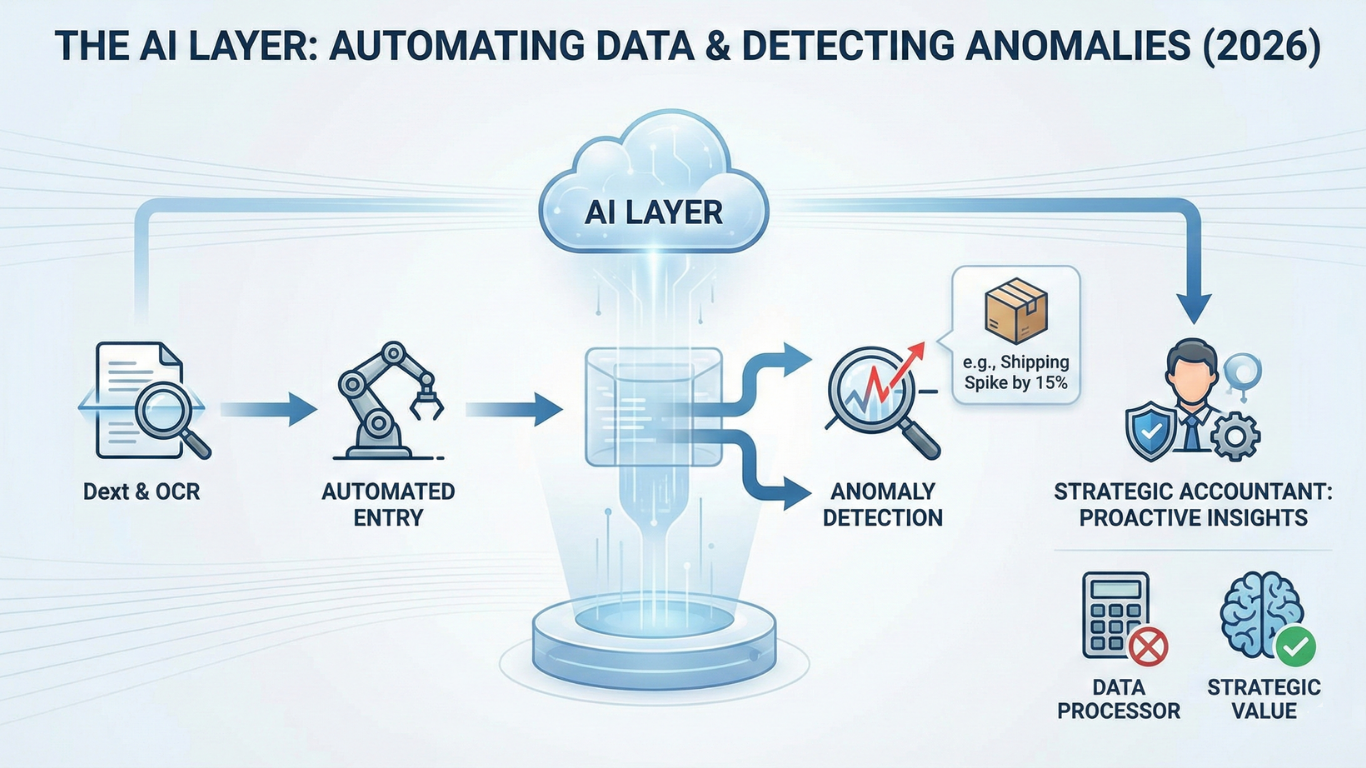
AI isn't coming; it's here. In 2026, we use AI not to write emails, but to spot financial leaks.
- Expense Management: Dext remains essential. It uses OCR (Optical Character Recognition) to read supplier invoices. You shouldn't be typing invoice data.
- Anomaly Detection: We are starting to see tools that sit on top of the stack and flag "weird" transactions. For example, if your shipping costs suddenly spike by 15% relative to sales, the AI flags it before the month-end review.
This is the difference between a data processor and a strategic ecommerce accountant. We look for the anomalies.
Cash Flow Forecasting: Moving Beyond Historical Bookkeeping
Bookkeeping looks backward. Forecasting looks forward.
If you are buying stock from China with a 90-day lead time, you cannot run your business on a P&L alone. You need a cash flow forecast.
I recommend integrating Float or Fathom into your Xero setup. These apps pull your actual data from Xero and allow you to project scenarios:
- "What if I order 5,000 units next month?"
- "What if ad spend increases by 20%?"
Scalability Check: Is Your Stack Ready for $10M+ in Revenue?
A common question I get: "Sam, will this stack break if we hit £10M?"
The stack I described above (Xero + Link My Books + Cin7 Core) can comfortably handle businesses up to £10M–£15M in revenue.
However, once you cross that threshold, or if your manufacturing becomes incredibly complex, you enter ERP territory (NetSuite). But be warned: moving to an ERP is a six-figure investment and a six-month implementation. Do not rush it. Maximize your cloud accounting stack first.
Summary: The Ideal 2026 Stack
- Ledger: Xero
- Connector: Link My Books / A2X
- Inventory: Cin7 Core (if complex) or Connector-based COGS (if simple)
- Payables: Dext
- Forecasting: Float
Need a hand building this?
I’m Sam Hoye. At Social Commerce Accountants, we don’t just file returns; we build financial infrastructure for the modern seller. If you want to stop guessing your numbers and start scaling with clarity, let’s have a chat.
This guide is not financial advice. All content is for educational purposes only. Please consult a qualified accountant or financial advisor to discuss how these strategies apply to your specific business circumstances before making any financial decisions.