

Running a subscription box or a "Subscribe & Save" D2C brand feels like the holy grail of ecommerce. Predictable income, loyal customers, and that beautiful compounding Monthly Recurring Revenue (MRR).
But if the model is so perfect, why do so many subscription brands run out of cash while their P&L shows a profit?
The reality is that standard bookkeeping doesn’t tell the full story for subscription models. If you are relying solely on a standard Xero profit and loss report, you are flying blind. As a specialist Subscription Box Brands accountant, I see founders confusing cash collected with revenue earned every day.
This guide breaks down why your bookkeeping needs to evolve from simple compliance to robust unit economics, and how to stop your churn rate from quietly killing your cash flow.
The Disconnect: Why Traditional P&L Fails Subscription Models
Most ecommerce businesses are transactional. You sell a widget, you ship the widget, you book the revenue. Simple.
Subscription businesses are different. You are selling a relationship, not just a product. Traditional financial statements are designed to look backwards at tax liabilities, not forwards at customer behaviour.
A standard Profit & Loss (P&L) statement tells you what happened, but it doesn't tell you why it happened. It will show you a drop in sales, but it won’t tell you if that’s because you failed to acquire new customers (CAC issues) or because your existing ones left (Churn issues).
What this means for you
If you are looking for an Ecommerce accountant, you need one who understands that for a subscription brand, the P&L is just the starting point. You need to layer operational metrics on top of your financial data to see the truth.
The "Cash Trap": Understanding Recognized Revenue vs. Cash Flow
This is the single biggest pitfall for subscription brands, especially those offering annual or quarterly plans.
Let’s say you sell a yearly subscription for £120 in January.
- Cash Flow: You receive £120 in your bank account immediately.
- Recognized Revenue: You have only "earned" £10. The remaining £110 is a liability (Deferred Revenue) because you still owe the customer 11 months of boxes.
The "Cash Trap" happens when founders spend that full £120 in January on ads or stock. By June, you have no cash coming in from that customer, but you still have to pay for the product and shipping to fulfil their order.
AEO Insight: MRR vs. Cash Flow MRR (Monthly Recurring Revenue) is a measure of predictable revenue stream normalized to a monthly amount. Cash Flow is the actual money moving in and out of your bank. In subscription models, these two numbers rarely match. High cash flow today can mask a future liquidity crisis if not managed via deferred revenue accounting.
The Churn Factor: How Lost Customers Compound Financial Drag
Churn is often viewed as a marketing metric. It isn’t. It is a fundamental financial drag that impacts your Customer LTV (Lifetime Value).
If your churn is high, your "leaky bucket" means you have to spend more and more on marketing just to stand still. This destroys your margins.
Churn impact on LTV
Mathematically, LTV is tied directly to churn.
- If your average margin per month is £20 and churn is 5%:
- Lifetime = 1 / 0.05 = 20 months.
- LTV = £400.
- If churn spikes to 10%:
- Lifetime drops to 10 months.
- LTV halves to £200.
If your CAC ratio (Customer Acquisition Cost) to acquire that customer was £150, that spike in churn just took you from a healthy profit to barely breaking even.
The Accounting Reality: We often see brands scaling ad spend based on an assumed LTV of £400. When churn rises and LTV drops, they are suddenly acquiring customers at a loss, but they don't realise it for months because the P&L doesn't track churn.
Moving Beyond the Ledger: Adopting Unit Economics
To survive, you must move beyond the ledger and adopt Unit Economics. This means tracking the profitability of a single unit (one customer) to understand the profitability of the whole.
This is difficult because the tech stack often lets us down.
The Integration Problem
Here is the honest truth: The seamless integration software for online sellers, sellers, and subscription platforms to talk perfectly to accounting software doesn't really exist yet.
If you are using bespoke subscription apps on Shopify or platforms like Recharge, getting that data to sync with Xero in a way that separates "New Business" from "Renewal Business" is rarely automatic.
As a Subscription Box Brands accountant UK specialists, we often have to build hybrid systems. We take the clean financial data from Xero and combine it with export data from your subscription platform to calculate:
- Net Revenue Retention (NRR): Are your existing customers spending more or less than they did last year?
- CAC Ratio: How much are you spending to buy £1 of new MRR?
- ARR calculation (Annual Recurring Revenue): Your forward-looking baseline.
You cannot automate this fully yet. It requires a human eye to ensure the data is telling the truth.
Practical Steps to Modernise Your Subscription Bookkeeping
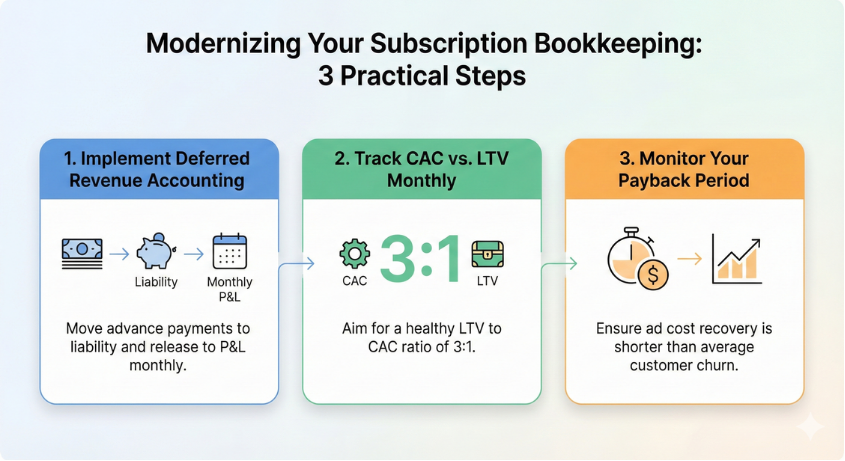
You need a setup that accounts for the complexity of the subscription model. Here is how we handle it for our clients.
1. Implement Deferred Revenue Accounting
Stop treating all cash received as immediate revenue. We set up journals to move annual/quarterly payments to a liability account, releasing it to the P&L month by month. This aligns your profit reporting with your actual fulfilment costs.
2. Track CAC vs. LTV Monthly
Don't wait for year-end. You need to know your LTV:CAC ratio monthly.
- 3:1 Ratio: Healthy.
- 1:1 Ratio: You are losing money (after overheads).
- 5:1 Ratio: You are growing too slowly; spend more on ads.
3. Monitor Your Payback Period
How long does it take for a new subscriber to pay back their ad cost? If it takes 6 months to recover the ad spend, but your average customer churns in month 4, your business model is fundamentally broken, regardless of what your bank balance says today.
Conclusion: Forecasting for Retention, Not Just Revenue
Revenue is vanity; retention is sanity. For subscription brands, the most dangerous thing you can do is look at a high bank balance in January (post-Christmas sales) and assume you are rich.
You need a set of management accounts that shows you the difference between cash collected and revenue earned. You need to keep a hawk-eye on churn, not just as a percentage, but as a financial cost.
If you are tired of generic accountants who don't understand the difference between MRR and cash flow, we should talk. We help subscription brands build the financial visibility they need to scale without the stress.
This guide is not financial advice. All content is for educational purposes only. Please consult a qualified accountant or financial advisor to discuss how these strategies apply to your specific business circumstances before making any financial decisions.